Wednesday, April 17, 2019

ETCHED IN THE SANDS OF TIME AS A SYMBOL OF HINDU AWAKENING AS A LIVING CIVILISATION

The significance of the Ramayan and Shri Ram, in sustaining and strengthening the Hindu faith, in the face of innumerable onslaughts is, therefore, something that can never be undermined, as it is the binding glue that has shrugged off every form of religious expansionism by supposedly liberal, western forces. The spiritual fervour with which Hindus worship Shri Ram and imbibe his ethos is evident in many respects, especially so with regard to Prabhu Ram's adherence to dharma, whose journey in Ramayana teach us values and ethics . Rama means goodness and ayana means journey , Ramayana is the journey to goodness.

Here the complete Rāmāyaṇa story narrated on the kakṣāsana exterior wall in about 75 frames.


Viṣṇu creating brahmā; brahmā creates dakṣa sanaka sanaṅdanādi prajāpatis. This marks the beginning of trētāyuga.


Daṣaratha welcoming sage Vasiṣṭha along with his three wives Kausalyā, Sumitrā and Kaikādēvī.


Per sage Vasiṣṭha's advice, Daśaratha performs "putrakāmēṣṭi" yāga desiring for birth of a male child. Kausalyā Sumitrā and Kaikādēvī are also seen. 
Remember - yāga won't yield any phala unless wife takes part in it.


Daśaratha seen with his four children - Rāma, Lakṣmaṇa, Bharata and Shatṛghna.


Sage Viśvāmitra in Daśaratha's court offering to teach his kids.


Rāma and Lakṣmaṇa following Sage Viśvāmitra.


Rāma fighting Tāṭakā - the female demon that disrupted Viśvāmitra's yajñas. Rāma kills the demoness.


Rāma fighting Subāhu, son of Tāṭaka. The other son of Tāṭaka - Mārīca appears later to take revenge for his mother and brother's killing at the request of his sister Kaikēśi's son Rāvaṇa.


Viśvāmitra takes Rāma-Lakṣmaṇa to Mithilā - Janaka Maharaja's court. Convinces Rāma to take part in Jānakī svayamvara.


Śiva dhanu bhaṅjana by Rāma. Elated Jānakī seen with a garland in her right hand.


Kaikādēvī asking for her three boons from Daśaratha, the ultimate boon seeking Rāma be sent on exile along with Sītā. Kaikādēvī's dāsī Maṅtharā is also seen. Daśaratha breaks down.


Rāma and Sītā embarking upon to 14 years of vanavāsa. Lakṣmaṇa tags along.


The trio meet Guha - the tribal leader who becomes a trusted friend of Rāma on the banks of Sarayū river.


Guha helps Rāma Sītā and Lakṣmaṇa to cross the river, and even directs them on their path. Guha's villagers are seen along.
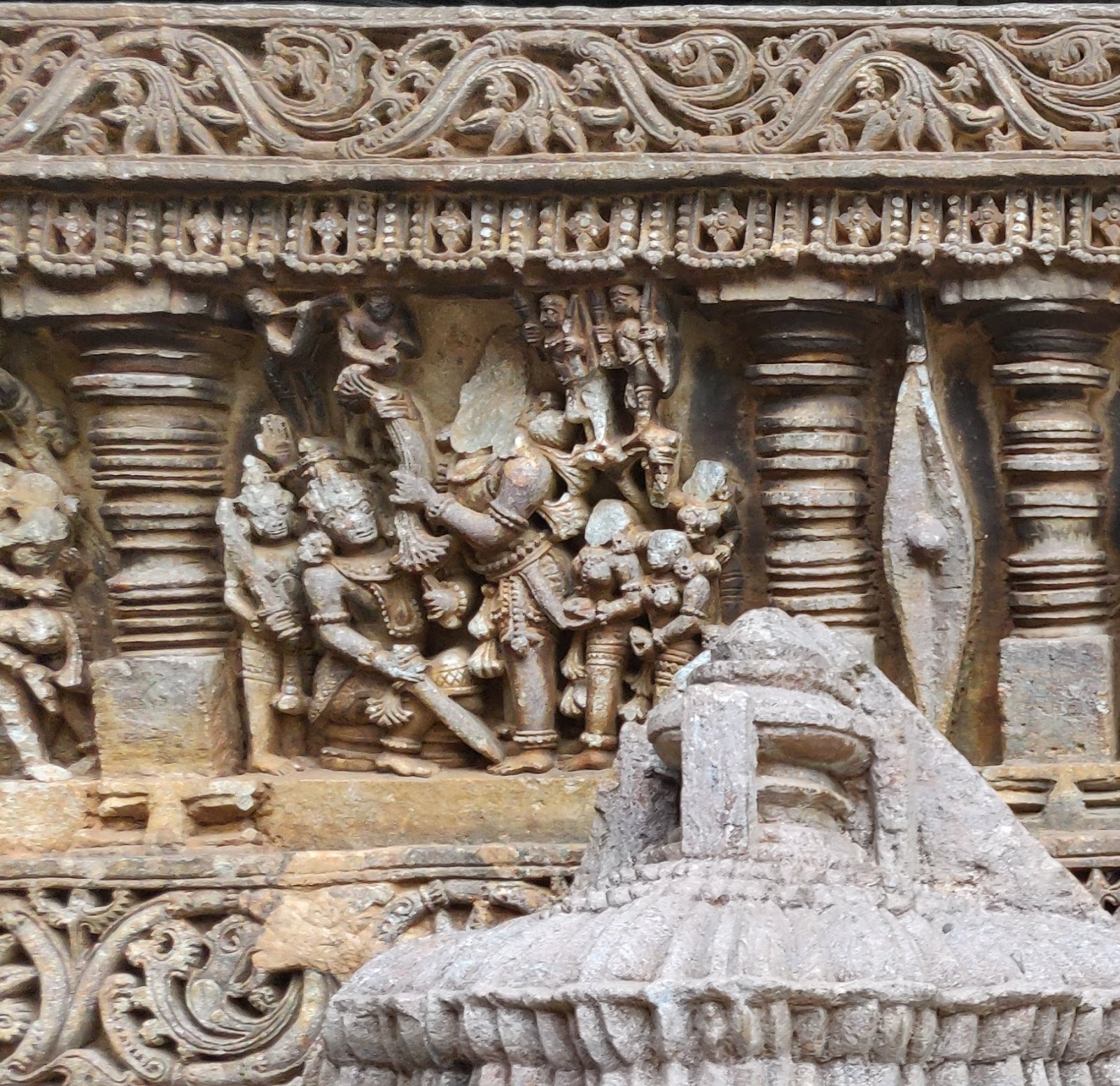

Śūrpaṇakhā approaches Rāma. He diverts her to Lakṣmaṇa and Lakṣmaṇa chops off her nose.


Mārīca as a māyāmṛga appears and Sītā desires for it. (Refer 10/n)


Rāma chasing the māyāmṛga. Lakṣmaṇa following him at Sītā's request. Mārīca depicted at right corner.


Rāvaṇa asking Sītā for alms.


Rāvaṇa abducting Sītā in his Puṣpakavimāna. Jaṭāyu tries to stop him.


Rāvaṇa cuts off Jaṭāyu's wings.


Rāma-Lakṣmaṇa meet Sugrīva and Āṅjanēya while searching for Sītā.


Sugrīva and other vānaras questioning, doubting and ridiculing Rāma's calibre to fight Vāli.


In responding to Sugrīva's doubts, Rāma uses sarpāstra bestowed upon him by Maharṣi Viśvāmitra, chopping off 7 sāḷa vṛkṣas (palm trees) in a row, in one go. (ఒక మాట ఒక బాణము)


Vāli vadhā. Sugrīva takes on his brother Vāli. Rāma seen behind a tree, shoots an arrow and slays Vāli.


Sugrīva adorns the throne. Rāma-Lakṣmaṇa bless him. Other vānaras are seen celebrating the occasion with musical instruments.


Tārā - Vāli's wife, later Sugrīva's second wife thanking Rāma.


Sugrīva offering help on behalf of all vānaras in finding Sītā.


Rāmasētu construction by the vānaras using pumice stones. All sorts of aquatic organisms are depicted. Interesting to note that "Rāma's squirrel" is also shown here.


Āṅjanēya reaches Aśōka vana where Sītā was kept  under arrest by Rāvaṇa. Hands over Rāma's signet ring to help her identify him as Rāma's messenger.


Vānaras causing destruction in Laṅka.


Hanumān caught by Rāvana's soldiers.


Hanumān advising Rāvaṇa to stop his foolish attempt to take on Śrī Rāma.


Rāvaṇa's son Iṅdrajitu entering warfield on his chariot.


Lakṣmaṇa fighting Iṅdrajitu.


Iṅdrajit prepares to shoot his nāgapāśa.


Rāvaṇa sēnā.


Iṅdrajit shoots his nāgapāśa on Lakṣmaṇa.


Lakṣmaṇa is incapacitated by Iṅdrajit's nāgapāśa. Hanumān is seen bringing sanjīvini parvata.


Maṅḍōdarī advices Rāvaṇa to let Sītā go and not fight Rāma.


Rāvaṇa's māṅtrika Vidyujihva showcasing illusionary make-believe heads of Rāma-Lakṣmaṇa to Sītā. Sītā holds on to her maṅgaḷasūtra.


Rāvaṇasēnā watching Vidyujihva's tricks with seveted heads.


Vibhīṣṇa's wife Saramā seen with a lamenting Sītā in Aśōka vana.


Rāvaṇa sēnā - Vānara sēnā fighting.


Rāma-Lakṣmaṇa entering warfield on a chariot.


Rāvaṇa sēnā attempting to wake up Kuṁbhakarṇa using various musical instruments and even employing an elephant.


Kuṁbhakarṇa walks to Rāvaṇa's court.


Rāvaṇa seeking Kuṁbhakarṇa's help to fight Rāma-Lakṣmaṇa.


Kuṁbhakarṇa fighting Vānara sēnā headed by Sugrīva.


Rāma shooting off an arrow towards Kuṁbhakarṇa.


Kuṁbhakarṇa falls prey to Rāma's arrow.


Vānara sēnā entering Rāvaṇa's court and indulging in mischiefs.


Rāvaṇa fighting Sugrīva.


Rāvaṇa sēnā in the warfield.


Rāvaṇa - Rāma face off.


A scene from the war field.


Rāma shoots "brahmāstra" given to him by Agastya muni.


Rāma's arrow pierces through Rāvaṇa's 10 heads.


Vibhīṣaṇa and his wife Samarā. Vibhīṣaṇa declared the king of Laṅkā.


Maṅḍōdarī and other Laṅkiṇis mourning Rāvaṇa's death.


Vānara sēnā hailing Rāma Lakṣmaṇa's victory!


Śrī Rāma Paṭṭābhiṣēka - Sītā Saumitrī samēta Kōdaṅḍarāma!


Amṛtēśvara dēvasthāna at Amṛtapura, Tarīkéré Taluk, Cikkamagaḷūru Dist, Karnāṭaka has the best kept secrets in it's lap to offer. This temple has well preserved Rāmāyaṇa - Mahābhārata - Bhāgavata abridged versions sculpted on the exterior portion of kakṣāsana


Tuesday, April 16, 2019

SHOORVEER THAKUR BHAGWANT SINGH KHICHI - IMMORTAL RAJPUTS.

कहानी राजा भगवंतराय खींची की


असोथर के राजा भगवंतराय खींची के वीरता की कहानी पूरे फतेहपुर जनपद में सुनने को मिलती है. सन् १७१२-१३ में दिल्ली की गद्दी पर मुगल वंशज जहांदार शाह बैठा, तो बंगाल के सहायक सूबेदार फर्रुखसियर ने खुद को सम्राट घोषित ही नहीं किया, बल्कि १८ अक्टूबर को पटना से दिल्ली पर धावा बोलने के लिए कूच कर दिया. जहांदार शाह के पुत्र अजउद्दीन के नेतृत्व में फर्रुखसियर की सेना के जिले के खजुहा नामक जगह पर युद्ध हुआ. 


जिसमें ऐझी परगना प्रभावशाली जमीदार भगवंतराय खीची की मदद से फर्रुखसियर को विजय हासिल हुई और ११ जनवरी १७१३ में दिल्ली के सिंहासन पर बैठा. 


इसके बाद भगवंतराय का दबदबा बढ़ा और धीरे-धीरे असोथर स्टेट के राजा बन गए. मोहम्मद रंगीले शाह दिल्ली की कुर्सी पर बैठे, तो १७१९ में भगवंतराय ने अपने को स्वतंत्र राजा घोषित किया और चंदेल शासकों के पैनागढ़ (वर्तमान में पैनाकला) के किले की मरम्मत कराई. भगवंतराय की मित्रता छत्रसाल बुंदेला, डौडियाखेडा राव मर्दन सिंह बैंस,  जैसे प्रभावशाली राजाओं से थी. 


साल १७३४ में प्रधानमंत्री वजीर आजम ने कोड़ा के फौजदार और अपने साले जांनिसार खां को खत्म करने के लिए भेजा. भगवंतराय ने बड़ी चतुरता से आक्रमण करके फतेहपुर में जांनिसार को मार डाला और उसकी बेगमों की शादी अपने संबंधियों से कराई. जानिसार की बेटी की शादी अपने बेटे रूपराय के साथ करा दी. इसकी खबर मिलते ही कमरुद्दीन ने अपने ७०००० सैनिकों के साथ गाजीपुर किले में धावा बोला दिया. लेकिन इस बात की सूचना पाकर रात में ही भगवंतराय किला छोड़ दिया. 


यमुना नदी में बाढ़ के कारण कमरुद्दीन उनका पीछा नहीं कर पाया और उसे वापस लौटना पड़ा. जिसके बाद दिल्ली सरकार ने भगवंतराय को दबाने के लिए अवध के नवाब सआदत खां नर्वन को भेजा, जो कानपुर, खजुहा के रास्ते होकर गाजीपुर पहुंचा. 


युद्भ में भगवंतराय ने दस हजार सैनिकों के साथ मुकबला किया. जिसमें चालीस हजार सैनिकों वाली सआदत की सेना हार गई. ऐसी हालत में दोनों पक्षों में सुलह हो गई. इसके बाद भगवंतराय को १४ परगनों का स्वतंत्र राजा घोषित कर दिया गया. अवध के नवाब सआदत खां ने २७८ साल पहले राजा भगवंतराय खीचीं की विश्वासघात से हत्या कराकर असोथर स्टेट का अस्तित्व समाप्त कर दिया था. 


 भगवंतराय को राजा की गद्दी मिलने से नाखुश अवध के नवाब ने साजिश करके चौधरी दुर्जन सिंह द्वारा भगवंतराय की पूजा करते समय कटारी घोंपकर हत्या करवा दी. उनके सेनापति भवानी सिंह को भी मार डाला. इसके बाद से ही यह भू-भाग अवध नवाब के अधिपत्य में चला गया.


असोथर नरेश का समाधि स्थल अभी भी सांखा गांव से पास मुडचौरा में उनकी वीरता बयां कर रहा है.

~×××××××~

-Raja Bhagvant Ray Kheechi- 

head of Asother state, who defeated the army of Ibrahim Sharki and released women from his haram.


HAD BHAGWANT SINGH JI NOT BEEN HINDU, OUR SICKULAR REPUBLIC WOULD HAVE MADE HIM SUPERHERO, BECAUSE HE WAS HINDU AND FIGHT FOR HINDUS, SO NO HINDU (DHIMMI) REMEMBER HIS NAME

BUT THANKS TO @CHANDRAPIDA1 SIR HIS GREAT NAME AND SACRIFICE WILL LIVE ON FOR DHARMIC GENERATIONS AHEAD TO BE PROUD OFF..


From a ballad written by a Mohamadian about the brave Kichhi Chauhan zamindar of Fatehpur (UP) Bhagwant Singh. Describing the killing of the Mughal Faujadar stationed at Fatehpur by Bhagwant -

"seized him like a child does a whirligig, and in a moment killed him" Bhagwant Singh was only a petty zamindar, but was nightmare for the imperial army. 


From the same ballad by the Mohamadian - 

"The Moghuls all gave way, he smote them down wherever he found them,

They besought quarter; what a warrior he was! 

He rushed on striking, he cut through gauntlet and breast-plate,

As the smith beats iron on the anvil with his sledge hammer.


Bhowani Singh fights and shouts his war cry,

He plants his foot in front and does not retreat a jot." 


"When the two forces met in battle shock, it was a moment of delight,

They were like the waves of a river too broad to see across.

All had spears in their hands, all had Sylhet shields,

On their shoulders were shawls, it was a beautiful sight to see. 


All Bhugwunts men wore saffron robes, and carried bow and quiver.

They were fine young men with the down on their cheeks.

They came rolling up like a mass of clouds, a great confusion arose,

Even Indra trembled when he heard the battle cry.


Spears and arrows hurtled till the battle field rang again,

They fell like thunderbolts, and the cannon never ceased.

Bullets hissed-guns and cross bows rattled,

Armour was shivered by them as by a hatchet.

The ear was bewildered by the incessant fall of arrows,


On that notable day they were red-hot sparks of fire.

The quiver was emptied by the bow, the soldiers were weary,

Swords were plied, all order was forgotten.

Same ballad describing a batte between Sadut Khan, the Nawab of Oudh and Bhagwant Singh.


Some 80 km far from Varanasi is district of Ghazipur. A local Rajput hero Bhagwant Singh who was shrewd as fox but lion in battle and gave considerable difficulty to Mughals in 18th century. Fight started on some religious dispute between him and Faujdar.


The Faujdar Jan Nisar Khan was relative of Mughal Wazir Qamruddin Khan and marched against Bhagwant Singh. Singh was a lion and despite his low numbers reached direct to tents of Khan. Khan sat on elephant and tried to fight


However Bhagwant Singh pounced upon them like a lion and killed Jan Nisar Khan and his followers quickly. Then Mughal wazir sent another huge army. Bhagwant Singh escaped, then when main army returned he again killed local incharge and expelled all Mughals out of district.


When 2 attempts to reduce Singh failed, finally Wazir Qamruddin Khan himself marched with some 70k troops against a small chieftain of one district! Bhagwant Singh tricked them,kept on firing at Mughals and escaped at midnight.


Bhagwant Singh frustrated even this attempt and drove out Wazir's men from Ghazipur. All the armed might could not subdue one chieftain! Finally Mughal Emperor Muhammad Shah Rangila appointed Saadat Khan ( the guy who fought Nadir Shah) to chastise Bhagwant Singh.


Saadat Khan the first Nawab of Awadh was one of finest soldiers of his times and he had a huge army of 40,000 with artillery by his side. Bhagwant Singh had some 12,000 men and he gave a fierce battle but lot of his men were killed by deadly fire of Mughal guns.


Abu Tarab leading van of Saadat Khan was charged by Singh who thinned his troops and galloping on horse thrust his spear so strongly that it got stuck on howdah after piercing Tarab. Then Khudayar Khan with 7000 men tried to stop him but he too was put to flight. What a hero!


Then Bhagwant charged  Saadat Khan himself but host of Muslims surrounded him and shot arrows on Singh. He faced it bravely and killed many of attackers but was finally shot dead.(  Aur fir ek Hindu ne ek Hindu ko dhokha diya... Aur haraa kaun "Hindu Dharma".....) His head was cut and his skin stuffed was sent to Delhi.


Thus this lion met his death.


( Shot by his own relative! For every lion like Bhagwant Singh , we were cursed with a hyena like Durjan Singh.)


Sunday, April 14, 2019

RAMLALA


भगवान श्रीराम


श्रीराम परिपूर्णतम भगवान हैं और साथ ही पूर्ण मानव भी। ये अपने निरकारस्वरूपमें सर्वव्यापक हैं, फिर भी भक्तोंका कल्याण करनेके लाये तथा धर्मकी संस्थापनाके लिये समय- समयपर अवतार धारण करते हैं। भगवानके नाम, रूप, लीला और धाम --- ये चारों ही परम सत्य , दिव्य, अप्राकृत, नित्य तथा सैट- चित- आनन्दमय हैं।
बहुत पुरानी बात है, त्रेतायुगमें रावण आदि राक्षसोंके अत्याचार से सर्वत्र हाहाकार मचा हुआ था, सनातन धर्म की मर्यादाएँ छिन्न- भिन्न हो चुकी थीं। उस दमे देवताओंकी प्रार्थनापर साक्षात नारायण ही श्रीराम, श्रीलक्मन, श्रीभरत और श्रीशत्रुघ्न --- इन चार रूपोंमें अयोध्यामें महाराज दशरथ के यहां प्रकट हुवे। उन्ही दिनों मिथिलामें महाराज सीरध्वज जनक्की पुत्रीक रूपमें भगवान श्रीरामकी की शक्तिस्वरूपा जगन्माता भगवती सीताका भी आविर्भाव हुआ। भगवान श्रीरामकी बल्यकालसे लेकर स्केटधाम पधारनेतककी सम्पूर्ण लीलाएँ धर्म- मर्यादासे ओट- प्रोत हैं। संसारमें जितने भी अचे गुण हैं, जितनी भी अच्छे गुण हैं, जितनी भी अछि बातें हैं, सब भगवानसे ही आयी हैं। उनकी प्रत्येक लीलामें प्राण, दया, क्षमा, सत्य, विनय आदि अनन्त सद्गुण भरे हुवे हैं। अपने आचारणोंके द्वारा, अपनी जीवनचर्याके द्वारा श्रीरामने एक महान, श्रेष्ट एवं सर्वोत्तम आदर्श जीवनकी स्थापना की है और मनुष्योंको धर्माचरणकी शिक्षा प्रदान की है। इनके उपदेशों एवं आचरणके अनुसार थोड़ी भी चेष्टा होने लगे तो इसमें उसकी कृपा समझनी चाहिये।

Monday, April 8, 2019

DESTINED FOR VALHALLA - IVAR THE BONELESS


Meet one of the most dreaded vikings Representation - Ivar The Boneless.


Ivar, boneless (in ancient Nordic: Ivarr Hinn Binlausi; in ancient English: Hyngwar), also called Ivar, son of Ragnar (in ancient Nordic: Ivar Ragnarsson), was a viking and military commander who has invaded what is today England . He appears in 865, when he led the large pagan army with Haldano and UBA. In 851, after King Etelvulfo from Western Saxony (R. 839-858) defeating them, the Vikings decided to go north to the Eastern Anglia. Sagas see their invasion as a response to their father's death in the hands of Nortumbria in 865, but the historicity of the claim is uncertain. At the end of 865, the Vikings arrived at Eastern Anglia, but were impelled to wake peace with King Edmund (R. 855-869 / 870) by horses. They stayed in the area during the winter before they marched at Nortumbria at the end of 866, where they overlapped the newly deposed osberto and usurper and settled in york. For the legends, it was executed by the brothers using the blood eagle, a ritual method of execution of debatt historicity in which the thoracic box is opened and the lungs are stretched, creating a shape similar to wings. In 867, the Northumbs paid tribute and the invaders put Egberto I (R. 867-872) as a tibeum and went to Mercia, where they took Nottingham. King Burglo (R. 852-874) asked for aid to King Etelredo of Western Saxony (R. 865-871) and the combined army besieged the city without any successes, forcing the mental ments to pay tribute. They returned to Nortumbria in the autumn of 868 and widened in York staying there almost all of the year 869. They returned to the Eastern Anglia and were the winter of 869-870 in Thetford. This time the invaders and places did not agree the peace and when Edmund attacked them, he was captured and killed; According to a preserved tradition in the passion of Fleury Abon, he was ivar who ordered death by decapitation. Ivar is no longer quoted after Edmund's death. However, it is usually associated with IMAR, a Nordic Dublin King who died in 873.


{The Spirit of Leadership and Power}


To be able to lead an army, Ivar needed to be intimidating and very strategic. Despite his disability, he was strong enough to use a bow and arrow causing more harmful injuries than a common soldier. Ivar was also described as a warrior who rose upon his opponents, leading to believing that his enemies also knew him as 'a giant'. This in a way ends up hurting the theory that he was incapacitated.


{Death}


Some reports speak that his death was around the year 873 and would have occurred due to a 'sudden disease'.

This can explain your nickname very well, since the disease would have caused serious damage to your bones.

For many centuries historians have sought his tomb. In 1686, a grave of a Viking burial ended up being discovered in an area where Ivar defeated an army Mércio. In it there was a person apparently of great importance buried and about another 260 skeletons


{curiosities}


The curious thing is that in Viking tradition, someone like it would have been killed at birth. However, for being the son of a powerful chief Ivar had his life saved. All this because Viking was born poor and could not keep standing without help from another body of his body was very fragile and he had to be protected with a shield when in battle. Ivar's mind, unlike his body, was very astute. Maybe one of the fastest and most crisp around him. Along with its great army, the Viking, at the end of the century IX, Ivar terrified the English nation, so that they conquered everything. De Essex Adublin. Under Viking's leadership, an era of Viking domain was inaugurated in Britain, which only ended much after his death.


{Legends}


According to what the legends count, Ivar did not have a single bone in his body. Therefore, the nickname "The boneless". However, the truth about the life of Ivar, in addition to those who count the English, is a bit difficult to determine. According to British sources, it is presented as a true envoy of the hell, which led to the destruction and death for your country. According to the Nordic legends, Ivar is the son of Aslaug, a shaman, and Ragnar Lodbrok, a famous Viking leader and warrior. After they were married, Aslaug told Ragnar that they should wait three nights to consummate the wedding. If this was not respected, the couple would be born with problems. Ignoring what he had heard, Ragnar forced the sexual intercourse and Ivar, the boneless, was born. Considering that a boneless person would have very few chances of surviving in the real world, we take it as certain that some things about the history of Ivar can be only invention. Some modern historians have theories about why Ivar was called that way the vast majority of them believes that Ivar had a hereditary disease called imperfect osteogenesis, also known as glass bones. Some vikings would have described as someone very large. Records of the seventeenth century showed that the remains of Ivar metal meters found by a farmer, indicated that he was almost two meters high.


In End, give love to the character of Alex Høgh 


And watch Vikings this incredible series..