Thursday, March 11, 2021

A FORGOTTEN HERO ALLURI SRIRAMA RAJU IN MOST INTENSE UPRISINGS AGAINST BRITISH THE MANYAM REBELLION


A veil of historical obscurity hangs thick over the ghats of Visakhapatnam and East Godavari districts—the tribal ‘Agency’ areas that erupted in an early revolt against subjugation by colonial forces between 1922 and 1924. Here, the name Alluri Sitarama Raju, a self-styled healer and social reformer from the plains who became the unlikely architect of an organised resistance, is like a river whose mutinous course is etched into the land, a canyon deepening over time. Washed away in the weathering are the stories of dozens of unaccredited heroes who, exhausted by their struggle with want, nevertheless betook themselves to the forests for a severe contest with authority in Alluri country and the site of his grave on the banks of the Thandava.


From here on, nearly every junction—in Nadimpalem, Rajavommangi, Makaram, Mampa—features the golden figure of a hermit with a flowing beard, a bow and a quiver full of arrows. The tribal revolt of 1922 against the late British rulers under the Raj and the sacrifice made by the indomitable freedom fighter Alluri Sitarararaju Raju who was executed by the colonialists because he instigated the rebellion against the Crown administration in Godavari Agency of the present day Andhra state. 

Not to be confused with Rampa Rebellion of 1879, the revolt of the same name in 1922, often referred to as the Manyam Rebellion, was organized by the tribes in Godavari Agency of the then Madras Presidency, British India. Led by none other than Alluri Sitarama Raju, a well-known freedom fighter and a saintly figure, this tribal uprising lasted from August 1922 until the capture and killing of Raju in May 1924.  

Nearly a century ago, the low hills of northeastern Andhra Pradesh were aflame with revolution. The ‘fituri’, as the British dubbed it, was rather randomly christened the ‘Rampa disturbances’ after a taluk in the hilly belt, although the epicentre was Gudem, an inaccessible block of about 1,865 square km where the conditions were ripe for rebellion. Today, it is hard to imagine these forests, in full monsoon livery, ringing with the crack of .303 rifles.

What is now part of present day Godavari districts of new Andhra Pradesh state, the Rampa administrative area, a hilly region, was made of about 700 square miles (1,800 km2), inhabited by about 28000 tribes. The tribal population was dependent on food production from their land for their needs and they traditionally followed what was called ''Podu System'', a sort of shifting of cultivation from one place to another. Every year some areas of jungle land were cleared by way of burning them and then the land would be used purely for cultivation purposes.

The colonial rulers - British Raj took control of the forest land mainly for commercial exploitation. They needed the produce from the area for building railways and ships. They wanted wood for their railways. In the tribal land there was prevalence of malaria and black water fever and the administrators wanted to improve the utility of the lands and income in Godavari Agency. This could be done by making the tribes move out of that place. The traditional cultivation activities by the tribal communities had an impact on the proposed commercial exploitation of money- spinning opportunities from forest lands by the Raj that was more concerned about taking the project forward and relegating the welfare and needs of the tribes to the back stage, not giving priority to their land rights that they had been enjoying for a pretty long time.


The oppressive Madras Forest Act of 1882, was a curse for the tribals of the Agency Area, who were prohibited from cutting trees for firewood and carrying out their traditional occupations. At such a time, Alluri Sitarama Raju emerged to fight for the tribal rights in Agency, and mobilize them for an armed revolution. At an age of 27 years,he managed to foment an armed uprising with limited resources and motivating the poor, illiterate tribal against British, Born on the 4th of July, 1897 at Pandrangi in Vishakapatnam district in a Kshatriya family. Ramaraju's ancestors originally hailed from Rajolu in East Godavari district, before they migrated outwards.

His parents Venkatarama Raju and Suryanarayanamma, were originally from Mogallu in West Godavari district. He had a sister Sitamma and a brother Satyanarayana Raju. His real name was Sriramaraju named after his maternal grandfather.


SriRama Raju lost his father when he was just 6 years old, and his family had to suffer a lot due to financial difficulties. His uncle Ramakrishna Raju helped the family both financially as well as assisting Raju in his education. In 1909, he joined the Mission High School in Bhimavaram and would walk daily to it from Kovvada. He also learnt horse riding from his friend at Chinchinada a small village near Narasapur. He studied later at various schools in Rajahmundry, Rampachodavaram, Kakinada.

When his family was at Tuni, in 1918, Raju used to tour the hills, valleys nearby, where he came into contact with the tribals living there, and saw their condition first hand. He had the nationalist feelings from an early age itself, and believed deeply in God Shri Ram. He would regularly do Puja to Devi, as well as spend long hours in meditation.

The turning point in his life came when he went on a tour to the North in 1916. He stayed with Surendranath Banerjee for some time, and attended the Congress session at Lucknow. He learnt Sanskrit during his stay at Varanasi, also visited Ujjain, Haridwar, Indore, Baroda, Amritsar. It was a period of learning for him, when he read books on medicine, animal breeding,and also wrote some himself. In 1918 he again went on another tour, this time traveling through Nasik, Pune, Mumbai, Bastar, Mysore, before coming back to Krishnadevi Peta.


With his prowess in various martial arts,Ayurveda, Raju became a leader and inspiration for people living in the areas surrounding Tuni, Narsipatnam. He began to fight for the rights of the tribals in the Manyam region, and also led a campaign against alcoholism, casteism. The lot of the tribals was miserable in the Manyam region, suffering exploitation from the Britishers in all ways possible. They were used as laborers, their lands taken over and their women folk were sexually exploited too. They led a harsh life dependent on Podu(Shifting cultivation) and selling forest produce, and the exploitation made it even worse for them. In collaboration with contractors, the tribals were made to work as coolies for building roads, and were not even paid for their services.

The contractors would treat the tribals like slaves, making them work hard, not paying them, beating them up mercilessly. The tribals were made to carry the contractors from one place to another, their womenfolk were used sexually, it was a truly miserable existence for them. Seeing the misery and exploitation, Alluri decided to stand along with the tribals, and fight for their rights. He bought awareness among them of their rights, infused courage and determination and motivated them to fight against the injustice meted out to them.

The tribals in turn turned to him for guidance and advice,and he soon became a leader for the 30-40 odd tribal villages there. He made them give up their habit of toddy drinking, taught them in guerilla warfare and combat. The Gama brothers Gantam Dora and Mallu Dora, Kankipati Padalu, Aggiraju became some of his trusted lieutenants. Bastian, the Tahsildar of Chintappali divison( now in Vizag district) was the most sadistic of all the British officers. He was notorious for his exploitation of the tribal coolies used for the construction of the road from Narsipatnam to Lambasingi. Tribals who demanded more pay were whipped to death, and Raju’s complaints to higher authorities fell on deaf ears. The authorities in turn getting reports of increasing revolutionary activity began to spy on Raju at Narsipatnam, Addateegala, and for some time he was in exile to avoid detection. with the help of Fazaulla Khan, the Dy.Collector of Polavaram, sympathetic to the tribal cause, Raju once again entered the Manyam region in 1922. For close to 2 years, Raju would lead one of the most intense uprisings against the British, that nearly shook them to the core. With Mallu Dora, Gantam Dora, Padalu, Aggiraju, he lead a team of nearly 150 fighters against the British, a formidable armed uprising.


August 22, 1922– The Manyam rebellion started with Raju leading the first attack on Chintapalli police station in the Rampachodavaram Agency. With 300 rebels, Raju attacked the station, tore apart the records, and took away the arms and ammunition from there. 11 Guns, 5 swords, 1390 cartridges were taken away from there, and Raju personally noted this in the register and soon it began to spread, Krishnadevipeta was attacked next and arms taken from there. On August 24, Rajavommangi was attacked, and after some resistance from the police there, it was overcome. Verayya Dora who was a prisoner there was also freed and he joined Raju.

The British struck back sending Cabard and Haiter, who began to comb the Chintapalli region for Raju and his associates. They were both killed in a guerrilla attack by Raju, and the rest of the party had to beat a retreat. The people were now fully in support of Raju and his team of revolutionaries, with this victory. One of the most daring attack by Raju was on the Addateegala police station which was heavily secured by the British. He along with his associates attacked the station, overpowered the police there, and took away all the weapons. It was a huge blow to the British authority in the Manyam region.

Rampachodavaram police station was attacked on Oct 19, and after overpowering it, the people there turned out in huge numbers to greet Raju who by now had become a folk hero in the Manyam. He was turning out to be a thorn in the flesh for the British, who sent a huge force under the command of Sanders to capture him. In a pitched battle Raju defeated the forces and made Sanders retreat. Whenever Raju captured policemen who were Indian, they were not killed, but rather admonished and asked to go. The British however began to use spies as well as lure some of Raju’s associates who were captured to track him down.
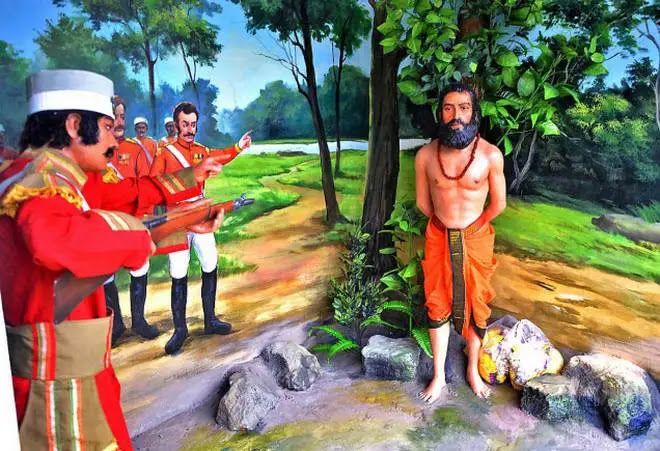

The first blow to Raju came on Dec 6, 1922, when in a pitched battle at Peddagadepalem, the British used cannons against his army. 4 of Raju’s close associates died in that battle, and the forces captured some of the weapons. In further raids by British forces, 8 more of Raju’s men were killed too. For sometime there was a lull amidst rumors that Raju had died, but the British still kept tracking him.

Finally Raju was again seen in Annavaram on April 17, 1923, where the people gave him a huge welcome. The Govt was more determined than ever to capture Raju, using spies to track him down. Regular clashes broke out between the forces tracking down Raju and his supporter there was a pitched battle fought on Sep, 1923 between Raju and the forces under the command of Underwood, which resulted in latter defeat. Later his trusted lieutnant Mallu Dora was captured, however the British could not find out the whereabouts of Raju. Mallu was later shifted to Andamans Cellular Jail, and also represented Vizag in Lok Sabha in 1952. The Govt now cracked down even more harshly, tribals were beaten up, tortured to reveal Raju’s whereabouts, the entire Manyam region was sealed off, it became a huge prison.

In the meantime, the raids by Raju and his men continued at Paderu and the army camp at Gudem. The Govt appointed Rutherford as the Special Commissioner, to the Manyam region, who had a history of suppressing armed revolts. Aggiraju, one of Raju’s bravest lieutenants was captured after a fierce encounter and deported to Andamans. Rutherford sent out an order, that unless Raju surrendered in a week, the people in the Manyam region would be massacred en masse. Raju was staying in the house of the Mampa Munsab at that time, and when he came to know that the tribals were being harassed to reveal his whereabouts, his heart melted. He did not want the tribals to suffer for his sake and decided to surrender to the Government. 

THE LETTERS OF ALLURI SHRI RAMA RAJU

But with none willing to surrender Raju to the Government, he himself decided to do so on his own. Finally on May 7, 1924 he sent an intimation to the Govt, that he was at Koyyur, and asked them to arrest him there.


May 7, 1924

Raju was captured by the police, and on May 7, 1924, shot dead by a senior British officer Gudal. It was clear treachery by the British, who promised him amnesty if he surrendered.
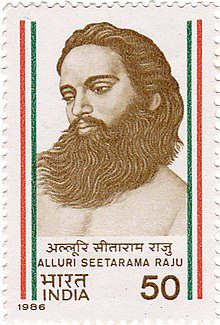

At 27 years, Alluri Sitarama Raju became a martyr, but not before he threw a formidable challenge to the British influence in the Manyam region.

Sadly Raju got no support from the Congress, they in fact welcomed the suppression of the Rampa revolt and his assassination.

The Swatantra weekly magazine, in fact claimed that people like Raju should be killed, and the Krishna Patrika said that police, people should be given more weapons to protect themselves from the revolutionaries.


Was left to Netaji to pay Alluri Sitarama Raju the best tribute

“I consider it my privilege to praise the services of Alluri Sitarama Raju to the national movement, the youth of India should see him as an inspiration”
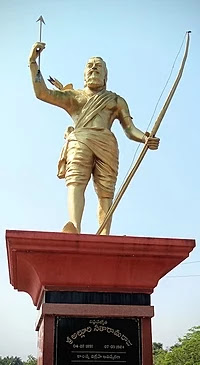

Alluri Sitarama Raju's legacy lives on in Telugu states, his statues can be seen in every town, village and city. There are many localities, colleges, schools named after him. He is a legend among most Telugu people. However Alluri Sitarama Raju's story and his fight against the British, his leadership of the armed revolt by tribals in the Manyam region, should be known to each and every Indian.


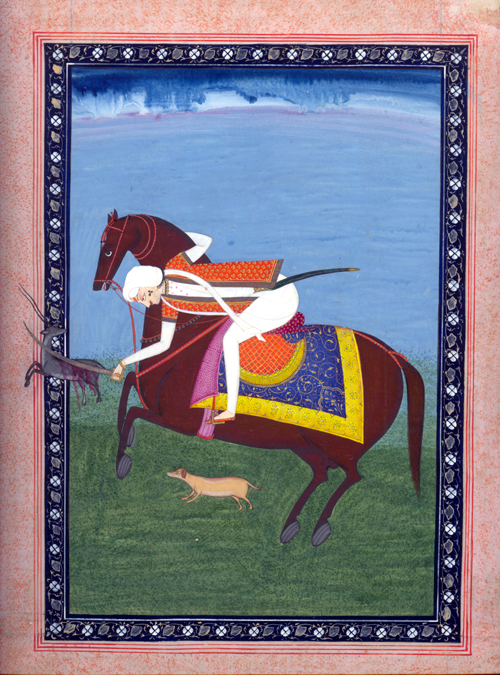


KANGRA IMMORTAL RAJPUTS FIGHT FOR FREEDOM


He, who holds the Kangra fort, holds the hills” 

From time immemorial the fort had been the target of attacks and invasions by several dynasties -- Greeks, Afghans, Tughluqs, Mughals, Gorkhas, Sikhs & the Britishers.


Supplanting it's original masters -- the Katoch kings from time to time.

Raja Ludar Chandra

Raja Ludar Chandra had succeeded his father (Raja Fateh Chandra) to the Jagirs of Rajgir and Changar. He had become a very good friend of Sher Singh and as a sign of good faith Sher Singh gave Ludar Chandra an additional Jagir of Batala in Punjab.

In A.D. 1833, Maharaja Ranbir Chandra (eldest son of Maharaja Anirudh Chandra) came to the throne (without a kingdom). On the request of Col. Wade, Maharaja Ranjit Singh granted Ranbir Chandra the Jagir of Mahal Morian (valued at Rs. 50,000/-). For a while he and his family resided at the village of Kurhin. From here he started to re-build his empire by gathering resources and men. In the first Sikh war of A.D. 1845-46 Raja Ranbir Chandra rendered conspicuous service to the British Government. He wrested from the Sikhs the ancient fort of Tira Sujanpur, Riahyal and took possession of the fort of Pathiar and Karot in the Palam, district they also re-occupied the forts of Sola Singhi and Chaumukhi in Nadaun.

By the end of A.D. 1846, British had acquired the territories of Kangra and the Shimla hills. Maharaja Ranbir Chandra expected the British to place him on his ancestral throne, like the British had done with all the rulers of the Shimla hills. This was not to be as the British wanted to keep Kangra for themselves as a trophy, in keeping with their frontier policy (which was created to check the advance of imperial Russia). On hearing of this Maharaja Ranbir Chandra revolted against the British. Unfortunately his revolt was short lived, as he died in early A.D. 1847.

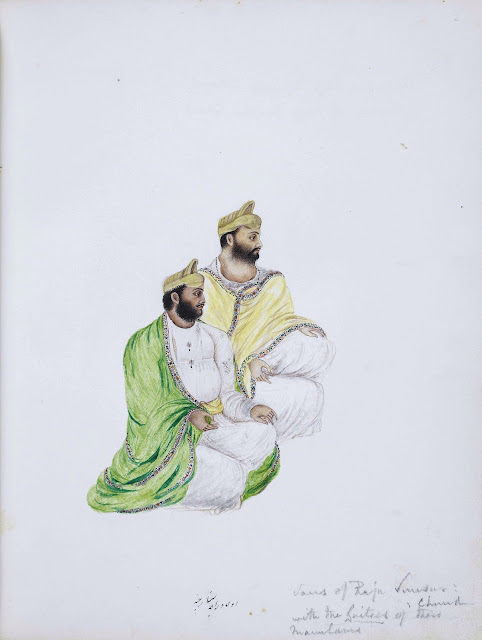
Maharaja Ranbir Chandra & His younger Brother Maharaja Parmodh Chand. G-sons of Sansar Chand. Kangra, 1838. Brit. Library.

His younger brother Parmodh Chandra sat on the Gaddi and was anointed Maharaja. In character he was more spirited than his brother and continued the revolt. He acquired the forts of Hamirpur, Abheymanpur. On his acquisition of these forts a traditional gun salute of 101 guns (same as the King of England) was fired from the ramparts of all his forts in order to inform the people that their hereditary King had now re-assumed power. Maharaja Parmodh Chandra strengthened his army and planned an attack on the British who were stationed at Pathankot & (in the second Sikh War), he was joined by the Rajas of Jaswan, Datarpur and Nadaun.

At the head of an army of 8000 brave Katochs, Maharaja Parmodh Chandra crossed the river Beas to take on the might of the British Empire. Col. Jack Lawrence incharge of the British defense mobilized the native infantry and started his march towards the advancing Katoch army (it is believed the Col. Lawrence was under the authority of the Commissioner to give the Katoch Chiefs their independence and make them ruling chiefs under the British only if they disbanded their troops). The Katoch chiefs did not listen to the British advice and continued with their course of action, except for the Raja of Nadaun (the rear guard of the Katoch assault) who betrayed the cause by disarming his troops & in return was granted his state and a hereditary honor of nine gun salutes.

The encounter between the British and the Katochs was very brief and in the battle, Maharaja Parmodh Chandra was injured and had to retreat to the fort of Tira Sujanpur. For two days the dialogue continued between the Katoch Raja and the British. Maharaja Parmodh Chandra finally surrendered to the British and was deported to Almora (his Maharanis were allowed to retain the fort of Tira Sujanpur, Hamirpur and Mahal Morian and their forests of Palampur).
(Raja Ludar Chandra did not take part in the revolt and was officially recognized as the Raja of Rajgir - who resided at Lambagraon - he also presented to the King of England two towns within the boundaries of his 280 sq. miles. States - Jaisinghpur and Thural which were termed as Badashayat - for this he was given a Bahaduri).

Maharaja Parmodh Chandra died (a freedom fighter) in Almora in A.D. 1851 without an issue. Now the question arose as to who would be the next head of the Katoch clan (as the throne could not be left empty).

Claimants arose from - Nadaun, Jaswan, Datarpur, Siba, Guler and Lambagraon.
Nadaun was rejected because their ancestor Jodhbir Singh was not of a pure lineage (illegitimate son of Maharaja Sansar Chandra).
Jaswan and Guler were rejected because their state had already broken off from the parent state many centuries ago. They had also changed their surnames.
Datarpur and Siba were not even considered claimants because they were off shoots of Jaswan and Guler respectively.
So the only state remaining was that of Rajgir (Lambagraon) Raja Partap Chandra (the great grand nephew of Maharaja Sansar Chandra) had descended upon the Gaddi of Lambagraon & he was now formally adopted by the elder Maharani of Maharaja Parmodh Chandra, as the 484th Maharaja of Kangra. He was granted all the states and the families' nau lakha haar (built in 1060 A.D.) which were under the Maharanis of Maharaja Parmodh Chandra. The British recognized his adoption and his position as the head of the Katoch clan, but they did not recognize the title of Maharaja of Kangra because most of the area of Kangra belonged to the British (9321 sq. Miles). After his adoption Maharaja Partap Chandra (recognized by the British as Raja) was in control of areas which stretched from Baijnath to Hamirpur and Jwalamukhi to Chandhiar (an area of 501 sq. miles whish was nothing in comparison to the kingdom once ruled by his ancestors). He, in order to please the British Government which now controlled all of Punjab from Lahore built a haveli in the city of Lahore. Maharaja Fateh Chandra died in A.D. 1864 and was succeeded by his son Maharaja Jai Chandra (he was only a minor then). His state was put under the care of the court of wards. In A.D. 1883 Maharaja Jai Chandra officially took charge of his state. The following information on Maharaja Jai Chandra has been taken from a letter written by the Rajas of Jaswan, Guler, Datarpur, Dada Siba and Nadaun & this letter had also been signed by all the elders of the Katoch clan (on behalf of their families). This letter addressed to his Excellency the Viceroy Governor General of India (in January, 1924), requested him to elevate Maharaja Jai Chandra to his old family status of a ruling chief with suitable additions to his state.

Maharaja Jai Chandra Katoch

"Raja Jai Chandra's illustrious ancestors have ruled for hundreds of years over the ancestors of the memorialists (writers of the letters) who have stood by the royal family and have shared with them the hardships and glories of hundreds of battles. Even now at the time of peace we will proudly follow his sword, for his country.

Even though, the Katoch Kings driven by disappointment and despair fought against the British Government... Your Excellency we the memorialists are convinced that the prayer we are putting forward is not an unreasonable one. The family that Maharaja Jai Chandra has the honor to represent is far more ancient and at one time enjoyed greater power than the ancestors of the Maharajas of Mysore and Banaras (these two rulers were made ruling chiefs due to the ancient importance of their states, they were both entitled to a gun salute of 21 guns and 17 guns respectively). Coming nearer to home the British Government relieved all the states in Punjab and Shimla hills from the Sikh rule of Maharaja Ranjit Singh and without exception even the tiny hill states of Shimla were given the honor of gun sales and made ruling chiefs by the British.

In A.D. 1903, Raja Jai Chandra was granted the power of adoption, a privilege allowed only to the ruling chiefs. (This honor was granted by Lord Curzon, the Viceroy and Governor General of India).
In A.D. 1908, the title of Raja "as a hereditary distinction" was conferred upon him by Lord Minto Viceroy & Governor General of India.
On June 23, A.D. 1922, Raja Jai Chandra received the title of Maharaja as a personal distinction (he received this title in Lambagraon after which he also purchased land in Delhi to establish a state house).
Maharaja Jai Chandra is highly educated, having received education from the Princes School of Mayo and Aitchison College - he also holds a hereditary seat on the Board of Governors of Aitchison College - (his father Maharaja Partap Chandra was a founder member of this institution), and is one of the most cultured chiefs of Punjab.
His excellent management and administrative qualities can be seen in his work as a member of the Imperial Council, the member of the Punjab Legislative Council and also as the elected President of Punjab Chiefs Council.

Col. His Highness Maharaja Shri Sir Jai Chand Katoch of Kangra-Lambagraon, K.C.I.E., C.S.I.

In his own state he has the power of a Magistrate and Civil Judge. He is also an honorary Colonel in the British Army. He took an active part in the expedition of Hazara, where he received the medal of K.C.I'E. (Knight Commander of the Indian Empire). In the expedition at Chitral he received the honor of C.S.I. (Companion to the Star of India).
During the First World War Maharaja Sir Jai Chandra supplied 1000 recruits and contributed generously to the war loan and the Red Cross. He also organizes the "Lambagraon War League" & this league won 5th place among the 250 districts of the British Indian Empire. By October, A.D. 1916, he had supplied almost 21,000 men to the Dogra Regiment.
(The Dogra Regiment in its early years of foundation comprised of the personal armies of Maharaja Jai Chandra and the Maharaja of Kashmir. - Maharaja Jai Chandra also established within his state a gun manufacturing factory, which supplied rifles to the British army - the work Maharaja Jai Chandra did for the people of Kangra is still remembered in the Dogra Regiments & his policies are still in use, i.e. The Dogra regiments get 30% compulsory reservation in all the regiments of the India Army - at one time Maharaja Jai Chandra and his son were the eldest and the youngest (respectively) members of the British Indian army - there are cups trophies, portraits, photos and a silver model of the Kangra fort in the headquarters of the Dogra Regiments (these were presented by Maharaja Jai Chandra to the Dogra Regiments)". Maharaja Jai Chandra introduced horse polo in the Dogra regiment.
Maharaja Jai Chandra founded the Hindi Newspaper "Samrat Vijaya" explaining to his people the benefits of education.

His sympathetic administration of the Temples in Kangra (his state)Haridwar, Mathura and Brindavan (Kangra Mandirs) has earned him the much coveted title of Dharamratan, which was conferred upon him by the Bharat Dharam Maha Mandal (the Chief Religious Organization of the Hindus in India).
Maharaja Jai Chandra has gifted the spacious middle school building in Lambagraon to his state. He also gifted to the people of Sujanpur the newly constructed Palace (this was build after the A.D.1905 Earthquake, which demolished most of Kangra valley along with its forts and palaces. This new palace was not liked by one of his Maharanis is presently being used as the Military School, the out house of this palace is presently the residence of the Principal of the Military School).

He also denoted to Sujanpur the 170 acre Chaugan (flat grassland - presently with Central Government of India) as a public park.

In Kangra he has denoted most of the shops around the Brijeshwari Temple (to their occupants), he also denoted land for the Rajputs Society, and the Missionary School (still existing) was originally the site for a palace being build after the earthquake of A.D. 1905. 

The Brahmins of Kangra requested Maharaja Jai Chandra not to build a residence which over looked the Brijeshwari Temple as it would be un-auspicious. He has also constructed and funds the King Edward Memorial Hospital in Lambagraon, where almost 37,000 patients have been looked at and a thousand admitted over the year.

At the time of severs famines he sent out grain from his granary to be distributed among the poor for free. During an influenza epidemic a team of doctors with medicines were sent all around the state on the expense of Maharaja Jai Chandra.

In the year when the rains are scarce. Maharaja Jai Chandra along with his subjects brought water from the river Beas (bare footed) and poured it over the Shivling in the ancient Shiv Duala temple of Lambagraon, until it was completely submerged (these practice of Jalchai is still done by the family in order to bring rain).

Maharaja Jai Chandra is one of the most popular chiefs, deeply loved and highly respected by all classes. It will give intense satisfaction to the whole country side, if the old status of ruling chief is conferred upon him.
Your Excellency will be doing an act of justice by restoring the noble family of Maharaja Jai Chandra to its ancient status.
The memorialists respectfully pray that your Excellency will take the necessary measures to get a favorable consideration to our prayers... ."

Lord Reading

A presentation of gifts and valuable items such as the heirloom necklace, made in A.D. 1060 - at that time believed to be worth 9 lac rupees. (In the 11th Century A.D. there existed 9 lac household in the kingdom of Kangra, who each contributed one rupee towards the making of this necklace) - this necklace is presently in the tower of London along with the British Crown Jewels & is called the Kangra Haar - was made along with this letter to the Viceroy and Governor General of India.


In April of A.D. 1924, the Viceroy and Governor General of India, Lord Reading on his way to Mandi, stopped at Lambagraon to meet with Maharaja Sir Jai Chandra (where it is believed that Maharaja Jai Chandra was promised the return of Kangra) - a house presently called the Angrezi Kothi (house for English) was built for the one night stay of the Viceroy and his party & after this meeting Maharaja Jai Chandra started construction of a large palace in Lambagraon.

Two months later on June 23rd A.D. 1924, Lord Reading issued a Sanad which granted Maharaja Jai Chandra the hereditary distinction of Maharaja of Lambagraon Kangra, along with this distinction he was returned the fort of Kangra (the fort once again came back to its founder family but was now in ruins due to the A.D. 1905 Earthquake). Along with this title he was also given a personal honor of 11 gun salutes.
(The Rajas who had signed the letters were given the honor of 9 guns salutes each within their states).

Maharaja Jai Chandra (a political sufferer at the hands of the British) was not satisfied and felt that a promise made by his very good friend Lord Reading was broken.
(When the British moved their capital from Delhi to Shimla, Maharaja Jai Chandra used to be a regular guest at the Viceregal Lodge here both the Maharaja and Lord Reading used to sit in the evening for a drink, the water for which was brought is so good that the present family has decided to bottle it under the name of Kangra Mineral Water).

H.H. Maharaja Colonel Sir Jai Chandra Katoch | KCIE, CSI, FRSA, Dharam Rakshak, Dharam Rattan of Lambagraon - Kangra.

As a result of not being returned the State of Kangra - Maharaja Jai Chandra swore never to see Kangra (town) (He went blind folded to Kangra to inaugurate the new Brijeshwari Temple which was rebuilt after the 1905 Earthquake) and never to use the ancestral title of Maharaja until the whole of Kangra was returned to him (the present family still abides the promise). On this account Maharaja Jai Chandra did not take his position as a voting member of the Chamber of Princes (a privilege given only to ruling chiefs).

After this disappointment Maharaja Jai Chandra shifted his residence and court (500 officials and about 700 staff) to a Maharaj Nagar (a township built by him), with his 9 wives and 18 mistresses. The construction of the palace in Lambagraon was abandoned, only the plinth and map remain.
Some other stories on Maharaja Jai Chandra are very interesting - in his early days he befriended the Maharaja of Patiala, who invited Maharaja Jai Chandra for a party which lasted for seven years! It was only when the British threatened Maharaja Jai Chandra with the annexation of his state that he returned to the Kangra Valley.
One of his Maharanis was from Bilaspur and on the days of their marriage, when Maharaja Jai Chandra entered his bride's room, she did not get up for him and on this account she was sent back to her father, the Raja of Bilaspur.
Maharaj Nagar was originally built as a Hunting Lodge which was later converted by Maharaja Jai Chandra into an orchard palace (within an area of 3,000 acres) - it is situated below the temple fortress of Asha Puri and still belongs to the family.
In order now to please the British he helped them in establishing the Tea Estates (existing ever now) near Palampur by donating his forests for the conversions into Tea States.


Maharaja Dhruv Dev Chandra in Procession
He introduced local postal and revenue stamp papers.
The bank of Kangra too was started by him. This bank was closed down due to India-Pakistan partition in 1947 (as it was based in Lahore, Pakistan). The present Kangra Co-operative Bank is run on the same basis.
He also re-established the old festivals of Holi, Dussehra and Shivratri - which are all state level functions now. He presided over the ancient festival of Holi in Sujanpur, Shivratri Mela in Lambagraon, Dussehra in Jaisinghpur & all these festivals till 1972 were presided over by the family (they are now official state functions).

Maharaja Jai Chandra died in A.D. 1933, and was succeeded by his eldest son Maharaja Dhruv Dev Chandra (at the age of 9). He too like his father was educated at Aitchison College Lahore. In A.D. 1945, he married the Princess of Tehri Garhwal.


Maharaja Dhruv Dev Chandra with Maharani Shailendra Kumari, Tehri Garhwal Palace

Maharaja Jai Chandra died in A.D. 1933, and was succeeded by his eldest son Maharaja Dhruv Dev Chandra (at the age of 9). He too like his father was educated at Aitchison College Lahore. In A.D. 1945, he married the Princess of Tehri Garhwal.

Maharaja Dhruv Dev Chandra was one of the first ruler in the Punjab to sign the instruments of acquisitions (the authority provided to the Union of India to merge his state with India). At the time of partition between India and Pakistan he helped the Muslims of his state to migrate safely to Pakistan.
Maharaja Dhruv Dev Chandra and his family lost the completely furbished Haveli of Lahore (with all its furniture, Persian carpets, paintings, hunting trophies and personal artifacts). The family could only bring back to India what they would carry in their hands.

He also fought the first elections in India as an Independent candidate for the Lok Sabha seat of Kangra.

Maharaja Dhruv Dev Chandra headed the council of Punjab hill rulers, which went to Jawahar Lal Nehru (first Prime Minister of India) to put forward their case.


Jawahar Lal Nehru officially recognized them as Allah-Maliks (superior Land Lords) an ancient system of Land holding - where the rulers owned every inch of the land and his subjects were his tenants (this is one of the reason why there are no Jagirdars in Kangra) only Zaildar was appointed (officials who were allowed to collect revenue (tax's) but could not keep an army).


Tehri Garhwal

Maharaja Dhruv Dev Chandra was fated to be the last official ruling chief of Lambagraon - Kangra, and as the rest of the ruling states of India, Lambagraon - Kangra too suffered the same fate. Finally in A.D. 1972, a law was passed against the rulers - abolition of the Princely order - which deprived all the rulers and Allah-Maliks of their privy purses & privileges. These princes were also put under a land ceiling act.

Thus, all the promises made by the Government of India at the time of mergers to the rulers were broken and the glorious chapter of the Indian princes closed overnight. The ruling family of Kangra about whom Mr. Moorcoft, Col. Jenkins & Harcourt have said the following - "Their ancestors were ruling over settled states while ours were little better than savages and the Roman empire was still in its infancy... in comparison to them most of the royal houses in the world are but as of yesterday... the oldest must yield the palm of some of the noble family's of India" thus came to an end.

Maharaja Dhruv Dev Chandra was married in Tehri Garhwal. He passed away in December A.D. 1988 and was succeeded by his eldest son the Erstwhile Maharaja Aditya Dev Chandra.


Raja Aditya Katoch and Rani Chandresh Kumari

Maharaja Dhruv Dev Chandra was married in Tehri Garhwal. He passed away in December A.D. 1988 and was succeeded by his eldest son the Erstwhile Maharaja Aditya Dev Chandra.

Maharaja Aditya Dev Chandra educated in Doon School - he is the present head of the Katoch clan and like some of the ex-rulers in India he too has now become a hotelier and businessman. In 1990 he contested for the Thural Legislative seat. He is also a patron member of the Akhil Bharatiya Shatriya Mahasabha.

He is married to the eldest Princess Chandresh Kumari of Jodhpur, Rajasthan (she is the elder sister of H.H. Maharaja Gaj Singh - II of Jodhpur). She joined politics (Congress Party) by contesting her first legislative assembly elections in A.D. 1972 from there she went on to become a Minister of State (Himachal Pradesh) for two terms. After spending almost 10 years in the State Assembly, she went on to become the youngest ever lady member to be elected into the Lok Sabha (Lower House of Parliament). She had contested from Lok Sabha constituency seat of Kangra and in a matter of speaking Kangra was once again (for 5 years) looked after by a direct member of the Katoch Royal Family. In 2001, the honor of Himachal Ratan was conferred upon her. From 2003 to 2007, she was elected as a member of Himachal Pradesh Legislative Assembly (third term). In 2003-2004, elected as Cabinet Minister in Health Department in Government of Himachal Pradesh. She was an elected member of the Rajya Sabha (Upper House of Parliament) and is also the President of - All India Mahila Congress (the women's wing of the Congress). In 2009, she won the Lok Sabha Member Parliament seat of Jodhpur and in 2012 she was appointed as a Cabinet Minister for Culture in Government of India.

They have a son Tikaraj Aishwarya Chandra Katoch, educated in Mayo College in Ajmer, Rajasthan;


Present Royal Family


Rani Chandresh Kumari with Prime Minister of India - Mr. Manmohan Singh & President of Russia - Mr. Vladimir Putin


Rani Chandresh Kumari with President of India Mr. Pranab Mukharjee, Prime Minister of India - Mr. Manmohan Singh & co-appointed cabinet ministers.


Umaid Bhavan Palace


Tikaraj Aishwarya Chandra Katoch & his wife Tikarani Shailja Katoch

Tikaraj Aishwarya Chandra Katoch, educated in Mayo College in Ajmer, Rajasthan; he is actively involved in family businesses and is also keenly involved in local state politics.
Tikaraj Aishwarya Katoch is successfully involved in the running of following companies as:


Director - Kangra Group
Director - Indiabulls Group
Director - Royal Expeditions
He is very closely attached to his mother's political career and in the congress party he has held the following posts.

Secretary Himachal Congress Committee. [2008 till date ].
General Secretary Himachal Pradesh Youth Congress. [2000 till 2008].
In 1998, he contested the elections for the Himachal Legislative Assembly from Thural
He has also held various posts in the government:


Director Consumer Board, All India Steel Authority of India (2009 to 2011).
Director Wildlife in the Ministry of Forest Govt. Himachal Pradesh [2002 to 2007].
Director Youth and Sports in the Ministry of Sports Govt. of Himachal Pradesh [2002 to 2007].
Former Member of the 20 point development program Himachal Government.
Former Member of the Grievance Committee Himachal Government.
On a personal level he has taken keen interest in sports and also held the posts of


Currently Vice President of Jump Rope Federation of India
Vice President Kangra Cricket Association. [2000 to 2008].
Member of the Accreditation Committee Common Wealth Games India 2010.
President of Taekwondo Association Himachal Pradesh. [2006 to 2008].
Vice President of Himachal Olympic Association. [2008 to 2010].
Tikaraj Aishwarya has actively works towards the upliftment of Kangra and is associates to the following social causes:


Founder of Ambika Educational Trust.
Founder of the Kangra Gramin Vikas Committee, an NGO, working in the villages of Kangra towards the upliftment of quality of life in the villages of Kangra.
Patron of the Desert Vikas Samiti, NGO.
Member on the board of Trinity Wisdom Educational Welfare and Cultural Society. [DPS Sushant lok ].
Patron Member of the All India Rajput Samaj.


He is married to the eldest daughter of the House of Sailana - Tikarani Shailja Katoch (daughter of H.H. Maharaja Vikram Singh of Sailana, Madhya Pradesh).

Tikarani Shailja Katoch done her schooling from Sophia High School, Mount Abu, Rajasthan and B.A. Honors (Economics) from St. Xaviers College, Ahmedabad. She is Director of Kangra Group. [www.kangragroup.com / www.royalkangra.com] and also involved in social activities. She is Founder of Ambika Educational Society and runs Happy Hours Public School, both in Kangra.

They have a son, Tika Ambikeshwar Chandra Katoch, who was born on 22nd December, 1998. Tika Ambikeshwar Chandra Katoch was born on 22nd December 1998. He is currently studying in DPS International, New Delhi. Tika Ambikeshwar plays cricket for Rajasthan under-16 and he is DPSI (Saket) school cricket captain.

He has also actively participated in trap shooting. He is qualified open water diver and a blue belt in Taekwondo. In 2010 he won gold in National Horse Riding (Dressage). In school he is actively involved in debates & Dramatics, Mun's and is a certified open water diver.(Further information on the history of Kangra can be found in various books written on Maharaja Sansar Chandra and Trigarth Kangra Dist. Gazzet. History of Punjab, Ancient History of India, Great Men of India.)


Tikarani Shailja Katoch


Sailana Palace


Tika Ambikeshwar Katoch

(Further information on the history of Kangra can be found in various books written on Maharaja Sansar Chandra and Trigarth Kangra Dist. Gazzet. History of Punjab, Ancient History of India, Great Men of India.)


Wednesday, March 10, 2021

PEACEFULLY GOING DOWN IN ONE LAST BLAZE OF GLORY

नमस्ते अस्तु भगवन

विश्र्वेश्र्वराय महादेवाय

त्र्यम्बकाय त्रिपुरान्तकाय

त्रिकालाग्निकालाय

कालाग्निरुद्राय नीलकण्ठाय मृत्युंजयाय

सर्वेश्र्वराय सदाशिवाय

श्रीमन् महादेवाय नमः ||


We already know everything... whatever we can imagine... but Purusharth is the 'time currency' that opens the door of our own choice.

Time is the only original currency. Everything else is a cheap copy...

Indian(indira) secularism summed up


Idiotic to see it as mutually exclusive. Not 'instead', but in addition to holding govt. responsible, educate children to value heritage and nurture it.


Typical pusillanimity, oh we will be brave in our bedrooms, but socially silent.

What a pity. But This reality has been camouflaged by left extremists, in media or in academia for long. Even the society at large has been ostrich.


Libtards can circulate as many Rose and tongue in cheek slogans with pretty faces - The reality is this and no one will support these Anti-National Acts

What protesters want:

Minority: divided this very nation in 1947 to create Islamic countries and  tortured minorities in their newly conquered lands to reduced them to an almost extinct stage

H: gave land with superior rights  peace!"

Mind blowing indeed...


Minority: We will file a review petition on Ayodhya judgment.

H: Why Ram temple? Let us build a hospital there. What is the point of a temple when rapes are happening in the country? Ram is everywhere. He is in your heart. Make the temple in the heart to attain peace.

Minority: Rohingya Muslims, we welcome you. Come to J&K

H: We oppose CAB. Assamese culture and demography will be destroyed if a few Bangla Hindus come over (When lakhs of illegal Bangladeshis came in all these years, we were silent. But then that is our choice, when to be silent)

Minority: All that fine, but vote for congress or Owaisi

H: All that fine, but what about the economy, what about the government job I did not get, what about the traffic jam, but he is not of our jaat?


Minority: 90%(conservative estimate) of Muslims will observe fasting during Ramzaan

H: : 90% of Hindus will not know anything about ekadasi. Navarathri for them is not for worship and fasting. It is just for band baaja and for garba.

Both fake church attack in 2015 and now New liberal jihadi SIO member are from kerala!

That time kerala church priest are forefront in propaganda and funded by church!


This time jehadis are at forefront !

Only church has money power, though jehadis are muscle!

But by looking at the details and accuracy levels of the ongoing (and growing) street chaos in India, one would reach a conclusion that, someone or some people are using AI to decide their moves.

We call it disruption. Disruption lead to innovation and innovation fall back to the “root”. This AI concept is nothing but a itching idea of “consciousness”

We would require similar counter measures.

LogOff or OutSmart


It is kNown as “velocity”. If u don’t match you lose the right to exist.


Let us not be reactionary. Let us learn from our mistakes instead. Childrens and pets are almost same. Both needs training. The finished product would be as good or as ignorant/pathetic as the training module...

Almost all of our Babas built Ashrams, while Missionaries built schools (for future), hospitals (for present) and lending network (for control).

While we were busy throwing Bhandara and Bhajan parties...

It's never too late. We have recently started to correct this historical mistake. But the pace is very slow. We need to remember, every upcurve eventually reaches a point of downfall as well...we need to spread the network of schools and hospitals, before we miss the bus, again.

It is the decisive time, if such protests will subside or escalate further. If escalation happens, Hindu must learn the commitment they have irrespective of education,status,etc otherwise survival ll be nightmare

Where are Hindu organisations?


Oh, there are none left. Bajrang Dal and VHP both have been weakened by BJP itself. All H depend on is police force which can take only limited action against chuIIa civilians because else international orgs gonna make life of Indian govt. hell.

This is the usual Sanghi cop-out: no institutional change, as we never tried to challenge the enemy's control over the institutions nor intend to dislodge him from his power position. Instead, become a boy-scout and do it yourself. Use your tooth-brush to clean Augias' stable.


Prolonged  Macaulayian Education 


It is very difficult to get Patriot Teachers, those 100 % dedicated for Schools, As Root reform of Education System is only way as only ldiot Hindu's will think they can stop all the evil forces just by teaching sanskars to their children.

When at the same time our kids are attending convent education that declared the Indic inferiority, reading distorted history, growing up on sleazy Bollywood and Chetan Bhonpu sort novels...what else to expect? Hindu's could not recover from the centuries  "guilt trap" that is, they're responsible for every bad thing which had happened in this country.

Since independence to till date education and human resource department never reaches to attention of any of our government. All the distortion got approval from since 1966 to till date. Secular words attachment to hide  truth of Veda.

So Dear Dharmics, Serious request. Don't choose brainwashed Hindus as your partners. You'd screw the next Gen unintentionally.

We don't need more Jihad man Fridays coz we have no idea if we will ever be able to reverse the damage done so far. 


Sunday, March 7, 2021

VEER LANCE NAIK SHREEPATI SINGH - IMMORTAL RAJPUTS


"आकाशे शत्रुन् जहि"


A STORY OF LEGEND UNKNOWN AWARDED VIR CHAKRA FOR GALLANT ACTION IN 1971WAR, TAKING DOWN FIRST FIGHTER AIRCRAFT ON 2ND DAY OF WAR AND CAME BACK TO LIFE FROM THE DEAD


After he passed away, 26AD (Indian Army's oldest Air Defence Regiment) on its Platinum Jubilee, installed his bust in Pathankot IIRC.


Legendary Shreepati Singh was then a Lance Naik in 26th Air Defence Rgt. He was a radar operator and commander of a troop of the Rgt, which was deployed with the 27th AD in Amritsar sector and from such legends are unit traditions created, and in the next conflict, others will strive to emulate him. 


It was time when  widespread genocide by the West Pakistani military forces, targeting Bengalis and Hindus in East Pakistan, led to a huge number of refugees, as much as 10 million, taking shelter in India. On 27th March, the then Prime Minister, Indira Gandhi decided that war with Pakistan would be more economical and in April, General Manekshaw was asked to ‘Go into East Pakistan’. By November, thousands of West Pakistan forces marched towards the border, and the massive Indian forces responded to this threat.On 3rd December, eleven airfields in north-western India were the targets of a massive pre-emptive air strike by the Pakistani Air Force, marking the declaration of war. The Indian military mobilized troops immediately and that very night, the Indian Air Force retaliated with an initial air strike.


On 3rd December, eleven airfields in north-western India were the targets of a massive pre-emptive air strike by the Pakistani Air Force, marking the declaration of war. On 03 Dec 1971 at 1747 hours, PAF launched simultaneous attacks on a number of forward IAF bases at Srinagar, Amritsar & Pathankot.


Four of the attacking PAF aircraft were hit by Indian Air Defence, one each over Pathankot, Halwara, Amritsar & a B-57 near Agra. The Indian military mobilized troops immediately and that very night, the Indian Air Force retaliated with an initial air strike. 


A Supersonic F-I04A Starfighter was the deadliest aircraft in Pakistan Air Force’s fighter fleet


The F-104 Starfighters remained in service with Pakistan Air Force for twelve years

During the 1965 Pakistan-India War, the F-104s flew a total of 246 hours and 45 minutes while during the 1971 war, the F-104s flew only a total of 103 hours and 45 minutes.


Of the fourteen aircraft, two were officially lost in the 1965 War.


Another two (plus a RJAF F-104A) were lost to Indian AAA fire and MiGs respectively in the 1971 conflict.


Only three of the aircraft has a combat history as far as we know.

- 56-0874 preserved at Peshawar had a Canberra night kill in the 1965 war and strafed a HF-24 on the ground at Uttarlai in the 1971 operations.

- 56-0879 preserved at Masroor shot down a Indian Su-7 Fitter on December 4, 1971 over Amritsar.

- 56-0804 shot down a Indian Folland Gnat F.1 on December 4, 1971 over Amritsar.


On the first day of the war it self, the unit was seeing a good amount of action due to PAF's pre-emptive strike idea.


With his radar was apparently located and a F..... F104 tried to strafe his position. when other move for cover, he stayed with the radar to track The F104 did manage to strafe him with its 20mm M61 Vulcan canon, but the radar track supposedly brought down the aircraft too. That would be the first F104 down on the 4 Dec 1971, 2nd day of the 1971 war.
His official citation


When his body was recovered, he was pronounced dead, and his body kept in the dead pile. But a young army doctor saw a little movement, and rushed to save him. he put his hand inside him (i was told), and tried to save him. He later recovered in hospital He was injured by three 20mm bullets, when Indira Gandhi visited injured soldiers in Jalandhar hospital. She asked him,

"Upar chale gaye the, wapas kaise aaye?",

he apparently replied,

"bhagwan ne danda maar ke bhagaya to wapas aa gaya"


The bravery of the such legends, exemplary skill, determination and above all, love for the country brought this historic victory, which changed the course of history for the Indian subcontinent forever. It is the duty of every Indian to remember such brave hearts, who made their supreme sacrifice for our safe and brighter tomorrow.

Jai Hind

Credits - Shwetabh Singh Rajput ( Grandson )


Monday, March 1, 2021

MAHAVIR SINGH RATHORE--AN UNSUNG NATIONAL HERO - IMMORTAL RAJPUTS


आजादी की इबारत लिखने वाले क्रांतिकारियों का बलिदान आधुनिक युग में व्यर्थ जा रहा है। अपनों के बीच बेगाने होकर रह गये हुुतात्मा महावीर सिंह को प्रशासनिक व स्वयंसेवी संगठनों की उदासीनता ने भुला दिया है। 

🕉️अमर बलिदानी महावीर सिंह को कोटि कोटि नमन एवं विनम्र श्रद्धांजलि🕉️


आइये परिचित होते हैं अमर बलिदानी महावीर सिंह से। उनका जन्म 16 सितम्बर 1904 को उत्तर प्रदेश के एटा जिले के शाहपुर टहला नामक एक छोटे से गाँव में उस क्षेत्र के प्रसिद्द वैद्य कुंवर देवी सिंह और उनकी धर्मपरायण पत्नी श्रीमती शारदा देवी के पुत्र के रूप में हुआ था। प्रारंभिक शिक्षा गाँव के स्कूल में ही प्राप्त करने के बाद महावीर सिंह ने हाईस्कूल की परीक्षा गवर्मेंट कालेज एटा से पास की| राष्ट्र -सम्मान के लिए मर-मिटने की शिक्षा अपने पिता से प्राप्त करने वाले महावीर सिंह में अंग्रेजों के विरुद्ध बगावत की भावना बचपन से ही मौजूद थी, जिसका पता उनके बचपन में घटी एक घटना से भी मिलता है।


हुआ ये कि जनवरी 1922 में एक दिन कासगंज तहसील (वर्तमान में ये अलग जिला बन गया है) के सरकारी अधिकारियों ने अपनी राजभक्ति प्रदर्शित करने के उद्देश्य से अमन सभा का आयोजन किया, जिसमें ज़िलाधीश, पुलिस कप्तान, स्कूलों के इंस्पेक्टर, आस -पड़ोस के अमीर -उमरा आदि जमा हुए। छोटे -छोटे बच्चो को भी जबरदस्ती ले जाकर सभा में बिठाया गया, जिनमें से एक महावीर सिंह भी थे। लोग बारी -बारी उठकर अंग्रेजी हुक़ूमत की तारीफ़ में लम्बे -लम्बे भाषण दे ही रहे थे कि तभी बच्चों के बीच से किसी ने जोर से से नारा लगाया–महात्मा गांधी की जय। बाकी लड़कों ने भी समवेत स्वर में ऊँचे कंठ से इसका समर्थन किया और पूरा वातावरण इस नारे से गूँज उठा। देखते -देखते गांधी विरोधियों की वह सभा गांधी की जय जयकार के नारों से गूँज उठी, लिहाजा अधिकारी तिलमिला उठे। प्रकरण की जांच के फलस्वरूप महावीर सिंह को विद्रोही बालकों का नेता घोषित कर सजा दी गयी पर इसने उनमें बगावत की भावना को और प्रबल कर दिया।


1925 में उच्च शिक्षा के लिए महावीर सिंह जब डी. ए. वी. कालेज कानपुर गए तो चन्द्रशेखर आज़ाद के संपर्क में आने पर उनसे अत्यंत प्रभावित हुए और उनकी हिन्दुस्तान सोशलिस्ट रिपब्लिक एसोशिएसन के सक्रिय सदस्य बन गए। इसी के जरिये उनका परिचय भगतसिंह से हुआ और जल्द ही महावीर भगतसिंह के प्रिय साथी बन गए। उसी दौरान उनके पिता जी ने उनकी शादी तय करने के सम्बन्ध में उनके पास पत्र भेजा जिसे पाकर वो चिंतित हो गए| अपने आप को मातृभूमि की स्वतंत्रता के लिए चल रहे यज्ञ में समिधा बना देने का दृढ संकल्प करने के बाद उन्होंने अपने पिता जी को राष्ट्र की आजादी के लिए क्रांतिकारी संघर्ष पर चलने की सूचना देते हुए शादी-ब्याह के पारिवारिक संबंधों से मुक्ति देने का आग्रह किया।

चंद दिनों बाद पिता का उत्तर आया, जिसमें लिखा था–मुझे यह जानकर बड़ी ख़ुशी हुई कि तुमने अपना जीवन देश के काम में लगाने का निश्चय किया है। मैं तो समझता था कि हमारे वंश में पूर्वजों का रक्त अब रहा ही नहीं और हमने दिल से परतंत्रता स्वीकार कर ली है, पर आज तुम्हारा पत्र पाकर मैं अपने को बड़ा भाग्यशाली समझ रहा हूँ। शादी की बात जहाँ चल रही है, उन्हें यथायोग्य उत्तर भेज दिया है। तुम पूर्णतः निश्चिन्त रहो, मैं कभी भी ऐसा कोई काम नही करूंगा जो देशसेवा के तुम्हारे मार्ग में बाधक बने। देश की सेवा का जो मार्ग तुमने चुना है वह बड़ी तपस्या का और बड़ा कठिन मार्ग है लेकिन जब तुम उस पर चल ही पड़े हो तो कभी पीछे न मुड़ना, साथियो को धोखा मत देना और अपने इस बूढ़े पिता के नाम का ख्याल रखना। तुम जहाँ भी रहोगे, मेरा आशीर्वाद हमेशा तुम्हारे साथ है।—-तुम्हारा पिता देवी सिंह

क्रांतिकारी गतिविधियों में स्वयं को पूर्णतः संलग्न करने के बाद महावीर सिंह ने कई अभियानों में सक्रिय भूमिका निभाई और वह दल के मुख्य सदस्यों में गिने जाने लगे। इसी बीच लाहौर में पंजाब बैंक पर छापा मारने की योजना बनी, लेकिन महावीर सिंह को जिस कार द्वारा साथियों को बैंक से सही -सलामत निकाल कर लाना था, वही ऐसी नही थी कि उस पर भरोसा किया जा सकता। अस्तु भरोसे लायक कार न मिलने तक के लिए योजना स्थगित कर दी गयी। तभी लाहौर में साइमन कमीशन के विरुद्ध लाला लाजपतराय के नेतृत्व में तूफ़ान उठा खड़ा हुआ, जिसमें एक प्रदर्शन में लाला जी पर लाठियों के अंधाधुंध प्रहार ने उनका प्राणान्त कर दिया। यह राष्ट्र के पौरुष को चुनौती थी और क्रान्तिकारियो ने उसे सहर्ष स्वीकार किया। बैंक पर छापा मारने की योजना स्थगित कर लाला जी पर लाठियाँ बरसाने वाले पुलिस अधिकारी को मारने का निश्चय किया गया। उस योजना को कार्यान्वित करने में भगत सिंह, आजाद तथा राजगुरु के साथ महावीर सिंह का भी काफी योगदान था और भगत सिंह और राजगुरु को घटनास्थल से कार द्वारा महावीर सिंह ही भगा ले गए थे।

Veer Savarkar park, Port Blair

साडर्स की हत्या के बाद महावीर सिंह अस्वस्थ रहने लगे क्योंकि लाहौर का पानी उनके स्वास्थ्य के लिए अनुकूल नही पड़ रहा था, इसलिए सुखदेव ने उन्हें संयुक्त प्रांत अर्थात आज के उत्तरप्रदेश वापस जाने की सलाह दी। चार दिन कानपुर रहने के बाद वे इलाज के लिए अपने गाँव पिता जी के पास चले गये, पर चूँकि पुलिस का डर था इसलिए रोज जगह बदलकर पिताजी से इलाज करवाने में लग गये ताकि जल्द से जल्द स्वस्थ होकर फिर से मोर्चे पर वापस जा सकें। सन 1929 में दिल्ली असेम्बली भवन में भगत सिंह तथा बटुकेश्वर दत्त द्वारा बम फेंके जाने के बाद लोगों की गिरफ्तारियाँ शुरू हो गयीं और अधिकाँश क्रांतिकारी पकडकर मुकदमा चलाने के लिए लाहौर पहुंचा दिए गये, ऐसे में महावीर सिंह भी पकडे गये।

जेल में क्रान्तिकारियों द्वारा अपने ऊपर किये जाने वाले अन्याय के विरुद्ध 13 जुलाई 1929 से आमरण अनशन शुरू कर दिया गया। दस दिनों तक तो जेल अधिकारियों ने कोई विशेष कार्यवाही नही की क्योंकि उनका अनुमान था कि यह नयी उम्र के छोकरे अधिक दिनों तक बगैर खाए नही रह सकेंगे, लेकिन जब दस दिन हो गये और एक-एक करके ये लोग बिस्तर पकड़ने लगे तो उन्हें चिंता हुई। सरकार ने अनशनकारियों की देखभाल के लिए डाक्टरों का एक बोर्ड नियुक्त कर दिया। अनशन के ग्यारहवे दिन से बोर्ड के डाक्टरों ने बलपूर्वक दूध पिलाना आरम्भ कर दिया, जिससे बचने के लिए महावीर सिंह कुश्ती भी करते और गले से भी लड़ते। जेल अधिकारी को पहलवानों के साथ अपनी कोठरी की तरफ आते देख वे जंगला रोकर खड़े हो जाते। एक तरफ आठ दस पहलवान और दूसरी तरफ अनशन के कारण कमजोर पड़ चुके महावीर सिंह। पांच दस मिनट की धक्का-मुक्की के बाद दरवाजा खुलता तो काबू करने की कुश्ती आरम्भ हो जाती। 63 दिनों के अनशन में एक दिन भी ऐसा नही गया जिस दिन महावीर सिंह को काबू करने में आधे घंटे से कम समय लगा हो। वह लाहौर षड्यंत्र के सबसे तगड़े आदमियों में से थे ।उनका सीना चौड़ा था ,शरीर भरा -पूरा और उस पर फहराती हुई राजपूती मूँछे ।उन्हें देख कर पुराने ज़माने के परमवीर राजपूतों की याद ताजा हो जाती थी ।ये कहना था उनके एक साथी क्रांतिकारी का ।


लाहौर षड्यंत्र केस के अभियुक्तों की अदालती सुनवाई के दौरान महावीर सिंह तथा उनके चार अन्य साथियों कुंदन लाल, बटुकेश्वर दत्त, गयाप्रसाद और जितेन्द्रनाथ सान्याल ने एक बयान द्वारा कहा कि वे शत्रु की इस अदालत से किसी प्रकार के न्याय की आशा नही करते और यह कहकर उन्होंने इस अदालत को मान्यता देने और उसकी कार्यवाही में भाग लेने से इनकार कर दिया। महावीर सिंह तथा उनके साथियों का यह बयान लाहौर षड्यंत्र केस के अभियुक्तों की उस समय की राजनैतिक एवं सैद्धांतिक समझ पर अच्छा प्रकाश डालता है और इस बात को स्पष्ट करता है कि आज़ादी के ये मतवाले कोई भटके हुए नौजवान नहीं थे बल्कि एक विचारधारा से प्रेरित जागरूक युवा थे। बयान के कुछ अंश इस प्रकार थे—


हमारा यह दृढ विश्वास है कि साम्राज्यवाद लूटने-खसोटने के उद्देश्य से संगठित किए गये एक विस्तृत षड्यंत्र को छोडकर और कुछ नही है। साम्राज्यवादी अपने लूट-खसोट के मंसूबों को आगे बढाने की गरज से केवल अपनी अदालतों द्वारा ही राजनीतिक हत्यायें नही करते वरन युद्ध के रूप में कत्लेआम, विनाश तथा अन्य कितने ही वीभत्स एवं भयानक कार्यों का संगठन करते हैं। हर मनुष्य को अपनी मेहनत का फल पाने का पूरा अधिकार है और हर राष्ट्र अपने साधनों का पूरा मालिक है। यदि कोई सरकार उन्हें उनके इन प्रारम्भिक अधिकारों से वंचित रखती है तो लोगों का कर्तव्य है कि ऐसी सरकार को मिटा दें। चूँकि ब्रिटिश सरकार इन सिद्धांतों से जिन के लिए हम खड़े हुए हैं, बिलकुल परे है इसलिए हमारा दृढ विश्वास है कि क्रान्ति के द्वारा मौजूदा हुकूमत को समाप्त करने के लिए सभी कोशिशें तथा सभी उपाय न्याय संगत हैं। हम परिवर्तन चाहते हैं–सामाजिक, राजनैतिक तथा आर्थिक सभी क्षेत्रों में आमूल परिवर्तन। हम मौजूदा समाज को जड़ से उखाडकर उसके स्थान पर एक ऐसे समाज की स्थापना करना चाहते हैं, जिसमें मनुष्य द्वारा मनुष्य का शोषण असम्भव हो जाए और हर व्यक्ति को हर क्षेत्र में पूरी आजादी हासिल हो जाए। रही बात उपायों की, शांतिमय अथवा दूसरे, तो हम कह देना चाहते हैं कि इसका फैसला बहुत कुछ उन लोगो पर निर्भर करता है जिसके पास ताकत है। क्रांतिकारी तो शान्ति के उपासक हैं, सच्ची और टिकने वाली शान्ति के, जिसका आधार न्याय तथा समानता पर है, न की कायरता पर आधारित तथा संगीनों की नोक पर बचाकर रखी जाने वाली शान्ति के। हम पर ब्रिटिश सरकार के विरुद्ध युद्ध छेड़ने का अभियोग लगाया गया है पर हम ब्रिटिश सरकार की बनाई हुई किसी भी अदालत से न्याय की आशा नही रखते और इसलिए हम न्याय के नाटक में भाग नही लेंगे।

केस समाप्त हो जाने पर सम्राट के विरुद्ध युद्ध और सांडर्स की हत्या में सहायता करने के अभियोग में महावीर सिंह को उनके सात अन्य साथियो के साथ आजन्म कारावास का दंड दिया गया। सजा के बाद कुछ दिनों तक पंजाब की जेलों में रखकर बाकी लोगो को (भगत सिंह, राजगुरु, सुखदेव और किशोरी लाल के अतिरिक्त ) मद्रास प्रांत की विभिन्न जेलों में भेज दिया गया| महावीर सिंह और गयाप्रसाद को बेलोरी (कर्नाटक) सेंट्रल जेल ले जाया गया, जहाँ से जनवरी 1933 में उन्हें उनके कुछ साथियो के साथ अण्डमान (काला पानी) भेज दिया गया, जहाँ इंसान को जानवर से भी बदतर हालत में रखा जाता था।

Cellular jail, Port blair


राजनैतिक कैदियों के साथ सम्मानजनक व्यवहार, अच्छा खाना, पढने -लिखने की सुविधायें, रात में रौशनी आदि मांगो को लेकर सभी राजनैतिक बंदियों ने 12 मई 1933 से जेल प्रशासन के विरुद्ध अनशन आरम्भ कर दिया। इससे पूर्व इतने अधिक बन्दियों ने एक साथ इतने दिनों तक कहीं भी अनशन नही किया था। अनशन के छठे दिन से ही अधिकारियों ने इसे कुचलने के लिए बलपूर्वक दूध पिलाने का कार्यक्रम आरम्भ कर दिया। वो 17 मई 1933 की शाम थी, जब आधे घण्टे की कुश्ती के बाद दस -बारह व्यक्तियों ने मिलकर महावीर सिंह को जमीन पर पटक दिया और डाक्टर ने एक घुटना उनके सीने पर रखकर नली नाक के अन्दर डाल दी। उसने यह देखने की परवाह भी नही की कि नली पेट में न जाकर महावीर सिंह के फेफड़ो में चली गयी है। अपना फर्ज पूरा करने की धुन में पूरा एक सेर दूध उसने फेफड़ो में भर दिया और उन्हें मछली की तरह छटपटाता हुआ छोडकर अपने दल -बल के साथ दूसरे बन्दी को दूध पिलाने चला गया। महावीर सिंह की तबियत तुरंत बिगड़ने लगी। कैदियों का शोर सुनकर डाक्टर उन्हें देखने वापस आया लेकिन उस समय तक उनकी हालत बिगड़ चुकी थी। उन्हें अस्पताल ले जाया गया जहाँ रात के लगभग बारह बजे आजीवन लड़ते रहने का व्रत लेकर चलने वाला ये अथक क्रांतिकारी देश की माटी में विलीन हो गया। अधिकारियों ने चोरी -चोरी उनके शव को समुद्र के हवाले कर दिया।


महावीर सिंह के कपड़ों में उनके पिता का एक पत्र भी मिला था, जो उन्होंने महावीर सिंह के अण्डमान से लिखे एक पत्र के उत्तर में लिखा था। इसमें लिखा था कि–”उस टापू पर सरकार ने देशभर के जगमगाते हीरे चुन -चुनकर जमा किए हैं। मुझे ख़ुशी है कि तुम्हें उन हीरों के बीच रहने का मौक़ा मिल रहा है। उनके बीच रहकर तुम और चमको, मेरा तथा देश का नाम अधिक रौशन करो, यही मेरा आशीर्वाद है।” आज के भौतिकवादी युग में जब माँ बाप अपने बच्चों को येन केन प्रकारेण धन ,पद -प्रतिष्ठा और व्यवसायों की ऊंचाइयों पर पहुँचते हुए देखना चाहते हैं और उसके लिए स्वयं या अपने बच्चों द्वारा कुमार्ग अपनाए जाने में भी संकोच नहीं करते, ये सोचना ही असंभव सा हो जाता है कि ऐसे भी माँ बाप हो सकते हैं जो अपने बच्चों को ना केवल देश-धर्म पर बलिदान होने की प्रेरणा दें वरन समय समय पर लक्ष्य प्राप्ति के उनका मार्गदर्शन भी करें।

आज जिस आजादी का उपभोग हम कर रहे है उसकी भव्य इमारत की बुनियाद डालने में महावीर सिंह जैसे कितने क्रान्तिकारियो ने अपना रक्त और माँस गला दिया पर हम कृतघ्न उन्हें भुला बैठे। हालाँकि उनके पैतृक गाँव शाहपुर टहला में स्थित चिकित्सालय का नाम महावीर सिंह मेमोरियल गवर्नमेंट हास्पिटल है, गाँव में हुुतात्मा महावीर सिंह स्मारक भी है, राजा का रामपुर में अमर हुुतात्मा महावीर सिंह स्मारक बालिका विद्यालय है। वर्ष 2009 में हुुतात्मा महावीर सिंह राठौर की प्रतिमा शासन ने पटियाली तहसील परिसर में स्थापित कर एक शाम शहीदों के नाम कार्यक्रम को अंजाम दे अमर शहीद को याद किया था और एटा मुख्यालय में भी महावीर पार्क की स्थापना शासन-प्रशासन द्वारा की गयी है। पर एक बार कार्यक्रम कर लेने के बाद उनके जन्मदिन व पुण्यतिथि पर याद करने की फुरसत न तो प्रशासन को मिली और न ही समाजसेवियों को।


हाँ, दो वर्ष पहले उनके बलिदान दिवस 17 मई पर जयपुर में, जहाँ महावीर सिंह का परिवार वर्तमान में मालवीय नगर में रहता है, उनकी स्मृति में एक विशेष कार्यक्रम अवश्य आयोजित किया गया जिसमे सभवतः पहली बार हुतात्मा महावीर सिंह को सम्मानपूर्वक याद किया गया। स्वातंत्रय समर स्मृति संस्थान के तत्वावधान में इसके संरक्षक एवं वरिष्ठ पत्रकार श्री गोपाल शर्मा की ओर से आयोजित विकट विप्लवी हुुतात्मा महावीर सिंह के 80 वें बलिदान दिवस पर आयोजित इस कार्यक्रम में शहीद महावीर सिंह पर लिखी गई पुस्तक ‘विकट विप्लवी महावीर सिंह’ का भी विमोचन किया गया और उनके प्रपौत्र श्री असीम राठौड़ को सम्मानित भी किया गया। आवश्यकता है कि हम अपने हुतात्माओं को याद रखें और उनसे प्रेरणा लें ताकि असंख्य बलिदानों के दम पर मिली इस आज़ादी को हम फिर से गँवा ना दें। हुुतात्मा की पुण्यतिथि 17 मई को चुपके से निकल गई। इस दिन उनको लेकर कोई भी आयोजन नहीं हुआ।


भारत को अंग्रेजों से लड़कर आजादी दिलाने वालों की अग्रणी पंक्ति के पुरोधा तहसील के ग्राम शाहपुर टहला में 16 सितम्बर 1904 को ठाकुर देवी सिंह के घर जन्मे क्रातिकारी अमर हुुतात्मा महावीर सिंह की 17 मई को पुण्यस्मृति पर किसी को याद तक नहीं आयी। वर्ष 2009 में हुुतात्मा महावीर सिंह राठौर की प्रतिमा शासन ने पटियाली तहसील परिसर में स्थापित कर एक शाम शहीदों के नाम कार्यक्रम को अंजाम दे अमर हुुतात्मा को याद किया था। इस बार स्वतंत्रता सैनानियों का लेखा-जोखा तहसील व जिला मुख्यालय पर सुरक्षित होने के बावजूद अधिकारियों को उनकी आदमकद प्रतिमा पर पुष्प चढ़ाने की फुर्सत तक नहीं मिली। 


Martyred ON 17th May 1933 The legend of Young Mahavir Singh Rathore might not have made its way into the country's conscience, but it remains alive within Cellular Jail at Andaman. Where this Murti was erected in his memory. 

“Knowing that you are fighting for the country p roves that we have not accepted slavery from our hearts. Now that you are on the path to freedom, don’t look back and never betray your associates.” 


These were the words Kunwar Devi Singh, father of the freedom fighter Mahavir Singh Rathore. Born in Etah, UP, he was first drawn towards the freedom struggle when He was in class 6th. He was just in his early teens when he raised the slogan of “Mahatma Gandhi ki jai” in the Aman Sabha organised by the British. He was punished for his audacity. But seeds of the revolution had been sown. During his studies at DAV College, Kanpur, that was the hub of the revolutionary activities, he joined the freedom struggle in all earnest.It was the gutsy Mahavir who was trained to conduct the secret operations of the Naujawan Bharat Sabha Org. 


He was the one who helped in the escape of Bhagat Singh, Batukeshwar Dutt and Durga Devi from Mauzang House in Lahore. For this he was sentenced for life time imprisonment .His death remains unmentioned, undocumented. “The British government never sent his death certificate, or even a telegram on his death to his family. They could not acknowledge his death, but could not suppress it either. It took some weeks, but the news finally escaped from Port Blair and made its way to mainland India The authorities at Cellular Jail, where he was imprisoned for his part in the John Saunders murder case, had killed him by failed attempts at force-feeding. Due to the poor conditions of jail specially the food was so dirty that even animal were not able to eat that food so he started hunger strike. He was on a hunger strike, demanding human conditions for political prisoners. 


So British authorities tried to break his hunger strike. He choked on the sixth day of his fast as the feeding pipe, directed from his nose to gullet, flooded his lungs instead, with milk. Scared that news of the death would cause a prison revolt, they tied a stone to his body and sank him in the sea...

Yes THEY SANK HIM IN THE SEA WITHOUT A PROPER CREMATION.

The sacrifice of Mahavir Singh has gone unnoticed all along. “While there is a statue in Andaman, his own state has not bothered even to appreciate his sacrifice.” He remains one of the Unsung Heroes of our Country who is lost in just the memory of some.His family, too, had to pay a heavy price for his heroism. They had to shift their residence nine times, as the British government would chase them everywhere. Finally, the family settled in Jaipur with little they could gather while The family’s property was encroached upon.

We pray that the unsung warrior will get his due one day. Om Shanti! Naman