ॐ
नमः शिवायः
O Rajputs,
In case you have forgotten the reason.
For the ashes of our forefathers,
For the temples of our Gods,
For the sacrifices forgotten,
It is time we reclaim,
What we had lost.
"What is sacred to the Pious is profane to the Wicked."
Vijay Stambh rising through the ruins. One may question How did they maintain the perfect geometry and balance and manage to build such heavy structure with so much art work ?
They were really genius. We look at the calculator and computer for simplest of questions now, technology has taken our brains to the ......
 |
| Ramappa Temple, Warangal |
शिल्पविद्या सदा रम्या सर्वदानन्ददायिका ।।
 |
| The Chennakeshava Temple, Belur, Hassan district, Karnataka. |
Shilpa Vidyā is always the best and gives all bliss.
 |
| Chennakeshava Temple |
The truth written on the stone of Temples is overshadowing the lies written in history books...
 |
| Veyyi Stambala Gudi - Thousand Pillar Temple, Warangal |
https://lifeispreciousnotrace.blogspot.com/2018/06/shame-on-we-inheritors-of-great-holy.html?m=1
Much heritage and cultural sites in Southern Parts of Bharata Khand which even today stands as a symbol of the Advancement and greatness of our civilization.
Three Major Temple Architectural Style :
1. Nagara Style
2. Dravidian Style
3. Vesar Style
Texts such as the Brihat Samhita, Vishnudharmottara, Agni Purana, Matsya Purana and others which deal with types of temples give us an idea of the kind of Jagatis that were raised for building temples in earlier times. As per Brihat Samhita “the height of a temple should be double its width and the flight of steps (over which the edifice is built) equal to a third of this height.
यो विस्तारो भवेद् यस्य द्विगुणा तत्समुन्नतिः |
उच्छ्रायाद् यः तृतीयांशः तेन तुल्या कटिः स्मृता ||
Brihat Samhita
As per Agni Purana the Jagati on which the temple stands should be made equal to the length of the shikhara, even twice the length of the shikhara if that adheres to standards of beauty.
शिखरेण समं कार्यमग्रे जगति विस्तरम् ।
द्विगुणेनापि कर्तव्यं यथाशोभानुरूपतः ॥
The Jagati at Bhitargaon and even at the Vishnu temple at Devgarh (U.P) which was built around the same period as the former had wide Jagati similar to the measurements given in the Agni Purana. This is another reason for suggesting that the shikhara of the temple at Bhitargaon was much higher than what its present form indicates.
Ground plan and cross section of the temple
The expansive Vedibandha of the temple, although devoid of embellishments, showcases some of its elemental features in a tall kumbha, kalasha, antarapatta and a kapotapali.

The great Nilakanthesvara temple at Udayapur or Udaipur (in Madhya Pradesh).
Frog Temple in Oel, Lakhimpur, UP
A one of its kind tantric temple based on “Manduk Tantra” dedicated to Lord Shiva built by the Janwar Rajput King of Oel, Raja Bhakt Singh in between 1860 to 1870.
9th century murti of Lord Vishnu's Viswaroopa form at the Changu Narayan temple in Nepal. The two storied Changu Narayan is the oldest temple in Nepal, probably constructed during reign of Licchavi (kingdom) King Manadeva.

Baroli Temple complex near Rana Pratap Sagar dam, built in architectural style developed during the reign of Pratihar Rajputs, this is a 9th century architecture covered with beautiful sculptures of Joginis and Apsaras, and is dedicated to Mahadev.
The sandstone Shiv Murti 'Natesa' was smuggled out of this temple to Britain, which was recovered recently, after 2 decades. This is a rare sculpture dating back to 9th century AD.
Baroli Temple complex is a beautiful representation of Rajput architecture.
Did you know this about our temple shikhara?
The Shikhara in the picture is of “Samadhiswara Temple”, Chittorgarh, Rajasthan.
“Srunga” means a projection out of lofty structure
“Uru Srunga” means large projection (Point 2)
“Karna Srunga” means Diagonal/Corner projection (Point 3)
All the Srungas (Projections) are the Miniature Shikharas around the Main Shikhara.
Main Shikhara is called “Moola Manjari”.
Moola means the central one.
Manjari means the “Sprout”.
when we observe the main shikhara, it looks as if it is sprouting from the miniature Shikharas/Srungas.
Absolute Grandure!!
The three-storeyed Jagdish Temple, built by Mewar Maharana Jagat Singh in 1651
An example of wonderful architecture, comprising of beautifully carved pillars, extensively decorated ceilings, painted walls and vast halls, which together gives it a magnificent look, Around 1.5 million rupees were spent in those times to build this amazing temple.
The significant feature of the North Indian (Nagara) style of temple architecture are the “Vimana” or sanctuary, the “Garbha Griha” or the small dark cell where the main idol is placed, the Shikhara - a ribbed curvilinear spire over the Garbha Griha, the Amalaka or round stone on the Shikhara surmounted by a golden Kalasa.
Every temple had a Sabha mandap which was used by devotees for group meditation, religious discourses etc., Examples of this type are the Vishwanath and the Khandariya Mahadeva Temples, the Khajuraho temples, the Surya Temple at Konark, the Lingaraj temple at Bhubaneshwar, the Jagannath Temple in Puri, dwarkadhish Temple at Dwarka and the Tejpala Temple at Mt. Abu.
The Khajuraho Temple at Bundelkhand (the present Chatarpur district of Madhya Pradesh) were constructed by the Chandela ruler of Jejabhukti between 950 A.D. and 1050 A.D. About twenty five temples in all, these belong to the Shaiva, Vaishnava , and Jain sects. Beautifully sculptured, there is no difference in architectural style in the different temples to distinguish one religion from the other.
Kandariya Mahadev Temple, Khajuraho Built by the Chandela Rajput King Raja Dhandadeva,(sometime during 1025-1050 AD), the Kandariya Mahadeva Temple is the tallest, the largest, ornamented with flamboyant sculptures & highly elaborated carvings, and the most stunning Temple in the Khajuraho complex. According to historical evidences , there were around 85 temples during 12th century, of which only around 20 temples have been left which still stand.

The biggest of these surviving Shiva temples is Kandariya Mahadeva temple. Chandela Rajputs, who had a great contribution in construction of these temples reached the zenith of their reign around 1030 and had ruled as the most potent rulers from the era of 9th to 12th century. The Chandela Rajput kings patronized artists, poets, & performers, & built irrigation systems, palaces,& numerous temples out of sandstone. Khajuraho was the then capital of the Chandela Rajput Dynasty having whole lot of temples which were built by them during 950 CE & 1050 CE.
True Masterpiece
From Khajuraho Built between 950 to 1050 C.E
To Shree Dwarkadhish Temple 16th Century
All the extant temples including the Kandariya Mahadeva Temple were inscribed in 1986 under the UNESCO List of World Heritage Sites under for its artistic creation and for the culture of the Chandela Rajputs.
The Kandriya Mahadeva temple and the temple of Vishwanath belong to the Shaiva group, the Chaturbhuja temple to the Vaihnava group and the Parswanath temple to the Jain group.
 |
| Chaturbhuja temple |
The Khajuraho temples are built of pink buff-coloured and light yellow fine grained sand-stone. Architectural beauty reaches its highest peak in these temples. The temple are compact and are erected on a high platform terrace. The temple have an entrance porch, a mandap or hall, a vestibule and the Garbha-Griha or sanctorum. The larger temples have space around the Garhha-Griha for purpose. of pradakshin. (or circumambulation) with a projecting balcony window on either aide and at the back giving it the shape of a cross with two long arms. The balcony window which have a canopy of overhanging eaves are the most attractive features of the Khajuraho temples. The temple has an Adhishtana or base which has beautiful mouldings. These hold the platform terrace. The space between them is taken up by very gracefully carved alternate projections and recessives. The central part of the temple or Janegha are the roofs of the several inner compartments rising gradually, one higher than the other - the one over the Garbha-Griha being the highest. The graded peaks being so arranged that they look like a mountain range.
The structure over the entrance porch and mandapa are pyramidal in shape but the Shikhara over the sanctum is tall and curvilinear. Entrance to the temple is through the entrance porch which has a Makara Torana flanked by crocodiles. The torana has minute figures carved on it. The doorways, pillars and ceilings are all profusely carved with floral and geometrical designs. The bracket figures of Apsaras, bhutas and ganas are masterpieces of sculpture.
Visvanatha Temple, Khajuraho
The Vishwanatha Temple was built by the Chandela king , Dhanga in 1002 A.D. and has all the features of the Khajuraho temple. It enshrines a Shiva Linga.
The Khandariya Mahadeva Temple also enshrining a linga is the largest monument of Khajuraho. It is 30.5 m in length and height and 20 m in width. It was built between 1017 AD. – 1029 AD. in the reign of Vidyadhara Chandela. Though similar to the Vishwanath temple in plan, it is a magnificent piece of architectural skill with a series of graded and ascending shikharas – 84 in all, it presents a picture of architectural excellence. Its lofty basement has sculptured friezes of elephants, horses, hunters, dancers, musicians etc. The erotic figures on its outer walls show the influence of Tantrism. The interior design of this temple is like that of any other Khajuraho temple though it is larger and more lavishly sculptured.
Jagadambi Temple, Khajuraho
The Parswanatha temple built in 950-70 AD dedicated to the first Jain Tirthankara is the finest and largest of Jain temples in Khajuraho. It is rectangular and has axial projections in the front and back. The entrance porch has a highly ornamental ceiling embellished with floral and chain patterns. The sanctum, a vestibule and mahamandapa are other features of the temple and contain figures of Jinas. A particular feature of this temple is that Vaishnava themes are more dominant in the sculptures such as those of Rama, Sita, Hanuman and Parasurama. Beautiful figures of Sura-Sundaris in various poses adorn the walls. The sikhara of the temple has three rows of sculptural bands on the outer facade.
Architecture reached a high degree of artistic excellence in the 11th and 12th century AD. during the rule of the Chalukyas as seen in their Jain temples at Girnar and Palitana in Gujrat, India.
Palitana, the city of temples, lies at the base of the Shatrunjaya Hill and near the Shatrunjaya river and is about 600 metres above sea level. One of the sacred hills of the Jains, there are more than eight hundred Jain shrines on it. The temples built of marble and stone are marvels of architecture. The most important of these is the temple of Shri Rushabha Dev, the first Tirthankara of the Jains. Another famous temple is the Chaumukh or four faced temple dedicated to Adinath built in the 16th, century. The temple has four entrances. The main entrance leads to the assembly hall.
The storey above has balconied windows. Jain scriptures engraved on marble slabs adorn the temple walls. A flight of steps leads to these temples. This conglomeration of temples look like a setting of ivory miniatures.
The 11th century Jain temples at Mount Abu in Rajasthan built by the ministers of the Solanki rulers show the heights of perfection reached the artists of that time.
Dilwara Jain Temple, Mount Abu, Rajasthan
The Dilwara Jain Temples, famous for architectural beauty, were built about 1088 AD during the reign of Vimalasah. Constructed in white marble, these temples were built to a set plan on a high platform, a cell enshrining a deity surrounded by a walled courtyard. Around the courtyard are other shrines with images of Jain tirthankaras. The two temples here of note are the Vimalavasahi temple dedicated to Adinatha, the Jain titthankara and the Tejpala temple with its intricately ornamental ceiling and white marble halls displaying delicate architecture. The circular design with spokes of finely sculptured figures on pedestals at the bases of which are other figures in a sitting posture add to the grandeur of the ceiling.
The temple architecture of Orissa, Khajuraho, Rajasthan, Madhya Pradesh and the Pallava, Chola, Katoch and Hoysala temples in the South belong to the later Rajput period. (900 A.D. to 1200 A.D.)
Rajputana is a juxtaposition of desert and flora, of vibrancy and serenity, of age-old history and bustling streets; and one of the best ways to experience the zeal of the state is through a heritage walk. Opting for the pedestrian route and biding adieu to the wheels will take you from feeling like a tourist to a local resident instantly, allowing you to see the unseen.

To understand the traditions and ethos at the grassroots levels through an unfiltered lens, offering a kaleidoscopic vision of regional values and folk tales. One of the integral components of life in Rajputana is scarcity of water in the arid regions and the oases of beauty that have emerged from it.
The spirited and electrifying state of Rajasthan was earlier known as ‘Rajputana’. Rajputana meaning ‘Land of Rajputs /Sons of Lord Eklingji’ refers to the warrior caste that lived mainly in Rajasthan.
Aristocracy like Plato and Aristotle intended. Rule of the most competent and fine men of Bharat. A strong military tradition amongst them. Open to the best.
Apart from being fierce warriors in battle, the Rajputs were also prolific builders who knew how to build an aesthetically pleasing legacy.
In the construction of Udaipur, a century ago was used by Rajwallabh. According to the formula, the capital is at such a place where the security of the hills, and the adequate sources of water.
The Mandan sutras protected traditional art and artificial generations in writing form. Vastumandana (Prasada Mandanam), Prasada Mandana (Prasad Mandanam) Design of Temples, Rajavallabha Mandana (Rajwalbha Mandanam), Rupa-Mandanam (Rupmandanam) on iconography.
Rajvallabh is about the tradition of City Planning While Vastumandana (architecture) is about the Design of individual homes and palaces.
Rajputana's stronghold, palace, and temple, are coming out of these traditional principles.
The effect of ancient architecture and artificial architecture of Rajpurana also reached other states. The tradition was extinct in the hit and break-burst of Islamic hikras.
When Tanwar Rajputs won and regain control over Gwalior to rebuild the temples and castle they ask for craftsmans from Mewar.
The architecture of Rajputana is a beautiful blend of Rajput Ancient and Modern styles.
Here we list three distinctive types of features and elements of Rajput architecture.
JHAROKHAS
A jharokha refers to small, suspended and enclosed balconies which are very significant of Rajasthani architecture. In ancient days, the jharokhas allowed royal ladies to enjoy events during festivals and functions without revealing themselves to outsiders.
राजपूत काल से 'झरोखा' का उपयोग वास्तुकला में हो रहा है। None of the old palaces of Pratiharas, Chauhans, Bhatis or Guhilots remain intact.
So the oldest surviving use of projecting windows and balconies is at the Maharana Kumbha palace in Chittorgarh
Jharokhas are an artifice of Rajput architecture to capture the cool air, while keeping out the scorching sun. These projecting windows were copied by invaders and are called 'oriel windows' in the west.
जैसलमेर में झरोखे
Jharoka windows at famous Mehrangadh, Jodhpur.
Palace at Bikaner
North Gujarat Jharokh
The jharokhas were made of wood or marble in intricate designs and sometimes mirrors or lights would be added to give it a distinguishing look.
Seen in palaces, forts and havelis like the Hawa Mahal in Jaipur.
Maharaja Sawai Jai Singh II is known to have founded the city of Jaipur on 18th November 1727.
Jaipur is touted as the first planned city of India. It was planned by a Bengali architect named Vidhyadhar Bhattacharya by following the principles of Shilpa Shastra (the science of Indian architecture).
Vedic planning for the comfort and prosperity of the citizens, or better known as Vastu Shastra, has also been incorporated in the planning.
This largest city is Rajasthan is also famous as the “Pink City”. It is so because in 1876, the city was painted with terracotta pink colour in grand welcome of the Prince of Wales. Since then the name has not only stuck, but has given the city a unique identity.
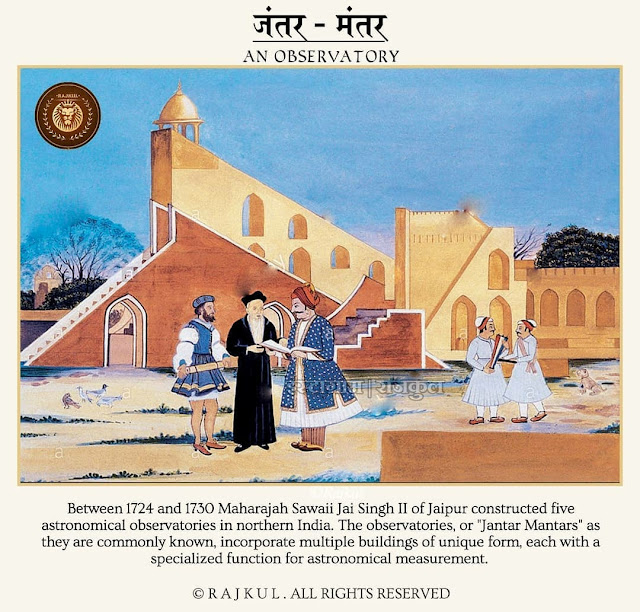
Between 1727 and 1734, Maharaja Jai Singh II of Jaipur constructed five astronomical observatories or Jantar Mantars.
These structures with their amazing combinations of geometric forms at large scale have captivated artists, historians and architects. The largest out of five Jantar Mantars is in Jaipur.
To natural cooling system which is also the World's Oldest Natural Air Conditioning Building whose Architectural history offers clues to low-carbon relief from the heat where examples as such aesthetics can be found in traditional building styles that evolved over centuries in response to local environments and cultures.
In India’s warm, humid regions, builders gravitated toward thin-walled structures with raised floors in order to promote air flow. In the country’s hot, arid zones, thick, windowless walls were used to keep out the sun’s heat, while courtyards promoted ventilation and fountains provided evaporative cooling. A strong wind blows, stops at the closed windows in mock surprise. It then rushes through the tiny orifices, quietly rising through the narrow spiral staircases and stopping at the other side.

Hawa Mahal, which is the quintessence of Rajput architecture, stands high in the heart of Jaipur city as a prominent attraction. The cylindrical balconies now appear stacked upon one another, like a set of different-sized flutes when tied together. From the chaotic crossroads at Badi Choupad in Jaipur, the road slopes down as it goes past the Old Legislative Assembly and Town Hall and the Hawa Mahal appears on the left, in a self-repeating fractal pattern spanning five floors in a series of smaller pyramids.
The Hawa Mahal in its fundamental design resembles a honeycomb structure. It has also been equated as a symbolic representation of Lord Krishna’s crown. The Hawa Mahal was designed by architect Lal Chand Ustad for Maharaj Sawai Pratap Singh. The original function of the building was to allow women watch processions on the streets below, through the intricate jharokhas, without a threat to their modesty.

Interestingly, the Hawa Mahal is designed like a natural cooling system, based predominantly on the ‘Venturi Effect’ in Physics. The 953 perforations in the façade serve as a device that generates wind for those who stand inside at its ramping corridors. The fractal design, with its self-repeating pattern at every scale—scaling up to the fourth floor where one can spot the Brihat Samrat Yantra, the tallest sundial at the Jantar Mantar. The air blown through is compressed, very similar to the ordinary laws which govern a modern day air-conditioner and is reflected through its curvy linear bay windows. With the Hawa Mahal being made of limestone, the principles that govern the making of the Hawa Mahal make it a very climate responsive building, to the point where it is dubbed as a ‘natural air-conditioner’. Hawa Mahal, designed as a beehive castle with small windows, has a height of 50 feet from its base. This structure, erected on a thin shield or podium approximately fifty feet high, has walls less than a foot thick. Constructed of red and pink sandstones by Lal Chand Ustad, Hawa Mahal is famous for its windows or 'Jharokhas' which enable free circulation of air within the structure. Its entrance is a door which leads to a spacious courtyard surrounded by two-storey buildings on three sides. Of the five storeys of the Mahal, the top three storeys have the thickness of a single room while the bottom storeys have courtyards. The interior of the Hawa Mahal is stark and plain with passages and pillars reaching to the top storey. The building does not have stairs to reach the upper floors; the storeys are connected by slopes.

A journey is successful if it surpasses your expectations, gives you unique experiences and sends you back with a bagful of memories to cherish. While hopping from one attraction to another on your itinerary is conventional, exploring gives you a pause and invites you to get intimate with the surroundings, offering an immersive experience.

Intricately carved 'Jharokha' from the durbargarh palace in gondal state, Rajkot
Phalodi Fort in Jodhpur
In Jaisalmer,
Octagonal tower with jharokhas Halvad Gujarat.
 |
| Dhrangadhra State Gujarat |
Halvad Palace with its 7-storey octagonical tower at the banks of Samatasar lake,Dhrangadhra state Gujarat.
The jharokha is also present today in many homes as a piece of décor in different forms, sizes and shapes due to its timeless appeal.
These jharokhas which are a classic element of Rajput architecture are good backdrop for photos.
STEPWELLS
“Why would a group of people choose to live in a desert, and what makes Thar so unique? It is because they could identify and find water when there was none and develop a life around it; everywhere you go you’ll find wells and lakes, all man-made; nothing is natural and that’s how it has become so beautiful,”
The grand and striking stepwells are the most exquisite feature of Rajasthani architecture. Called as ‘baori’ or ‘bawdi’ in Rajasthan, due to its climatic and geographical conditions, the state often witnessed water shortages. Hence the stepwells were built for water harvesting.
That highlight traditional water mechanisms and the marvels of the water flow in the age-old structures,
The earliest stepwells were simple in terms of their design with mainly two parts:
a vertical shaft through which the water was drawn and the other being the steps which gave access to the well.
Lost Stepwell of chiryai, Udhampur
However over time attention was also given to its architecture and design making it more fancy and elaborate. Built quite wide in space, the stepwells were also used for religious ceremonies and events.
One of the most famous and attractive stepwells, the Chand Baori, which is a visually spectacular landmark of Rajasthan is waiting for you to visit. With around 3,500 narrow steps and 13 storeys, is the Chand Baori stepwell that creates a hallucinatory effect while descending down its steps.
Bundi
As the history behind this baori goes, Rani Nathavati Ji was the younger wife of ruler Rao Raja Anirudh Singh. She gave birth to a son, Maharao Raja Budh Singh. But the previous wife of the king who was unable to give birth to a baby became envious of the younger queen. Thus, Rani Nathavati Ji gave her son to the previous queen of the raja and devoted herself for the well being of the common man. This is the reason she started the construction of this Raniji Ki Baori.
The beautiful carvings at the Rani ji ki Baori, Bundi.
It was just as shocking to see the state of the stepwells and the colossal mismanagement of water resources that you are blessed with a worshipping place at each of the floors of the stepped well. Raniji Ki Baori is well carved with ogee bracket work.
Dhabhai Kund
Dhabhai Kund (south of Raniji-ki-Baoli) creates a fascinating geometry with its steps and deserves a visit despite its abysmal state.
Nagar Sagar Kund
A pair of matching step-wells (just outside Chogan Gate) are called Nagar Sagar. Located outside the Chauhan Gate, the Nagar Sagar Kund, a set of twin step wells, was constructed to provide water during times of famine.
The 16th-century Bhoraji-ka-Kund (north of Nawal Sagar) is impressive and attracts birdlife post-monsoon. In Bundi, you will often cross one stepwell or the other. Sadly, the state of most of them evinces neglect.
Datia
Baladar ki baoli
Datia’s most attractive stepwell is an 1810-creation of the princely state’s ruler Parikshit. It is a large double storied structure built in an octagonal shape with a balcony that covers its upper level. At the edge of the balcony, overlooking the well-shaft are stone elephants. It has seen better days, with the plaster falling off now and the elephants crumbling.
Chandewa:
East of Datia town on the road to Bhander, a fort-like structure looms on the right. Nothing outside indicates that it contains a stepwell, a large one at that. A long flight of steps goes subterranean towards a deep well-shaft. Pillared corridors line the sides, ideal places to escape the oppressive summer heat. Records indicate the well was repaired by Orchha’s Bundela ruler Bir Singh in 1618, also mentioning that the work was done over a pre-existing well which dated to the 11th-12th century CE.
Sirol:
Bir Singh constructed another baoli north of Datia town, indicating the town was a magnet for medieval travellers, who rested awhile at the baolis before reaching their destination. The Sirol baoli is entered via an arched gateway flanked by two huge towers, both in the trademark Bundela style so prominent at Datia and Orchha. The place, though a state-protected monument, is now lived in by a peasant family accompanied by their dogs, cats and cattle. Once a visitor gets past this menagerie, he finds himself in a stepwell identical to that of Chandrewa, except that it is even larger.
Khadauna:
The Bundela stepwell pattern is seen once more at Khadauna, further north of Sirol, close to Indragarh.
This baoli is entered via a gateway painted blue and was built under the patronage of a Bundela princess called Kunjawati, daughter of Bir Singh and sister to Hardaul Shah, a cult figure who forms the basis for many folk ballads.
The distinct feature of the Khadauna stepwell is that is now a temple. And apart from the main deity, the shrine-stepwell houses one little-known aspect – a tiny carving of Kunjawati, worshipped as a goddess, is housed in the depths of the stepwell. This legend of Bundelkhand lives on, four centuries after Kunjawati’s passing.
Sirsa :
Gwalior
Built by Raja Man Singh Tomar, Assi Khamba Ki Baori circular is a step-well with 80 pillars all around and is therefore called Assi Khamba Ki Baori.
In 1505, Sikandar Lodhi invaded Gwalior. In response, Man Singh ordered the Gwalior fort to be closed down. He ordered the construction of this huge baori for storage of water during the siege. It is said that because of urgency this huge baori was built by ancient engineers in just 5 days.
A beautiful water structure, a stepped tank outside Pichhor, Gwalior.
See the ease of access that provides comfort to the user: the placement of steps and direction and the structure for shade and cloth changing within the pit. Nothing of the entire construction in the pit is above the ground level. Hydrated lime was used to fix bricks. A structure that one would see in proximity to a temple. Except there is no temple in the vicinity. It is visible frm the hilltop fort.
CHATTRIS
The Hindu temple architecture and sculpture together with the mortuary architecture received an impetus under the Rajput rulers of Rajasthan.
Thousands of cenotaphs cropped up during this period under the Rajputs who introduced a new chapter to the annals of the art movement of the State of Rajputana.
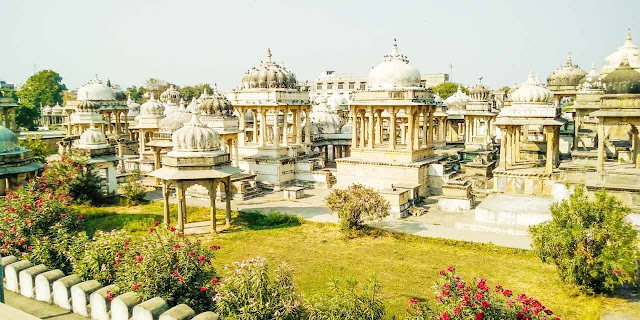
Chhatris in the land of Rajputs were meant for cremation of distinguished and affluent personalities and were memorials for royals, which was later on adapted in the construction and architecture of many other buildings in Rajputana.
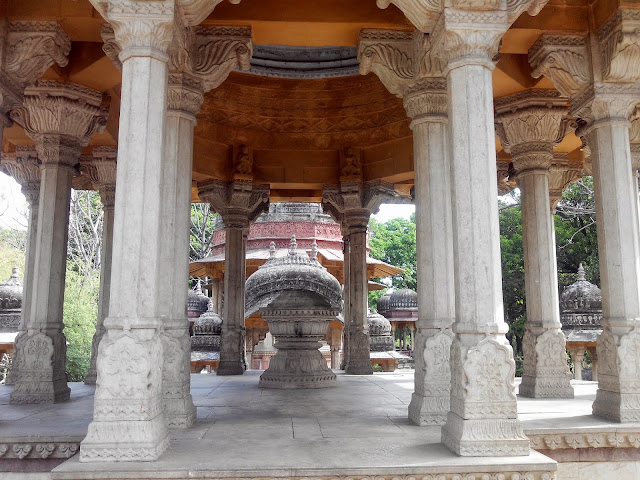
The chhatris in Gadisagar Lake, Jaisalmer seem like small formed islands. Many other prominent chhatris exist today in cities like Jaipur, Jodhpur, Bikaner, Alwar, Orccha, Datia and Udaipur.
Jaswant Thada, Jodhpur
In the royal state of Jodhpur lies Jaswant Thada, a splendid marble cenotaph monument that is also a mausoleum for the kings of Marwar.
The memorial was built in the honour and memory of Maharaja Jaswant Singh II by his son Maharaja Sardar Singh in 1899 and is still used by the Marwar Royal Family as cremation grounds.
The beautiful edifice is made out of intricately carved marble that is offset vibrantly against the red steps that lead up to the entrance.
Jaswant Thada in Jodhpur is considered as an architectural landmark and must be seen by one and all.
On the steps leading up to the monument, one can see local musicians and folk dancers entertain the visitors.
The cenotaph also has a beautifully maintained garden which the tourists can explore along with the monument.
One can explore the intricate artistry on the carved marbles.
The skilfully carved thin sheets of marble are worth appreciating.
The entire structure resembles a temple with unmatched beauty.
It is also called the Taj Mahal of Marwar and attracts tourists from all over the world.
Bada Bagh, Jaisalmer
Bada Bagh incorporates the Chhatris of Maharawals of Jaisalmer, the Bhati Rajputs of Yaduvanshi Clan, descendants of Shri Krishna, who ruled over Jaisalmer from 1156-1947.
The dynasty at Jaisalmer was established by Rawal Jaisal Singh in 1156.
Jait Singh Bhati II (1493–1528), commissioned a dam to create a water tank during his reign in the 15th century. This made the desert greener and life easier of the people.
After his death, his son Lunkaran built a beautiful garden next to the lake and a chhatri(Hindi for cenotaph) for his father on a hill next to the lake. Later on, many more cenotaphs were constructed here for Lunkaran Singh Bhati and other Kings of the Dynasty.
Today, the Cenotaphs(Chhatris) lie in dilapidated state, but even the ruins of these structures tell us about the Glorious Past of our ancestors.
The point to be noted is that even after constant attacks from Invaders, these Cenotaphs are in such great state.
Gaitore Ki Chhatriyan
Gaitore, the royal cremation ground of the Kachhwaha Rajputs, was chosen as the designated place by Maharaja Sawai Jai Singh II, the founder of Jaipur, after he shifted the capital to the city. From 1733, the cremation of every Kachhwaha king was done here.
The only cenotaph which is missing from here is the one of Maharaja Sawai Ishwari Singh whose cremation was done in the city palace complex in Jaipur
The word 'Gaitore' is believed to be a mispronounced form of the Hindi phrase, 'Gaye ka Thor' which means 'resting place of the departed souls'.
The cenotaphs of Gaitore symbolise the perfect blending of Rajput architecture.
These are open domed pavilions which are built on a raised platform.
Among the various cenotaphs dedicated to Sawai Ram Singh, Sawai Madho Singh and Maharaja Sawai Jai Singh II,
the one which is dedicated to Maharaja Sawai Jai Singh II stands out, this cenotaph, made of pure white marble, is decorated with stunning peacock deigns and patterns.
The carvings in each cenotaph reflect the style and taste of the specific king and the culture which was prevalent in his time.
Traces of paintings which once decorated the walls of the cenotaphs can still be seen.
Raja ki Chhatri ( राजा की छतरी )
This is cenotaph of Raja jaysingh I of Amber , which was known as ' Raja ki Chhatri ' in local.
Chhatri is situated on the bank of the Tapti about 4 miles from Burhanpur
This charming little edifice has pretty gumbazs (round roofs) and 32 decorated pillars.
Devikund Sagar
Devi Kund Sagar is the cremation ground of Bikaner Royal family situated in the outskirts of Bikaner, Rao Kalyanmal ji, the 5th ruler of Bikaner died in 1571, his son Rao Raisingh had built first cenotaph here
the last cenotaph was built after the death of Maharaja Karni Singh ji in 1988.
Devi Kund Sagar cenotaphs are built with pure white marble and red sandstone where an inscription of the remains is engraved on top of the cenotaph
The chhatris are flanked on two sides along a reservoir and is indeed one of the best examples of Rajputana architectural style.
The cenotaphs of the earlier rulers of Bikaner are in Dulmera red stone and the later ones are made of marble.
The chhatris for women, men and children of the royal family are different, The chhatri of a male has a vertical memorial slab where as that of a female has foot marks engraved on the slab.
A memorial erected for a minor is called nada and it is a simple structure without a canopy, among these memorials.
the cenotaph of Maharaja Anup Singh (1669-98 AD) is a marvelous piece of art and architecture. It stands on 16 pillars and bears carvings depicting acts of Lord Krishna
Devi Kund also has cenotaphs of 22 female members of the royal family prior to Maharaja Gaj Sigh Ji, who committed sati. There is also one cenotaph of a Sata (male sati) of a ruler.
Maharaja Surat Singh's Chhatri is built entirely in white marble with spectacular Rajput paintings on its ceiling.
Some of the cenotaphs also have epigraphic memorial stones.
Suraj Chattri ( cenotaph of sun )
This cenotaph has been built by Rajmata Shyam Kanwar Rathod of Bundi in the memory of her husband Maharao Chhatrasal Hada.
Kshaar Bagh ki Chhatri
Kshaar Bagh the royal cremation ground of the Hada Rajput of kota,
first cenotaph was a built in the memory of maharao madho Singh the founder of kota kingdom by his son Maharao mukund Singh.
The cenotaph of the rulers from Madho Singh to Umaid Singh 2 are situated here.
The Cenotaph of Ksharbag are unique pieces of architecture.
The major feature of this style is the craftsmanship, soundness, ornate method, safety, utility and spaciousness as well as variety of subjects.
The Bundi style is fully incorporated in the paintings and sculptures carved with finely carved marble stones on the umbrellas.
Known as Kota painting, the style of the portraits of female characters, eyes big, nose small, curved lehenches and unkempt veni is a prominent feature in this style,
Along with this, hunting, war, festivities, Shrinath Katha depictions and depictions of animals and birds make these umbrellas special,
The biggest thing in these pictures is the depiction of his greatest skill in the war involving the death of the king.
84 Pillared Cenotaph Bundi
This cenotaph is also known as " Chaurasi Khambon ki Chhatri "
Located at Devpura at the south of Bundi city on Bundi-Kota road, Rajasthan The 84-pillared cenotaph was built the year 1683 by Maharao Anirudh Singh of Bundi in the honor of his Dhay deva who gave him love and affection when he was a kid ,Rao Anirudh was very attached to his dhay deva.
The 84-pillared cenotaph is a two storeyed structure and is comprises of 84 strong pillars
The interiors of the Chhatri are lavishly designed and decorated with elaborated stylish patterns, on the upper level of this monument.
16 pillars are there to support the core cenotaph overpowered by a dome. This cenotaph consists of 4 chhatris placed on 4 sides or corners of the structure. At the lower part of the structure, one can find a large Shiva Linga which is protected by a remarkably adorned rooftop that stands sturdy with the support of 84 pillars.
Bhuj Chhatardis
The Chhatardis of Bhuj are cenotaphs of Royal family situated to the southwest of Hamirsar Lake.
The Chhatris in Bhuj were constructed in the 18th century by Jadeja ruler Rao Lakhpatji.
The structure of these monuments is in Rajputana architectural style,
These umbrella-shaped dome structures are specimens of fine carvings in red sandstone and Almost all the Chhatardis has curved lines, domes and arches in their structure.
The exterior walls are heavily ornamented, with sculptures of deities and panels depicting hunting scenes and couples in local costumes,
Many of the monuments are in ruins due to earthquake in 2001.
this cenotaph was brilliant example of Rajputana style Architecture, in beauty we can compare it with the cenotaph of Jaisalmer.
Ahar Cenotaph
Ahar Cenotaph also known as mahasatiya, ahar cenotaph was royal crecremation ground of mewar royal family , ahar cenotaph has around 250 cenotaphs with 19 Mewar rulers cremated in them.
Maharana Amar Singh 1 was first Ruler of mewar died in Udaipur and cremated at ahar, his cenotaph built by his son Maharana karan Singh.
The architecture of Ahar Cenotaphs boasts of the bravery and glory of the great kings of Mewar kingdom,
The striking architecture of memorial adds beauty to this region,
Arched roofs neatly shelter the stunning columns which are raised on higher platforms making it truly attractive,
The ceilings of the Ahar Cenotaphs are graciously studded.
The inspiration for the same has come from the marvelous temples built in the mid 15th century
Inside the cenotaphs, you will find a stone of the architraves standing upright showcasing an imitation of God Shiva along with sculpture, the image depicts the Maharana and his wives, who are referred to as Satis in the picture.
The most amusing cenotaph is of Maharan Sangram Singh as his porch includes 56 pillars and his 21 wives are buried with him in it. It is believed that in 1734, his 21 wives performed Sati.
Cenotaph of Maharana Amar Singh 2
RAJPUT ARCHITECTURE
The Rajput architecture combines a number of elemental designs that stand on the plain of geometry and traditional advisory as well. In easier ways most of the designs are reflective of exquisite artwork which ranges from royal carvings of the famous kings and majestic rock carved figures.
Yet another aspect of these palaces has been the vibrant use of brick red colouring which marked an ecstasy of royalty to their traditions. The forts have been crafted over large areas of land and have the ambient company of an exquisite garden that renders an ethnic touch to the royalty.
The massive interior halls and the exquisite lawns render a spacious and in intricate feeling to the entire palace. The rooms have been placed in higher numbers. It is evident that the entire royal family dwelt under one roof. The architectural designs and flavour of “Rajputana” suggests that this royal lineage had a certain appreciation for fine arts and music.
The Rajput Rulers had a keen sense of beauty in Art and Architecture which is seen in the artistic excellence of their temples, forts and palaces. The Nagara style of architecture developed in North India and Upper Deccan and the Dravidian style in South India during the Rajput period. Both sculpture and architecture attained a high degree of excellence. only the Rajputs could have tamed such terrain and established prosperity!
Majestic forts in Chittorgarh; Kumbhalgarh; Sawai Madhopur; Jhalawar; Jaipur, and Jaisalmer. The ecclectic architecture of the forts, some up to 20 kilometres in circumference, bears testimony to the power of the Rajput princely states that flourished in the region from the 8th to the 18th centuries. Enclosed within defensive walls are major urban centres, palaces, trading centres and other buildings including temples that often predate the fortifications within which developed an elaborate courtly culture that supported learning, music and the arts. Some of the urban centres enclosed in the fortifications have survived, as have many of the site's temples and other sacred buildings. The forts use the natural defenses offered by the landscape: hills, deserts, rivers, and dense forests. They also feature extensive water harvesting structures, largely still in use today.
Outstanding Universal Value
https://lifeispreciousnotrace.blogspot.com/2020/09/the-unique-dodagadhgagron-fort-immortal.html?m=1Within the State of Rajasthan, six extensive and majestic hill forts together reflect the elaborate, fortified seats of power of Rajput princely states that flourished between the 8th and 18th centuries and their relative political independence.
The extensive fortifications up to 20 kilometres in circumference optimized various kinds of hill terrain, specifically the river at Gagron, the dense forests at Ranthambore, and the desert at Jaisalmer, and exhibit an important phase in the development of an architectural typology based on established “traditional Indian principles”. The vocabulary of architectural forms and of ornaments shares much common ground with other regional styles, such as Sultanate and Mughal architecture.
Rajput style was not ‘unique’, but the particular manner in which Rajput architecture was eclectic (drawing inspiration from antecedents and neighbours) together with its degree of influence over later regional styles (such as Maratha, etc architecture) do make it distinctive.

Within the defensive walls of the forts, the architecture of palaces and other buildings reflects their role as centres of courtly culture, and places of patronage for learning arts and music. As well as housing for the court and military guard, most had extensive urban settlements within their walls, some of which have persisted to the present day. And some also had mercantile centres as the forts were centres of production and of distribution and trade that formed the basis of their wealth. Most of the forts had temples or sacred buildings, some pre-dating the fortifications and outliving the Rajput kingdoms, and many of these remarkable collections of buildings still attract followers. Collectively the forts contain extensive water harvesting structures, many of which are still in use.
As a former capital of the Sisodia clan and the target of three famous historical sieges, Chittorgarh is strongly associated with Rajput history and folk lore. Furthermore the sheer number and variety of architectural remains of early date (ranging from the 8th to the 16th centuries) mark it as an exceptional fort in its scale and monumentality comparable to very few other Indian forts.
Kumbhalgarh was constructed in a single process and (apart from the palace of Fateh Singh, added later) retains its architectural coherence.

Its design is attributed to an architect known by name –Mandan – who was also an author and theorist at the court of Rana Kumbha in Chittorgarh. This combination of factors is highly exceptional. Situated in the middle of forest, Ranthambore is an established example of forest hill fort and in addition, the remains of the palace of Hammir are among the oldest surviving structures of an Indian palace. Gagron is an exemplar of a river-protected fort. In addition its strategic location in a pass in the hills reflects it control of trade routes. Amber Palace is representative of a key phase (17th century) in the development of a common Rajput-Mughal court style, embodied in the buildings and gardens added to Amber by Mirza Raja Jai Singh I. Jaisalmer is an example a hill fort in desert terrain. The extensive township contained within it from the outset, still inhabited today, and the group of Jain temples, make it an important (and in some respects even unique) example of a sacred and secular (urban) fort.
The Hill Forts of Rajasthan exhibit an important interchange of Princely Rajput ideologies in fort planning, art and architecture from the early medieval to late medieval period, within the varied physiographic and cultural zones of Rajasthan. Although Rajput architecture shared much common ground with other regional styles, such as Sultanate and Mughal architecture, it was eclectic, drawing inspiration from antecedents and neighbours, and had a degree of influence over later regional styles of Architecture.

Criterion (iii): The series of six massive hill forts are architectural manifestations of Rajput valour, bravery, feudalism and cultural traditions, documented in several historic texts and paintings of the medieval and late medieval period in India. Their elaborate fortifications, built to protect not only garrisons for defence but also palatial buildings, temples, and urban centres, and their distinctive Rajput architecture, are an exceptional testimony to the cultural traditions of the ruling Rajput clans and to their patronage of religion, arts and literature in the region of Rajasthan over several centuries.
Integrity
As a series, the six components together form a complete and coherent group that amply demonstrate the attributes of Outstanding Universal Value, without depending on future additions to the series.
When considered as individual components, Ranthambore and Chittorgarh include all relevant elements to present their local, fort-related significances. However, ICOMOS is concerned about the surrounding development and industrial activities around Chittorgarh Fort, in particular the pollution and landscape impact of the nearby quarries, cement factories and zinc smelting plants, which, if continued or even expanded, have the potential to adversely affect the property.
The wider setting of Chittorgarh is vulnerable to urban development as well as industrial and mining activities that cause notable air pollution. At Jaisalmer the wider setting and views to and from the fort could be vulnerable to certain types of urban development in the surrounding town. While at Gagron the setting could be under threat from unregulated construction.
Within the forts, there are acknowledged development pressures derived from continued encroachment and enlargement of residential communities. The stability of the overall hill on which Jaisalmer rests is vulnerable to water seepage as a result of the lack of adequate infrastructure.
Authenticity
As a series, the six sites have the capacity to demonstrate all the outstanding facets of Rajput forts between the 8th and 18th centuries. Each of the sites is necessary for the series.
For the individual forts, although the structures at each of the sites adequately convey their value, some are vulnerable. The original exterior plaster at Amber Fort and Gagron Fort has been replaced, which has caused a loss of historic material and patina. At Chittorgarh and Kumbhalgarh Forts, there are structures in a state of progressive decay or collapse, which are vulnerable to losing their authenticity in material, substance, workmanship and design. At Jaisalmer within the urban area, individual buildings are in need of improved conservation approaches. Protection and Management requirements Chittorgarh, Kumbhalgarh, Ranthambore and Jaisalmer Forts are protected as Monuments of National Importance of India under the Ancient and Historical Monuments and Archaeological Sites and Remains (Declaration of National Importance) Act of 1951 (No. LXXI of 1951 (AMASR)) and the AMASR Amendment of 2010. They were listed in 1951 (Kumbhalgarh, Ranthambore and Jaisalmer) and in 1956 (Chittorgarh) respectively. The 1951 national legislation provides unlimited protection to the monuments designated in its framework and the 2010 amendment establishes a 200 metre protection zone around the area of the designated Monuments of National Importance.

Gagron and Amber Forts are designated as State Protected Monuments of Rajasthan under the Rajasthan Monuments, Archaeological Sites and Antiquities Act of 1968. They were both listed in the very year the act was adopted. The 1968 Act stipulates that no person, including the owner of the property, can carry out any construction, restoration or excavation work, unless permission has been granted by the responsible state authorities. In the case of Amber Palace an additional notification for the protection of a 50 metre buffer zone around the property has been issued. All sites have buffer zones designated, but there is a need for clearer planning policies for these in order to regulate development.
The overall management of the six properties is steered by the State Level Apex Advisory Committee, which was established through Order A&C/2011/3949 on 11 of May 2011. It is chaired by the Chief Secretary of Rajasthan and comprises members of the concerned ministries, namely Environment & Forests, Urban Development and Housing, Tourism, Art, Literature & Culture, Energy and various representatives of the heritage sector including the ASI. The Apex Advisory Committee meets on a quarterly basis and is designed to constitute the overall management framework of the serial property, guide the local management of the six serial components, coordinate cross-cutting initiatives, share research and documentation, share conservation and management practices and address the requirements of common interpretative resources.To implement the recommendations of the Apex Advisory Committee, the Amber Development and Management Authority, acts as an overarching authority for management implementation. This was legalized through notification by the Chief Secretary of the Government of Rajasthan dated 14 October 2011. There are Management Plans designed to cover the period 2011 to 2015 for five of the six sites. For Jaisalmer, the Management Plan for the property along with sub-plans including visitor management, risk preparedness, and livelihood generation for the local population, will be completed by end of 2013. There is a need for policy statements in the Plans to reference Outstanding Universal Value and for more detailed action plans to be produced for the implementation of the management policies, as well as for indicators for management quality assurance during the implementation processes. For the first revision of the Plans, it would be desirable to provide an over-arching volume for the whole series that sets out agreed approaches.
https://lifeispreciousnotrace.blogspot.com/2020/09/jaisalmer-golden-city-of-jaisal.html?m=1
To reverse the vulnerabilities of certain individual structures within the forts, there is a need for short-term conservation actions.

For Jaisalmer, there is a need to ensure the major conservation project for infrastructure and conservation of individual buildings is delivered according to the agreed timescale. Conservation of the extremely extensive fortifications and ensembles of palaces, temples and other buildings will call for extensive skills and resources. A capacity building strategy to raise awareness of the importance and value of these skills, as part of an approach to livelihood generation, could be considered.
In order to ensure a clear understanding of how each of the forts contributes to the series as a whole, there is a need for improved interpretation as part of an interpretation strategy for the overall series.
The royal palaces of Rajputana have been among the major attractions that can be seen as the best of Indian royalty. The palaces since the inception of time have been the major attractions of Jaipur. Such a fine architecture combined with the ambiance of luxury can be seen forth as the major reason as to why the people in here have been reluctant with their pride for “Rajputana”
Most of these palaces had been built during the period of Rajput Empire. The glorious history of the Rajput Empire speaks of valour and their amazing ability to overcome any challenge. The Rajput had been seen as the most valiant of all souls that roamed on the heart of India.
The elegance and the royalty of these palaces are evident since they have been based on the exquisite architecture of the “Rajput Gharana”.
With a perfect blend of traditional and contemporary architecture, there is something illusive about these royal palaces. Be it their massive proportions or seemingly their majestic approach; any person is sure to be fantasized with such a monumental display of valour, class and royalty.
The royal essence
Above all of the royal palaces spread across the entire land of India, the Rajput architecture stands in a metropolis of its own. It is simply ethnic and transcendent to its richness. The fine architecture and the precision of art pieces suggest that perfection played a pivotal role in the foundation of such an architectural ecstasy.
The royalty in here seemingly has an orthodox yet new touch to it. There is a completely visible amazement to the monotonous display of such euphoric designs. The simplicity in itself has been the best of reasons as to why such architecture stands tall amidst the Indian soil.
To the truest of words the Rajput architecture is a fine example of the taste that the royal families of the valiant had during those period of time. It is an iconic evidence of the rich history in art and music that made India such a discreet existence of culture.
RAJPUT CIVIL ARCHITECTURE
The Rajput Rulers being great builders spent lavishly on constructions other than temples.
They built dams, artificial lakes, canals, toranes or arched gateways, sthambas or towers, fortresses and palaces which even today testify to the their skill in engineering and architecture.
A political vacuum exists in India. The infighting among the various nobles of the Delhi Sultanate has caused many kingdoms and provincial governors to assert their freedom. From this vacuum come the kingdoms of Vijayanagara, Golconda and Bijapur in the south. In the Centre, in Rajputana, Mewar, Marwar, Aamber, Jaisalmer, Bikaner, Pubiya, Saurasthra, Kutch, Bundelkhand, Baghelkhand, Gwalior, etc. In north Dogra, Kangra, Garhwal, Kumaon, Etc the proud fighting clans of the Rajputs too seize this opportunity. This will be the time of chivalry, of great forts under the hot sun, of pomp and splendor, the making of a warrior tradition which will provide eventual stiff resistance to the Mughal onslaught.

However, a break in building tradition – caused by the Delhi Sultanate in the preceding years – means that the science of architecture is no longer the same – the ancient texts which were followed in early temple building have either been lost, or forgotten, or need to be modified in response to changing needs. The craftsmen, too, have now practiced on Islamic buildings, and bring with them the tradition of Islam.
The current of cultural exchange now flows both ways – earlier it was Islam which had to forcedly borrow indigenous craftsmen for its architecture – and now it is these very same guilds who return to the service of Rajput kings. Architecture will now be truly a fusion, and will be one of the first, and among the most prominent, tools of a sub-continental identity, a true Indo-Islamic culture.
Meanwhile the principal players in this drama are of course a little less aware of their eventual place in history, and are more occupied by the more mundane aspects in life. This is the old story of kingdoms waging war against each other and rulers erecting palaces and monuments to their glory, and fortresses to preserve their rule.
RAJPUT FORTS
Rajputana is shaped by conflict, either against nature or against foreign invaders. The harsh desert environment affected trade, agriculture and water resources, and constant warfare hindered the building of urban settlements, human migrations and expansion of territory. As a result, Rajputana was divided into small kingdoms competing with each other for land, power and resources.
Urban settlements were confined within walls of heavily fortified hilltop forts. However, the tenacious spirit of Rajputs prevailed over unfavourable circumstances and they managed to retain their freedom during much of Mughal rule and throughout the British Raj (except in Ajmer).
Their struggle is reflected in the history of Rajputana fort. Not one fort or ruler anywhere on earth can proudly claim the it didn’t surrender to the Invaders except Chittorgarh, Ranthambhor & Jaisalmer.
Where Rajputs died to the last Man & Women committed Jauhar but not surrender.
Some of the places where they built majestic fortresses are Chittorgarh, Jaipur (Amber), Jaisalmer, Jodhpur, Mandu, Ranthanbor and Gwalior. These forts were usual built on hillocks and entry was a circuitous ascent made difficult by barriers at intervals. The forts had strong massive walls and numerous round and square towers. They are excellent specimens of Rajput skill.
The Sisodias of Chittor and Rana Kumbha (1433-68) were among the most active patrons of building. The Jayastambha (Tower of Victory) is an odd structure, combining as it does the urge to commemorate a victory (that over Malwa in 1458), with the principles of temple building. The structure thus becomes quasi-religious, a sort of vertical temple.
Chittorgarh today is a sleepy little town, much like many others in semi-rural India. The youth all want to leave, the cows blink stupidly in the ferocious heat of the mid-day sun, and the halwai is the main cultural centre, where politics is discussed over chai. It doesn’t even have a proper train line, the only connection is by an old metre-gauge to Delhi and Ahmedabad.
Nothing spectacular, one would say. Except for the low plateau in the near horizon, and the massive slumbering walls around its top. This is the fort of Chittor, once home to kings and nobles, of beautiful queens and princesses, of stirring tales of manhood and valor, of noble but futile chivalry, and of eventual, glorious death.
Chittor fort, along with Mandu and Chanderi, represent the start of the tradition of synthesis between native and imported ideas, which was to be carried on with increasing skill in the forts of Gwalior, Orchcha and finally Fatehpur Sikri.
Chittorgarh Fort
Victory Tower, Chittorgarh
The most exquisite of their Sthambas is the Jaya Sthamba or Victory Tower in Chittor. A 37 metres. High nine storeyed structure - it is elaborately decorated with statues of Hindu deities both inside and outside. It was erected by Maharana Kumbha in the 13th century to commemorate his victory over Mahmd. I, the ruler of Malwa. The tower is as square structure and has balconied windows and mouldings on all four sides.
Beautiful examples of Rajput palaces are the Udaipur Palace on lake Pichola built by Maharana Udai Singh and the Hawa Mahal in Jaipur built by Raja Jai Singh.
Elaborate and decorative architecture, carved balconies, marble trellis-work, inlaid mirror and mosaic work and exquisite miniature paintings adorn these palaces. Built on Lakes and having extensive gardens, these palaces are pieces of picturesque beauty.
Gwalior Fort
The strategically located Gwalior fort was fair game, in its position as the gateway to central India, for all would-be potentates.
The climb up to Gwalior plateau is tortuous and not easily accomplished even by a motor vehicle. This no doubt contributed to its fine system of defences designed to slow down and eventually stop any attacker.
Among its many remarkable buildings, its greatest is perhaps the palace of Rajput King of Gwalior Man Singh Tomar built in the 15th century. Unlike even its successors, Man Singh’s palace is in an excellent state of preservation, with even the blue and yellow tile work on the façade still visible.
Bundi:
Architectural Heritage of a Forgotten Rajput Capital” In shadows of erstwhile power centres of medieval India, are small historic towns largely unknown today beyond their immediate geographical context.
Bundi erstwhile capital of Hada Chauhan Rajput province known as Hadauti located in south-eastern Rajasthan, is one such place also known as City of stepwalls, blue city and also as Chotti Kashi. In ancient times, the area around Bundi was apparently inhabited by various local tribes, of which the Parihar Rajput was prominent.
Best example of medieval Indian city exhibiting water harvesting methods adopted at settlement level as well as finest examples of water architecture. Location of Baoris and Kunds outside the walled city was also influenced by social considerations as ascess to baoris and kunds were located within walled city was controlled.
Architectural heritage of Bundi can be classified in six typologies: -
1) Garh (Fort) -Taragarh
2) Garh Mahal (Royal Palace) -Bhj Mahal, Chattar Mahal and Ummed Mahal
3) Baori (Step well) - Khoj Darwaja ki Baori and Bhawaldi Baori
4) Kund (Stepped tank) - Dhabhai ji ka Kund, Nagar Kund & Sagar Kund and Rani Kund
5) Sagar mahal (Lake Palace) - Moti Mahal, Sukh Mahal, Shikar Burj.
6) Chhatri (Cenotaph) - Chaurasi
Taragarh Fort was constructed by Rao raja Bair Singh in 1354 on a hilltop 1426 feet high. In the centre of the fort is located Bhim Bhurj on which was once mounted a particularly large cannon called Garbh Gunjam, or ‘Thunder from the Womb’. With its curved roofs topping pavilions, excess of temple columns and elephant and lotus motifs, the palace is a tribute to Rajput style. The fort includes Hazari Darwaza, Haathi Pol, Nau Dhaan, Ratan Daulatkhana, Darikhana, Ratan Niawas, Chatra mahal, Badal Mahal & Moti Mahal.
Orchha
At Orchha there are three palaces of note – the Ramji Mandir of Raja Rudra Pratap (1501-31), the Raj Mahal of Madhukar (1554-91), and the Jahangir Mahal of Bir Singh Deo. These last two were built on an island in the river Betwa.
All three palaces, built in the time when the Mughal influence had begun, have square courts - like most islamic buildings – surrounded by living quarters. Arches and domes mingle with beams and columns.
This is how a temple having similar shikhar of Parmar Rajputs Architecture in Malwa was broken down and ugly "Mehrab" was put on...
Though What is this ‘Mughal/Islamic style’ in what is patently a design based on Hindu architectural traditions. Please refrain from such embarrassing posts and acquaint yourselves with your country’s art and architecture to begin with.
“Even the pointed arch only acquired from India the religious significance which eventually led the Saracenic builders to adopt it as their own”...and thus the very feature by which all Western writers have distinguished Saracenic architecture from the indigenous architecture of India was originally Indian”
- EB Havell
“at the durbar of 1911, the King made it very clear: “It is my desire..the planning and designing of the public buildings to be erected will be considered with the greatest deliberation and care, so that the new creation..in every way be worthy of this ancient and worthy city.”
What you @IndianExpress call the “four centred pointed Mughal arch” is very much a part of the native ancient Indian architectural tradition.
What you call the four centred pointed *Mughal* arch can be seen in various Hindu structures of the ancient times when Mughals hadn’t even appeared on the scene.
The ancient, 5th century CE, Vishnu temple, a terracotta marvel, at Bhitargaon, Kanpur. It's known for "possessing the earliest voussoir arch in India."
The temple at Bhitargaon was built during the Gupta era. Guptas' love "for moulded bricks had opened a new architectural front in which all the details of building techniques were incorporated according to the best aesthetic standards of the age" of which "the temple at Bhitargaon stands as the earliest extant example, remarkable both for its high quality of sculpture and architectural devices"
This is another example of the voussoir or true arch from ancient India unearthed during an excavation by the ASI in Kaushambi, UP, in 1961-62.
Features of the arch
Another example of the voussoir or true arch from ancient India was brought to light during an excavation undertaken by the ASI in the Kaushambi district of UP between 1961–62. The arches discovered at Kaushambi were constructed several centuries prior to the one at Bhitargaon and had once formed part of a palace which now lies in ruins. The foundational phase of the palace at Kaushambi has been dated to the pre NBP period or around the 8th century BCE. Although the plan of the palace had remained the same, alignment of structures underwent changes over time.
Arches discovered during an excavation at Kaushambi
From the Indian Archaeology Review 1961 – 62
“A vast network of underground chambers and the superstructure in the three blocks and the galleries were found to be built on the principle of true arch. The arches allowed different varieties, the four centres pointed arch for spanning narrow passages and segmental arch for wider areas”
These arches are from several centuries earlier to the one at Bhitargaon and form part of the Palace ruins at Kaushambi.
“A vast network of underground chambers and the superstructure in the three blocks and the galleries were found to be built on the principle of true arch. The arches allowed different varieties the four centres pointed arch for spanning narrow passages and segmental arch for areas.”

The so called fusion experiment with Rajput Architecture at Orchha culminated in Bir Singh’s Govind Mahal at Datia. In plan the Govind Mahal distinctly follows the islamic concept of a central court, with a symmetrical disposition of elements around it.
The four corners culminate in domes which set off the larger one crowning the central royal quarters.
However, perhaps the most surprising creation at Orchha is the giant Chaturbhuja temple.
More than its size, the architectural plan is surprising, resembling more a cathedral, being a cross in plan. The other astonishing thing is the large interior space, quite unusual for a temple where the interiors tend to be closed and cramped.
This trend of fusion was to be evident in Islamic architecture of the period as well.
The history of the Indian subcontinent is best studied in this way – as a product of diverse influences, each of which leaves its own mark, rather than a narrow division into Hindu, Buddhist, Jain, Islam etc. For none of these developed in isolation, but were rather a product of the volatile political process around them. So if architecture can define a nation, it is at this period in history that we witness a remarkable change – a sort of rapprochement between Hindu and Islam – at least in the domain of architecture. Though for craftsmen do not know any religion except for what feels good to build, and what pleases the eye.
Jains flourished only under Rajput rulers of Rajputana & Gujarat during the Rajput Age, 600-1200 CE. Rajputs never persecuted Jains or anyone else & allowed them to build their temples.
Ranakpur Jain Temple or the Chaturmukha was built under the patronage of Rana Kumbha !
Kirti Stambh was built during the reign of Rawals of Chittorgarh.
Mirpur Jain Temples, group of 4 was made in 9 CE when Rajputs ruled the region.
Mahavir Jain Temple at Osian, Jodhpur was built during the Pratihara Vatsraj in 8 century.
The Jain temples of Jaisalmer fort and Lodrawa are testimony to plurality of Rajput rulers of Jaisalmer
who though devout Hindus allowed Jains to flourish.
Sambhavnath and Chandraprabhu Temples dedicated to Jainism.
Bavan or 52 temples at Kumbhalgarh, the hill fortress of Ranas of Chittorgarh & Jain Temples in Jalore are all built during the Rajput Age.
The only temple where 40000 kg of pure ghee was used instead of water in mortar ..
The bhandasar Jain temple is epitome of rajputana architecture with intricate design works. Marble pillars, gold leaf walls, intricately decorated ceiling mark the presence of the temple .
The temple is situated in desert city of bikaner , Rajasthan ...
Bhandasar Jain Temple is a three-storied shrine that dates back to the 15th century. Dedicated to tirthankar Sumatinatha ..
Almost all surviving old Jain Temples are in Rajasthan and Gujarat both under Rajput rulers.
Aerial photograph of Sun Temple, Modhera(Gujarat)
Patron: King Bhimadeva
Simply stunning geometrical precision! No wonder, Al-Beruni said,
"Our people when they see them, wonder at them and are unable to describe them, much less to construct anything like them.”
Yet the reason for the downfall of the Modern day Rajputs was the cessation of sun worship.
Earlier Rajput kings always worshiped the sun but why did we worship the sun? For that, first we have to understand the planetary system.
Our scriptures say that the whole universe is contained in our body. If the first sage wanted to know what to see, he would look inside himself with divine vision and he would know everything. There are nine planets in our universe. The sun is in us. Our soul is called the sun. Meaning we were worshiping our own. We were going to live on our own. The nine planets show the same. The sun means the soul. The moon is our mind. Mars means our fighting power Mercury gives us intelligence. Guru means our knowledge is spiritual knowledge. Venus means our happiness. Fun hobbies. Saturn means our Karma Naokar Chakar. Rahu is our Kut policy. Ketu provides salvation. being Rajput

If you look carefully, this is the cabinet of a king. The sun means the king himself. The moon is its mind. Mercury is the wise minister of the king. Guru means the spiritual guru of the king, Acharya. Venus means the king's royal dancers and the king's other hobbies. Saturn means the king's servants, his servants. Mangal means the husband of the king's fighting army. Rahu means the king's master.

The cabinet of the nine planets of the universe is the cabinet of the same king. Who provides energy and light to the nine planets of the universe? The sun. This means that only the one who has more self-confidence can become a king. In the words of the one who has self-strength, all re. Only he has the power to run a good administration. And we used to worship the sun only to increase this self-confidence. The sun never needs anyone. Such a king never needs anyone. But for that, the king needs to maintain his self-confidence. All the planets orbit the sun to get energy from the sun. But the sun does not orbit anyone. In the same way the whole cabinet of the king is wrapped around the king. The king does not need anyone. And that is why we Rajputs always worshiped the sun. being Rajput
But some invaders like Khilji destroyed all our temples. At present we have a Sun Temple in Modhera which is fragmented but there is no worship but only to show people. There are bats flying inside. Which shows an insult to the sun god. Our king Bhimdev Solanki built this temple to worship the sun. Not for the government to perform in a state of ruin. The Rajput community strongly opposes this and it is necessary to install Surya Murti inside and start Surya Puja again. being Rajput

If the Rajput community is to rise again from fall to rise, it is necessary to resume sun worship and increase its self-confidence. The only fault of Surya Puja is that with the increase of self-power, ego comes and ego falls.
It is very important that ego does not take the place of self-confidence. The biggest example of this is Hanumanji. Whose guru was the sun itself. There was a lot of confidence but no ego at all. So far no one was able to send in the perfect solution, which is not strange.
So Hail Rajputana with the hope that our society will once again be full of confidence and self-reliance.
Jay Maa Jwala ji
Note - These are a Just few illustrations of Major Ancient Rajput forts there are thousands more Major and minor Rajputs Forts, Palaces and Temples still left to read about.
They changed hands many times but most of these were constructed by Hindu Rajputs and Entire books can be written about each of them....












_(8441306001).jpg)


