Sunday, December 5, 2021

उत्साह.....?


_/\_सभी सनातनी राष्ट्रवादियों को शौर्य दिवस पर हार्दिक शुभकामनाएं _/\_


जीवन में सफलता प्राप्त करने के सभी साधनोंमें  उत्साह का प्रमुख स्थान है। इसके बिना अपनी उन्नति के किसी भी कार्यक्रम में आप सफल नही हो सकते या युं कहिये की उत्साह का सहारा लेकर ही आप अपने परिश्रम का पूर्ण लाभ उठा सकते हैं। जीवनमें आपको जो कुछ भी करना है चाहें- एकाग्रता का पाठ पढ़ना चाहें, अथाह शक्ति अर्जित करना चाहें अथवा आत्मोन्नति करना चाहें- सभीमें उत्साह का कार्यशील बनाता है, कार्यरत रखता है और उन्नतिकी ओर अग्रसर करता है। किंतु यह उत्साह क्षणिक नहीं बल्कि स्थायी होना चाहिए।

उत्साह बडा ही प्रेरणापद है। बिना उत्साह के बड़े ही प्रभावशाली तर्क-वितर्क भी आपको कार्यशील नहीं बना सकते। किसी भी कार्य में यदि आप श्रेष्ठता प्राप्त करना चाहते हैं अथवा करके शिखर पर पहुँचना चाहते हैं; चाहे वह आपका प्रिय व्यापार हो, आपका दैनिक कार्य हो या आपके अध्यन्नका विषय हो तो इसके लिए आपको पहले अपनेमें उत्साह उत्पन्न करना पड़ेगा और फिर उस तीव्र उत्साहको बनाये रखना पड़ेगा।


उत्साहको उत्पन्न करने और बढ़ाने के कितने ही नियम हैं। आप उन नियमों को पालन करने का प्रयत्न कीजिये, सफलता आपकी दासी बनकर रहेगी। अपने विषयमें विशेषज्ञ बननेका प्रयत्न कीजिये। आप विद्यार्थी हों तो अध्यन्नसे, चकित्सक हों तो गान-विद्या-विषयक अभ्यास सानुराग उत्पन्न कीजिये। अपने कार्यसे एकाकार हो जाइये। अपने विषयकी गहराइयोंमें प्रवेश कीजिये तो उत्साह बढ़ता ही जायेगा। उत्साह आपकी योग्यता और चतुर्यके साथ बढ़ता ही जायेगा। जैसे ही किसी विषयमें आपका उत्साह कम होने लगे, उस विषय की सूक्ष्मताओं की खोजमें लग जाइये।


जो भी कार्य कीजिये, उसमे नया जीवन फूंक दीजिये, हस्ते हुवे, मुस्कराते हुए, कीजिये। सदा सर्वत्र आपके मुखपर आशा और उमंगकी छाप होनी चाहिये।


अपनी विफलताओं पर निराश न होईये, उनको बार-बार मस्तिष्क   में स्थान न दीजिये। विफलताएँ  सफलता का रास्ता खोल देती है। अपनी सफलताओं और पूर्ण किये हुवे कार्योंके विषयमें दूसरे से बातचीत कीजिये ; परंतु ध्यान रखिये की अहंकार का भाव न आने पाये। अपने सौभाग्य के विषय में  दूसरों को बताइये अपनी विफलताओं और भूलोंके  विषय में दूसरोंको न बताइये। अपनी विफलताओं और भूलोंके के विषयमें चुप, परंतु सावधान रहिये आपका उत्साह दिन दूना रात चौगुना बढ़ेगा।

महापुरुषों की जीवनी पढ़िए, उनके-जैसे चरित्रवान् बनने का प्रयत्न कीजिये। जनरल ज़ोरावर सिंह की जीवनी पढ़िए जिसको हिमालय पर्वतने रास्ता दे दिया था और कुमार (सम्राट) स्कन्दगुप्त के जीवन से प्रेरणा लीजिये जिन्हें बरसात में बड़ी हुई नदी ने रास्ता दे दिया था। ये उत्साहके प्रत्यक्ष उदाहरण हैं।


हमारी मानसिक स्थिति का प्रभाव हमारे शरीर पर पड़ता है और हमारी शारीरिक दशा हमारे मानसको प्रभावित करती है। उत्साह मुस्कान, हँसी, लगन, शक्ति, ध्यान अथवा सावधानी के रूपमें प्रकट होता है। ये ही शक्तियाँ हमें सफलताकी और अग्रसर करती हैं। संसार के चित्रपट पर उत्साही पुरुषका अभिनय कीजिये। यथार्थ उत्साह स्वयमेव उपरकी शक्तियों को प्रकट कर देगा।


जीवनके हर पहलू मैं उत्साह ही मनुष्यको सामान्य या वशिष्ट बनाता है। एक विद्यार्थी, जिसके लिए विद्याध्ययन केवल कर्तव्य है, एक साधारण नागरिक ही बन पाता है, जबकि दूसरे विद्यार्थी यदि अपना कार्य साहस और उत्साहके साथ करता है तो महान् बननेकी योग्यता रखता है।


उत्साह आपके कार्यको उस प्रसन्नता और सफलता में बदल देगा जिसकी आप बहुत दिनों से आशा लगाये बैठे थे। उत्साह ही सफलताका रहस्य है जो कि आपके गुणों कों और समृद्ध बनाने में सहायक है।


Sunday, November 28, 2021

THE REALITY OF RAJA UDAYBHAN RATHORE OF BHINAY


𝗪𝗵𝗼 𝘄𝗮𝘀 𝗨𝗱𝗮𝘆𝗯𝗵𝗮𝗻 𝗥𝗮𝘁𝗵𝗼𝗿𝗲 𝗥𝗲𝗮𝗹𝗹𝘆? 

 𝗪𝗵𝘆 𝗮 𝗴𝗿𝗲𝗮𝘁 𝘄𝗮𝗿𝗿𝗶𝗼𝗿 𝘀𝗵𝗼𝘄𝗻 𝗶𝗻 𝗯𝗮𝗱𝗹𝗶𝗴𝗵𝘁?


𝗔𝗻 𝗮𝗻𝗮𝗹𝘆𝘀𝗶𝘀 𝗼𝗳 𝘁𝗵𝗲 𝗺𝘆𝘁𝗵 𝗺𝗮𝗸𝗶𝗻𝗴 𝗶𝗻 𝗠𝗮𝗿𝗮𝘁𝗵𝗮 𝗵𝗶𝘀𝘁𝗼𝗿𝘆.

Raja udaibhan Rathore of bhinay was great grandson of great Rao chandrasen Rathore and He was also a relatives of Mewar's Maharana Raj Singh, Their character has been shown very wrong in the movie where  (एक धर्म निष्ठ राजा उदयभान राठोड़ को एक विधवा स्त्री का अपहरण करने वाला दिखाया गया)


Bhinay thikana genealogy

Rao chandrasen

Ugrasena Rathore

Karmasena Rathore

Shyam singh Rathore

Udaibhan Rathore ( 5th head of bhinay thikana ) 


Kushal kunwar a Doughter of Raja udaibhan Rathore married Raja Bhim Singh Banera ( Son of maharana Rajsingh of mewar )

Source 
 1 Rathores of Rajasthan
 2 Rathore ri vighat
 3 Banera Rajya ka itihas

Bakidas ri khyaat also mention bhinay thikana genealogie.

The reality of history of Udaybhan Rathore and Tanaji

Udaybhan rathore was the head of Bhinai thikana (84 villages) in Ajmer. He was the direct descendant of the famous Rao Chandrasen, Raja of Marwar (4th generation) who resisted Akbar all his life and never made any alliance with mughals like Maharana Pratap. Later in 1783, Maharaja of Jodhpur gave title of Raja to Bhinai family for their military service. Bhinai family and their direct descendant Raja Sh Mayuraj Singh still lives in Ajmer. Anyway coming to Udaybhan Rathore and story of Tanaji. Jai Singh's march on Shivaji and treaty of Purandar (1665) is a well known episode to repeat here. After getting the hill forts from Shivaji under the treaty, Jai Singh didn't have enough man-power to man every one of the small forts because of his next campaign against Bijapur. Jai Singh personally took over a couple of important forts like Kondhana (Sinhgarh), Purandar etc. Others were given to some mughals or their fortification walls destroyed. Jai Singh died in 1667 near Burhanpur while enroute to the north.

The fort of Kondhana was under Udaybhan Rathore placed by Jai Singh not sent specially by Aurangzeb as shown in the movie. In 1670 the fort was captured by marathas after a sanguinary fight in which the maratha army leader Tanaji Malusare and Udaybhan Rathore both died. The reality was simple, marathas under Tanaji captured the fort from Udaybhan Rathore but as we will see, slowly this story expanded to one of the biggest fiction in maratha history. Start with contemporary evidence, there is not a single contemporary evidence of this. First mention of this fight is in Sabhasad bakhar written almost 30 years after the battle. The Sinhgadh campaign is given in detail, that there was one Tanaji malusure who commanded the army. Although this battle is described in detail, there was no exaggeration about Udaybhan which were made later.  Udaybhan was only mentioned as a great warrior who was the commander of the Kondhana fort. And that Tanaji climbed the fort with help of mawle soldiers who were expert in mountain climbing. 

Even Chitnis Bakhar which was written about 130 years later doesn't say anything wrong about Udaybhan. The event is also mentioned vividly by British historian Grant Duff's in his 'History of Mahrathas' written in 1826, story is same as Sabhasad bakhar. Nothing wrong against Udaybhan here too. Later in British period this story is deformed to another level. In 19th century one powada was composed allegedly by one Tulsidas shahir. The powadas are ballads; songs sung by wandering performers, there is nothing historical about it. In this powada Udaybhan is made a monster, some description about Udaybhan is as follows, Udaybhan eats one cow, one goat and more than a maund of rice in ONE MEAL. He has 18 wives and 12 sons (which is also fake as he had only one son and which wasnt in kondhana)

He remains drunk and doesnt go to fight until all his fake 12 sons get killed. Cherry on the top, it is shown that he also converted to Islam, goes to mosque and when he died he cried "Allah". In the ballad there are many other unbelievable things like how a ghorpad (monitor lizard) helps Tanaji to climb up the fort which was not true according to Sabhasad Bakhar, and like how ghorpad stopped climbing midway and then Tanaji asked her to climb but when she doesnt, Tanaji threatens her that he will cook her and will eat her if she doesnt climb. Then the ghorpad again starts climbing. HG Rawlinson who wrote 'shivaji the maratha' added an english translation of the powada, he himself say that there is no contemporary evidence of this story.

There are many other geographical mistakes too like how Rajgarh is confused with Raigarh by the composer. Although the story has little historic value, the story being interesting was copied by some colonial and pune writers. Later comes a man named Hari Narayan Apte, a historical novel writer who is hailed as Walter Scott of Marathi literature. He wrote in 1903 a novel named Gad aala pan sinh gela. He btw also wrote a novel named "Tiger of Mysore" on Tipu Sultan. He went a step further from Powadas and added in this an extra story of Kamal Kumari. And also made Udaybhan rathore an illegitimate son of Mewar Rana from a slave girl. And how did illegitimate son of a sisodia rajput adopted Rathore surname is a mystery that Apte didn't think over.

Anyway in his story Udaybhan kidnapped Kamal Kumari, a Rajput widow against her wishes, she wanted to become Sati. Udaybhan is shown in much disgust in this book. Finally a man of honour Tanaji frees Kamal Kumari from Udaybhan's clutches so she can commit sati. This book of Apte gained quite popularity and became anchor point for further writings on Udaybhan and Tanaji. Many works on this were composed later, to name a few Acharya Chatursen a hindi novel writer's book "Sayadri ki Chattane" follows the same story of Udaybhan. There were marathi films made on this story before independence. And finally a hindi film Tanhaji in 2020 by a Marathi film maker Om Raut. This film is on another level, it takes all the story from these fictions but remove all those impossibles like eating cows and all to make story believable and also specifically mentions that Udaybhan is Rajput which was removed by censor board. He shows Aurangzeb as a simple guy weaving caps but made Udaybhan a vilest guy you could imagine, there was also a scene of Udaybhan killing his own mother because she was "neecha khoon", all this was removed by censor board not by film maker but by censor board. This is how character of Udaybhan was ridiculed beyond any imagination by slow process of fictional myth making.

The truth is much simpler, that Udaybhan was a mere soldier and was appointed by Jai Singh and was doing his duty. For siding with mughals, even Shivaji attacked many forts while serving under mughals. Shivaji's son Shambhaji also served under mughals. Shivaji's father Shahji also served under Mughals, Bijapur and Ahmadnagar Sultans as it suited him. But looks like Udaybhan got in the wrong side of Maratha myth-making. Finally I expect atleast descendants of Udaybhan in Bhinai and Badanwara would raise some awareness on this.

For people asking in DM abt dialogues in the movie, read the 1st change in the list of changes made by censor board. This is at 1hr 26 min in the movie where Kamal's brother tell the story of Kamal and Udaybhan's past to captured Tanaji.

We wanted to do a thread on this myself, didn't reach the trigger point to carry on with it though. Thanks, @Engr_Who for saving our effort 😅.

Historiography of the whole thing as traced by G.S. Sardesai comes from 'Ballads of the Marathas' by H.A. Ackworth, who also did the vernacular version with a certain Shankar Tukaram Shaligram in the 1890s.


Ackworth helped by some locals compiled the local stories in his work.

The Malusare story comes from 'Tanaji Malusare Yane Sinhghad Ghetla'/'The Ballad of Tanaji Maloosre', a ballad that is taken from the local lower-caste Koli community that sought and did see Sanskritisation and Upward Mobility in the Maratha ecosystem towards the late 1800s. The sole purpose of the Powada is to claim the Kolis as Kshatriyas, an assertion the powada tries to make again and again. This mythmaking attempts to compare and elevate the Kolis to communities Kolis locally percieved as of a relatively higher birth be it Maratha or Mughal. There is a multititude of supernatural impossibilities in the Powada - Goddesses materialising, spirits flying, lizards and elephants talking, bodies possessed, astral projections, dead resurrected, all of which when combined reach triple digits, so we will skip those here.

Udaybhan Rathore along with his sons is called a Mughal and at the same time a Kshatriya skilled in 5 weapons. These discrepancies were observed by H.A. Ackworth himself who brought forth the Powada first time in writing. The movie 'Tanaji' however doesn't derive from the Powada directly but from the Marathi Novelist Harinarayan Apte's 'Gad Ala Pan Simha Gela', that further embellishes upon the Powada.

The work has been called by authors as one that deals in "exaggerations" and "impossibilities".

Ackworth himself wasn't too sure about the authorship of Tulsidas as cited by the Powada who apparently didn't even write in Marathi but Braj. A supporting argument for this would be that Shivaji endorsed poets of the Braj Langauge like Bhooshan.

This explains the overreaching and repetitive themes of a Maratha Lower-Caste Koli Hindu Vs Northern Upper-Caste Rajput Imperialist in the Powada.

The battle was otherwise insignificant as Marathas couldn't hold the fort for more than 8 months. This further solidifies the point. While Maratha histories during the time of Phule and Shahu of Kolhapur were directed against local Brahmins of Pune, as the Imperial National establishment set in, their movement was infiltrated by those very Marathi Brahmins like Tilak, they turned vehemently anti-Rajput.

Marathi narratives directed against Rajputs are from a time when most of North India was under them, directly as Princely states or indirectly through Zamindaris. As the idea of nation changed for Marathis, the pretension of 'ownership' also changed, now it included whole India. It is unfortunate, how unreliable histories like these were weaponized as propaganda and used to target a community that has been at the forefront of protecting this part of the world for millennia so that people of a certain region can turn the North into a political colony.


Tuesday, November 16, 2021

NARSINGHGARH VALIANT FREEDOM FIGHTER KUNWAR CHAIN SINGH PARMAR - IMMORTAL RAJPUTS

भारत की स्वतन्त्रता के लिए किसी एक परिवार, दल या क्षेत्र विशेष के लोगों ने ही बलिदान नहीं दिये। देश के कोने-कोने में ऐसे अनेक ज्ञात-अज्ञात वीर हुए हैं, जिन्होंने अंग्रेजों से युद्ध में मृत्यु तो स्वीकाOर की; पर पीछे हटना या सिर झुकाना स्वीकार नहीं किया। ऐसे ही एक बलिदानी वीर थे मध्य प्रदेश की नरसिंहगढ़ रियासत के राजकुमार कुँवर चैनसिंह।


कुंवर चैन सिंह मध्य प्रदेश में भोपाल के निकट स्थित नरसिंहगढ़ रियासत के राजकुमार थे, जो २४ जून १८२४ को अंग्रेजों के विरुद्ध लड़ते हुए वीरगति को प्राप्त हुए। १८५७ के सशस्त्र स्वाधीनता संग्राम से भी लगभग ३३ वर्ष पूर्व की यह घटना कुंवर चैन सिंह को इस अंचल के पहले स्वतंत्रता संग्राम सेनानी के रूप में प्रतिष्ठित करती है। 


सन 1818 में ईस्ट इंडिया कंपनी ने भोपाल के तत्कालीन नवाब से समझौता करके सीहोर में एक हजार सैनिकों की छावनी स्थापित की। कंपनी द्वारा नियुक्त पॉलिटिकल एजेंट मैडॉक को इन फौजियों का प्रभारी बनाया गया। इस फौजी टुकड़ी का वेतन भोपाल रियासत के शाही खजाने से दिया जाता था। समझौते के तहत पॉलिटिकल एजेंट मैडॉक को भोपाल सहित नजदीकी नरसिंहगढ़, खिलचीपुर और राजगढ़ रियासत से संबंधित राजनीतिक अधिकार भी सौंप दिए गए। बाकी तो चुप रहे, लेकिन इस फैसले को नरसिंहगढ़ रियासत के युवराज कुंवर चैन सिंह ने गुलामी की निशानी मानते हुए स्वीकार नहीं किया। व्यापार के नाम पर आये धूर्त अंग्रेजों ने जब रियासतों को हड़पना शुरू किया, तो इसके विरुद्ध अनेक स्थानों पर आवाज उठने लगी। राजा लोग समय-समय पर मिलकर इस खतरे पर विचार करते थे; पर ऐसे राजाओं को अंग्रेज और अधिक परेशान करते थे। उन्होंने हर राज्य में कुछ दरबारी खरीद लिये थे, जो उन्हें सब सूचना देते थे। 


नरसिंहगढ़ पर भी अंग्रेजों की गिद्ध दृष्टि थी। उन्होंने कुँवर चैनसिंह को उसे अंग्रेजों को सौंपने को कहा; पर चैनसिंह ने यह प्रस्ताव ठुकरा दिया। तब अंग्रेजों ने आनन्दराव बख्शी और रूपराम वोहरा नामक दो मन्त्रियों को फोड़ लिया। एक बार इन्दौर के होल्कर राजा ने सब राजाओं की बैठक बुलाई। चैनसिंह भी उसमें गये थे। यह सूचना दोनों विश्वासघाती मन्त्रियों ने अंग्रेजों तक पहुँचा दी। उस समय जनरल मेंढाक ब्रिटिश शासन की ओर से राजनीतिक एजेण्ट नियुक्त था। यह पता चलने पर कुंवर चैन सिंह ने इन दोनों को मार दिया। मंत्री रूपराम के भाई ने इसकी की शिकायत कलकत्ता स्थित गवर्नर जनरल से की, जिसके निर्देश पर पॉलिटिकल एजेंट मैडॉक ने कुंवर चैन सिंह को भोपाल के नजदीक बैरसिया में एक बैठक के लिए बुलाया। बैठक में मैडॉक ने कुंवर चैन सिंह को हत्या के अभियोग से बचाने के लिए दो शर्तें रखीं। पहली शर्त थी कि नरसिंहगढ़ रियासत, अंग्रेजों की अधीनता स्वीकारे। दूसरी शर्त थी कि क्षेत्र में पैदा होनेवाली अफीम की पूरी फसल सिर्फ अंग्रेजों को ही बेची जाए। कुंवर चैन सिंह द्वारा दोनों ही शर्तें ठुकरा देने पर मैडॉक ने उन्हें २४ जून १८२४ को सीहोर पहुंचने का आदेश दिया। अंग्रेजों की बदनीयती का अंदेशा होने के बाद भी कुंवर चैन सिंह नरसिंहगढ़ से अपने विश्वस्त साथी सारंगपुर निवासी हिम्मत खां और बहादुर खां सहित ४३ सैनिकों के साथ सीहोर पहुंचे। जहां इस बार उसने चैनसिंह और उनकी तलवारों की तारीफ करते हुए एक तलवार उनसे ले ली। इसके बाद उसने दूसरी तलवार की तारीफ करते हुए उसे भी लेना चाहा। चैनसिंह समझ गया कि जनरल उन्हें निःशस्त्र कर गिरफ्तार करना चाहता है। 


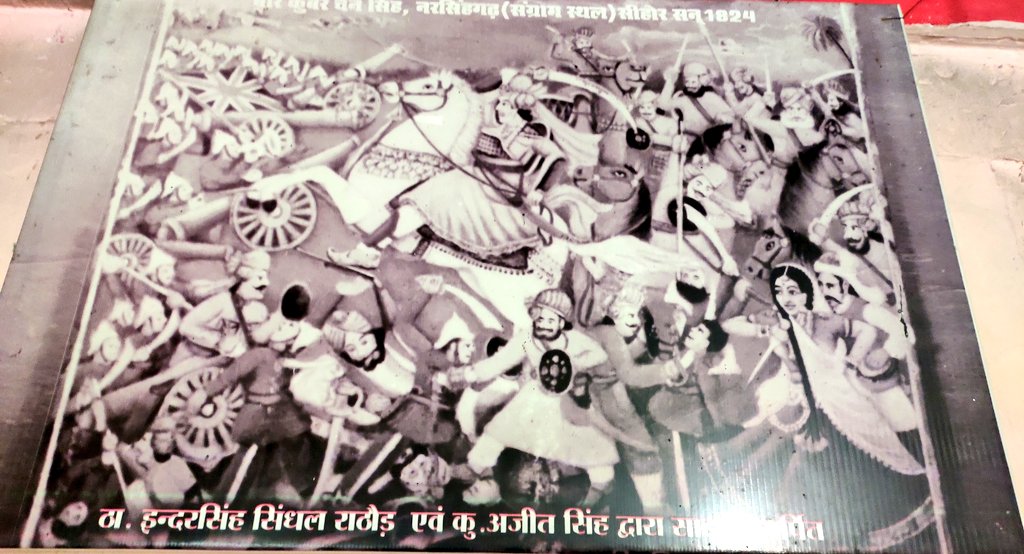
उन्होंने आव देखा न ताव, जनरल पर हमला कर दिया। फिर क्या था, खुली लड़ाई होने लगी। पॉलिटिकल एजेंट मैडॉक और अंग्रेज सैनिकों से उनकी जमकर मुठभेड़ हुई। कुंवर चैन सिंह और उनके मुट्ठी भर विश्वस्त साथियों ने शस्त्रों से सुसज्जित अंग्रेजों की फौज से डटकर मुकाबला किया। घंटों चली लड़ाई में अंग्रेजों के तोपखाने ओर बंदूकों के सामने कुंवर चैन सिंह और उनके जांबाज लड़ाके डटे रहे।


नरसिंहगढ़ रियासत के वीर सपूत कुँवर चैनसिंह जी ने मात्र २३ वर्ष की उम्र में सन १८५७ की क्रांति से ३३ वर्ष पहले ही भारत की स्वाधीनता के लिये शंखनाद कर दिया था !

इतिहासकारों के अनुसार २४ जुलाई सन १८२४ में नरसिंहगढ़ रियासत के युवराज और परमार राजपूत वंश के कुँवर चैनसिंह ने नरसिंहगढ़ स्टेट के कुछ चुनिन्दा जागीरदरो व अपने साथी हिम्मत खां एवं बहादुर खां एवं ४३ सैनिको के साथ फिरंगियो के विरुद्ध बगावत का बिगुल बजाकर सीहोर के लोटियाबाग जहां की अंग्रेजो की छावनी थी एक निर्णायक युद्ध लड़ा और वीरता से लड़ते लड़ते वीरगति को प्राप्त हों गये। नरसिंहगढ़ स्टेट के राजपूत सरदार व ठिकानेदार जो उनके साथ पधारे थे वे भी वीरता से लड़ते-लड़ते उनके साथ शहीद हो गये।


युद्ध के दोरान कुँवर चैनसिंह ने अंग्रेजो की अष्टधातु से बनी तोप पर अपनी तलवार से प्रहार किया जिससे तलवार तोप को काटकर उसमे फंस गयी और मोके का फायदा उठाकर तोपची ने उनकी गर्दन पर तलवार का प्रहार कर दिया जिससे उनकी गर्दन रणभूमी में ही गिर गयी और उनका धड उनका घोडा नरसिंहगढ़ लेकर आ गया, कुँवर चैनसिंह सिंह जी पत्नी कुवरानी स्वरुप कँवर जी राजावत तक जब यह समाचार पंहुचा तो उन्होंने उसी दिन से अन्न को त्याग दिया एवं उस दिन के बाद से केवल पेड़-पोधो के पत्तो पर जीवन व्यतीत किया। 


कुंवरानी राजावत जी ने कुँवर चैनसिंह सिंह जी की याद में परशुराम सागर के पास एक मंदिर भी बनवाया जिसे कुंवरानी जी के मंदिर के नाम से जानते है। इस मंदिर की खासियत यह है की इन प्रतिमाओ में भगवान का स्वरुप मुछों में है अर्थात कुंवरानी जी भगवान की इन मुछों वाली प्रतिमाओ में कुँवर चैनसिंह सिंह जी का प्रतिबिम्ब देखकर उसी रूप में उनकी आराधना करती थी। 


चैनसिंह के इस बलिदान की चर्चा घर-घर में फैल गयी।


उन्हें अवतारी पुरुष मान कर आज भी ग्राम देवता के रूप में पूजा जाता है। घातक बीमारियों में लोग नरसिंहगढ़ के हारबाग में बनी इनकी समाधि पर आकर एक कंकड़ रखकर मनौती मानते हैं।भारत सरकार ने भी माना शहीद।


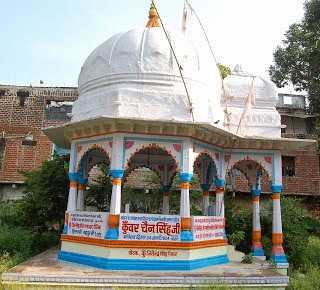
भारत सरकार ने नरसिंहगढ़ एवं सीहोर दोनों स्थानों पर कुँवर चैन सिंह जी के स्मारक बनवाये है!

Prince Kunwar Chain Singh of Narsinghgarh (MP) who died fighting British in Sehore. Narsinghgarh was a riyasat of Umat Parmars. 


The Royal family of Narsinghgarh is well connected directly and indirectly in relationship with all the important Rajput Royal families of India. The State of Narsinghgarh was carved out of the State of Rajgarh by Paras Ramji, the younger brother of the then Ruler of Rajgarh, Rawat Mohan Singhji in 1681 A. D


Rawat Paras Ramji (1681-95)

Rawat Dalel Singhji (1695)

Rawat Moti Singhji (1695-1751)

Rawat Khuman Singhji (1751-66)

Rawat Achal Singhji (1766-95)

Rawat Sobhagh Singhji (1795-1827)

Raja Hanwant Singhji (1827-73)

Raja Pratap Singhji (1873-90)

Raja Mehtab Singhji (1890-95)

Raja Arjun Singhji (1895-1924)

Maharaja Vikram Singhji (1924-57)

Maharaja Bhanu Prakash Singhji (1957)


A majestic fort privately held is in the Rajgarh district of the State of Madhya Pradesh. It is two kilometers from main Bhopal - Guna highway, and approximately 83 kilometers from Bhopal.The two kilometer road which is inside from main highway is on uphill and is made of mud and sand. Approach road to fort is steep, difficult to drive and non motorable.


The fort is said to be built nearly 300 years ago and is constructed in Mughal & Malwa style of architecture. 


It is said to be third in size after Gwalior and Mandu fort in Madhya Pradesh. 


It has approximate 350 rooms, 4 halls and 64 varandahs. 


It is situated in a hill overlooking lake and a temple. 


A Young Prince who Fight against EAST INDIA COMPANY in 1824 kunwar Chain singh ji was lived . He is considered as “Amar Shaheed of Malwa,” as told by ancestors and old peoples the raja of Narsinghgarh fought with his enemies without his head. where his cut head looks and the body follows that and kills the enemy. it is also told about him that he has such power that he had cut a top which is kept in sehore Samadhi.

At the time of British arrival in Malwa, Narsinghgarh was ruled by Rawat Sobhagh Singh, his health was fast deteriorating. British in 1818 signed a treaty with Sobhagh Singh. His son Chain Singh was not happy with this over reaching of British in their state, as his father was ill, he took administration in his own hand. His anti-british stance made him enemy of the British.

(Flag of Narsinghgarh)

Kuwar Chain Singh ji married with Kuwrani RAJAWAT ji from Thikana-Muvaliya a Royal Thikana (Jageer) of Narsinghgarh State. Kuwar Chain singh ji’s Due to illness of his Father Rawat Sobhag Singhji,Prince Chain Singhji was in charge of the administration of the State.Prince Chain Singh ji was courageous, brave and intelligent.He was a highly self-respecting person.He ruled the State with a firm hand giving justice to one and all evenly.The People of Narsinghgarh State admired him and held him in high respect.Historical evidence says Prince Chain Singhji was reluctant to acknowledge the supremacy of the East India Company. This irritated the Company and they were waiting to get to his jugular vein. In a planned murder one palace official named Vora who was returning from the palace was assassinated.


The Company held Prince Chain Singhji responsible behind the murder and asked him to leave the State and proceed to Banaras. The Prince refused to accept the murder charge and defied the Company. This was considered as rebellion by the East India Company. As a result a battle took place between Prince Chain singhji's forces and military of East India Company in 1824 at Sehore a town about 37 kilometer West of Bhopal. They tried to remove him from power which culminated in a battle near Sehore Cantonement in 1824. Kunwar Chain Singh attacked the cantt with his select few Jagirdars and men. Heavily outnumbered he laid his life fighting against ever rising British empire at a young age of 24.


Kunwar Chain Singh ji SAMADHI

His Samadhi is situated near the battlefield.He is considered as “Amar Shaheed of Malwa” and as such recognized officially by the government of Madhya Pradesh. All communities go to his Samadhi and offer prayers and seek his blessings. Himmat Khan and Bahadur Khan, Jagirdars of Dhanora of Narsinghgarh State were killed along with him. Their tombs are built near the Samadhi of Prince Chain Singh ji at Sehor.


Every Year Government of Madhya Pradesh healed a Program on 24-july called Shaheed Kunwar Chain Singh ji jayanti Samaroh, where a Procession Starts from his SAMADHI at Char-Bag Narsinghgarh.


Kunwar Chain Singh Sagar DAM


A Beautiful DAM also named to Kunwar Chain Singh SAGAR DAM by Government of M.P.The DAM is 30km from City and Reached By a Road.


Kuwrani ji-Kunwar chain Singh ji's wife


Kunwar Chain Singh ji married with Kuwrani Rajawat ji from Thikana Mualiya jageer a Royal Thikana of Narsinghgarh State just 3km away from city and forefather belongs from royal family Thikana Jhilay Jaipur. After Veergati of Shaheed Kunwar Cahin singh ji his wife Kuwrani Rajawati ji took a Life time FAST without Food only takes fruits and Make a Temple at Parsuram Sagar called “KAWRANI JI MANDIR“ for Pray to GOD.


This temple near Narsingh-Dwar or closed to chamapawat ji Temple.


Rani Lakshmi Bai of Jhansi had heard about Prince Chain Singhji's rebellious attitude towards the East India Company and the battle he fought with the Company at Sehore in 1824. She decided to approach the Narsinghgarh State for help in the first war of Independence of 1857 against the Company to which the then Ruler of Narsinghgarh agreed. But unfortunately before Narsinghgarh could render any sort of help, the Rani was surrounded by the Company forces at Gwalior and she became a martyr. After the martyrdom of Rani Lakshmi Bai,Tatya Tope her close confidant and main supporter in the first struggle for Indian Independence of 1857 came to Narsinghgarh and was clandestinely kept by the Ruler in the thick forest of Kantora just behind the Fort Palace for quite a long time till he moved to another location to carry out his struggle. Such a inspiration he was that still every year a "Guard of Honour" is given by Madhya Pradesh government at his Cenotaph. 


Wednesday, November 3, 2021

IN THIS NEW DIMENSION - WHO ARE WE AND WHERE DO WE BEGIN? PART-3

ॐ Siyavar Raja Ramchandra Ji Ki Jay ॐ


Shubh Deepavali, May this Parv/utsav bring you good health, unfettered peace, and profound happiness. May the power of good always prevail!


To begin with since we are going to write in a language which is alien to our Dharma we need to explain some important words we would come across.  The very first one is the word ‘religion’ and Our Dharma is not a religion.

There is no exact translation to the word religion in any of our native languages beginning from Sanskrit and Tamil.  The word ‘matham’ is a loose translation for what we know by matham is not exactly what is known to the westerners as religion.  So what is this religion?

In religion there is a god and his abode is heaven; there is a hell where the rebel angel called devil resides.

God is postulated as the creator. He is the repository of all that is good. Devil is the repository of all that is bad. All human beings are created by god which means they did not exist before they were born.  Also all human beings are born sinners. And sinners are destined to go to hell which is the most evil ridden place. As everyone by the very scheme of being sinner at birth is destined to go to hell, a panacea had to be invented to save the religion from being draconian.  Thus the birth of jesus was to save the sinners. The awful death of the savior at the cross needed a redemption to make him the conqueror and not a victim and therefore a second coming was postulated.  Mohammed seized this as his opportunity and declared himself as the messiah and the last prophet. 

The second coming is fulfilled!

Both Christianity and Islam are same religion except for the last prophet claim by Mohammed. In essence a religion haunts a person with his impending sojourn to hell. Believing in a savior and living by its tenets is the surest method of avoiding hell.

This in a nutshell is what is known as ‘religion’!

We on the other hand hold that everything is subject to cause and effect.  This is the kaarmic theory.  So much so we can not be created arbitrarily. We are the product of what we have done before. This essentially means that we had a prior birth ad infinitum. This also points out to the fact that we are beginningless and endless and all we do is to appear and disappear in endless forms in which we enjoy and suffer the fruits of our karmas. Since we are karma bound and each fruit of karma that we earn will diminish and finally cease over time any attempt to confine us in an everlasting hell is simply out of question. 

In other words there is no such thing as hell as is peddled by the western religionists.  If there is no hell why need a savior?


Birth of the State


Even though who we are is not in conformity with the definition of a religion we are branded as the followers of a religion which got a naamadheyam called Hindu by the westerners beginning with Greeks and then Arabs and later by those who follow religion ie. the Biblical religion.  If you are the only one then do you need a name? Yes, Bharathavarsha for thousands and thousands of years had only the Dharma as it guiding light. Jains and Buddhists also swore by the Dharma.  So they were non-different.  Following them did not amount to betrayal of belief for there is no such thing as belief in our concept.  Being who we are need no belief!

So the name given to us called Hindu was in reference to those who lived beyond the Sindhu river.  There is no such thing as Hindu in the Sanskrit or any other indigenous language.  So at first Hindu represented those who live around the river Sindhu and the east beyond. The word Hind is perhaps Persian which is now the land called Iran.  The Islamist invaders called us Hind merely to name us as inhabitants but in contrast to their ‘religion’ we are kafirs the infidels, non-believers.

 It is the later arrivals viz. the European colonialists who stuck us with the name ‘Hindu’.

We are Hindus even though that is not our name and we belong to Hindu religion even though ours is not a religion at all And we have accepted this branding and foisted religion.  Very very sad indeed.

In the concept of the believers of biblical religions, the non-believers are the atheists and infidels or kafirs. But Christo-secularists (about whom more later) contended (a) that we have gods and therefore belong to a religion and (b) our Dharma is all inclusive and so they could find similarity to their religion so it became convenient to declare that we are a religion. Making our Dharma into a religion serves a definite purpose for the secularists so they can rein us in the name of being a threat to minorities. On the question of our gods about whom these biblical religionists berate as being polytheist because they refuse to accept that god can be all yet in many forms.  On that account they contend that we are infidels and we have to be converted. In the 250 years since the battle of Plaissey the colonial rogues have destroyed our identity and named us as something we are not and subjected us to a tortuous secular ethics.  Therefore our first priority is to resurrect our lost identity. Let us begin in that mission starting from the very beginning.


The birth of the State


In the non-state (मत्स्य न्याय ) men enjoy (भोग) but do not own.  It is like primitive communist society where everything is accessed by everyone that includes conjugal relationship. The concept of property is unknown in this non-state.

The addition of ममकार (mineness or ownership) makes this into a state.  The ममकारम्  or property is secured by दण्ड or weapon that causes भय or fear.  Fear forbids enchroachment. So the बन्धम् or attachment to the property is called लौकिक.  This is the basis of civil society.

The weilder of दण्ड enforces ownership by means of pronouncements or dictum. In those early days Manu said, “the land belongs to the one who cleared the forest and the deer to him who first wounded it.”  This is the beginning of the law.  And दण्ड creates sacredness in the property. 

The दण्ड takes the fear out of men that their property will not be divested by vile men.  The दण्ड creates security.   This is the principle of civil society.

In मत्स्य न्याय dharma is non-existent for dharma is identical to the law.  मत्स्य न्याय is anarchy. 
Dharma comes into existence with the birth of the state i.e. दण्ड. 
 In the Hindu concept Dharma is held higher to the दण्ड.  
क्षत्रस्य क्षत्रं धर्मं is the vedic dictum. 

Dharma holds the weilder of weapons accountable.

विराट पुरुष

In the Hindu tradition the evolution of the state starts from the God/man called विराट पुरुष.  Let me give it to you of this in our own unique tradition of story telling: 

“नैवेह किञ्चनाग्र आसीन्मृत्युनैवेदमावृतमासीदशनाययाशनाया हि मृत्यु:”  
(Brihadhaaranyaka Upanishad)

In the beginning there was nothing whatsoever. This universe was enveloped by death called Hiranyagarbha because of hunger. And hunger is death.

Why so?

The beginning we are talking about is the beginning of time called ‘कल्प’. This beginning also happens to be the end of the previous kalpa. Time indeed is a phenomenon that has a beginning, life and end. Like all phenomenon, it is cyclical. Well then, What is a kalpa? A kalpa consists of 4 yugas called Sathya yuga, Thretha yuga, Dwapara yuga and Kali yuga and like the day succeeds another day, a kalpa succeeds another kalpa. The principle of entropy works through the four successive yugas during which Dharma loses its glory steadily and at the end of Kali yuga complete adharma prevails.


Why and how did the previous kalpa end?


In all periods of time, what sustains the creation is the Dharma. Prakrthi is made up of opposites and so there is also adharma that opposes Dharma. Whenever adharma takes an upper hand, Vishnu as the preserver incarnates to restore Dharma to its glory. As it happened at the end of last Kali yuga all orders broke and complete anarchy prevailed. Vishnu the preserver felt that the restoration ofDharma is impossible in such condition and so he decided to end the adharma by totally destroying the creation!

He knew that food sustains the creation and so he decided to sap the food by means of Vedic Karma. He sapped the food of all living organisms and they died and merged into Prithvi from where they had arisen. He then sapped the food of Prithvi and Prithvi died and merged into water from where it arose. He then sapped the food of water and so it merged into fire. He sapped the food of fire and it merged into air. He sapped the food of air and so it merged into space. He finally sapped the primordial sound that is the food of the space and the space collapsed and merged into him. What remained then was this great destroyer, this Mrithyu, this death completely devoid of food and in great hunger. So we say hunger is death. We do not know how long this death remained as death because there was no time to measure. As we said before there was nothing at all except death.

 “सवै नैव रेमे, तस्मादेकाकी न रमते, स द्वितीय मैच्छत्.”

In fact He did not at all feel happy. Therefore one (still) does not feel happy being alone. He desired a mate. Do you not say “I have every mind to do this” or “I have no mind to do this”? Thus we know that without mind nothing can be done. “May I be possessed of a mind” desired He, this Mrithyu, whom we now can call as Hiranyagarbha (literally a golden potent of all creations) and he produced the mind. This mind became his consort that is why at the time of marriage the bridegroom takes an auspicious thread and says: 

“माङ्गल्यं तन्तुनानेन मम जीवन हेतुना । कण्ठे बध्नामि शुभगे त्वं जीव शरदश्शतम् ॥.”,

“by this you become the cause and reason of my life”, 
(The exact meaning of this verse is: "I tie this Mangal Sutra for my long life, O auspicious one, may you live a hundred years (with me).") and ties it round the neck of the bride as the neck is the residence of the mind. From then on the void is filled by the wife even to this day.

With a wife with him, Hiranyagarbha is now qualified to perform a yagna (sacrifice), because only a Grihastha – a man with a wife – is qualified to perform Vedic Karma. For, again, without a yagna nothing could come about. The yagna he performed is called Brahmahooth. Since there was nothing besides him, he himself became the pasu or sacrifice. From this yagna came Virat or Brahma the creator.  Brahma then embarks on the creation called Pravrthi.

He churned his mouth and rubbed his hands and produced fire. Whatever is liquid in the world He created from his seed. Soma the Moon (who has a liquid body) is indeed the food. And fire is the eater. This universe is this much only. The food and the eater. This mortal created Agni and Soma the Gods who are immortal. Therefore this is a surpassing creation!

He created from his mind seven Prajapathis called Saptha Rishis known as Marichi etc. and asked them to create. They first created women whom they gave away in marriage to each other. Then they produced two sets of beings called Devas andAsuras. Devas were few in number and were good guys and the Asuras were many but were bad guys. They fought each other bitterly for world domination. Not satisfied with this state of affairs, Brahma called the Prajapathis and told them, “Look, if your creation is so self destructive, then there is no hope for creation. So I want you to go back and do it again.”


So the Prajapathis went back and this time produced Yakshas and Rakshasas. TheYakshas are merry go lucky guys like the hippies who sang and danced and roamed the universe. Brahma looked at them and shook his head. He was unimpressed of their creative abilities in furthering the creation. Then he turned his attention to the Rakshasas who were cruel to others and were even cannibals. Brahma‘s hair shot up in shock and utter disgust. When the hair curled Snakes and vermins were produced. He was not at all satisfied with the creative process that had taken place so far. So he said to himself, “These Prajapathis are useless, let me create more Prajapathis out of my mind” and he created 4 charming young men known as Sanath Kumaras. Brahma asked these new Prajapathis to create. Being smart as they are, these young boys asked Brahma, “Father, what are you going to do?” Brahma replied, “I am going to reflect on the Self.”

The curiosity of the boys increased and they asked of their father if reflecting on the Self is superior to creation. Brahma replied that it is the parama purushartham or the ultimate objective of any being. That answer proved disastrous for Brahma for the children told the father they would rather know about the self which is superior rather than embark on creation. That is why the maxim in all times is that a Brahmana who sets out to know his real Self cannot be faulted for not performing karma. 

The Sanath Kumaras then went to Dhakshinamoorthi and surrendered to him andDhakshinamoorthi taught them the knowledge of the Self in silence (मौन-व्याख्यान-प्रकटितम्) by means of Chin Mudra indicating that the jeevathma and paramaathma are one and the same. Thus Dhakshinamoorthi became the first guru. 

“दक्षिणामूर्ति समारम्भाम् शंकराचार्यमध्यमाम् |अस्मदाचार्यपर्यन्ताम् वन्दे गुरू परंमपराम् ||”

Now back to Brahma, who found himself at square one, sighed to himself “There is no point in delegating any work to any Prajapati. They are all useless, I will take over the job of creation myself”, he declared.

He instantly split himself like a pea into two, as male and female. The female was shy and wanted to hide herself from the male and she became a cow. The male became a bull and united with her and from them the cows were born. Then she turned into a she-goat and he changed to a he-goat and propagated. Then they took the forms of mare and stallion and propagated. In this manner they continued to reproduce. She became a Naari and he became a Nara and propagated the men and women. This way he set out the great pravaham of pravrthi.

(This whole creation is nothing but the mind!  He creates the mind, enters it and roams in it!  As He expands the universe, He finds ‘रुचि‘ or taste in it and gets attached to it! –  मानस सञ्चर रे! अभिमानश सञ्चर रे!)

From the unmanifest world He manifested the world of names and forms. So even now this manifest world is of names and forms only. This Supreme Self penetrated into all these bodies just as a razor lies in its case. People do not realize It when they view it from its particular function such as when it is breathing, it is called Prana. Because such a view is incomplete. He is the eye of the eye, ear of the ear, and mind of the thoughts. Eye, ear and so on are only names due to functions. . . If we know each aspect then our knowledge is incomplete. So the totality called the Self alone should be meditated upon for knowing of which everything else is known.

तदेतत्प्रेयः पुत्रात्प्रेयो वित्तात्प्रेयोऽन्यस्मात्सर्वस्मादन्तरतरं यदयमात्मा । (बृहदारण्यकोपनिषद्भाष्यम् 1.4.8)

This Self is dearer than a son, dearer than wealth, dearer than all other objects because it is the dearest than all.

Why dearer?

Because all others will perish but not the Self. 


This self (before the realization of its eternal identity) was actually Brahman  and it knew only itself as “I am Brahman” and so he became the Universe.


Whosoever among the Gods, sages and men realize this then they too become Brahman.


Thursday, October 14, 2021

VIJAYADASHAMI - A FESTIVE DAY, VIEWED AS BEING SYMBOLIC OF THE VICTORY OF GOOD OVER EVIL


Vijayadashami festival is most commonly associated with the victory of Prabhu Shri Ramachandra over Lankapati Ravana. But it is also a day on which we would do well to recount Prabhu Shri Rama's grace at the moment of his greatest triumph. We live in times of extreme polarization and self-righteousness.


Every party is convinced that "Right" is on their side, and that the other side deserves hell. Grace and kindness at the moment of victory is hard to come by. So it is worthwhile to hark back to Yuddha Kanda of Rāmayaṇa and observe that incomparable hero of this great land in action.


How did Prabhu Shri RamChandra ji handle his victory?

स तु निहररिपुह् स्थिरप्रतिज्ञः |
स्वजनबलाभिवृतो रणे रराज |
रघुकुलनृपनन्दनो महुजा |
स्त्रिदशगणैरभिसंवृतो यथेन्द्रः || ६-१०८-३४

"That Rama, the delight of Dasaratha, for his part, who had just killed his enemy and thus who was steadfast in his vows and who was endowed with a great splendour, who stood surrounded on the battle-field by his own people and the army shone like Indra the lord of celestials"


It was a moment of great elation. Sure, it was a personal victory for Rāma, but it was also a great victory for the Vānara sena, and a moment of utter delight for the Devas.

राघवस्तवसंयुक्ता गगने च विशुश्रुवे |
साधु साध्विति वागग्य्रा देवतानां महात्मनाम् ||

"Excellent pronouncements of the great-souled gods saying "well done! Bravo!", combined with a panegyric in praise of Rāma, was distinctly heard in the sky".

But even this celestial adulation did not distract Rāma from his obligations -


ततः सकामं सुग्रीवमङ्गदं च विभीषणम् |
चकार राघवः प्रीतो हत्वा राक्षसपुंगवम् ||

"Having been pleased with the killing of Rāvaṇa, Rāma then fulfilled the desire of Sugreeva, Angada and Vibhishana".


वदन्तं हेतुमद्वाक्यं परिदृष्टर्थनिश्चयम् |
रामः शोकसमाविष्टमित्युवाच विभीषणम् ||

"Soon after Ravana fell, Vibhishana was struck with grief at the death of his elder brother. But Rāma did not use this opportunity to gloat at his triumph, but instead consoled Vibhishana by reminding him of his brother's valour".


नायं विनष्टो निश्चेष्टः समरे चण्डविक्रमः |
अत्युन्नतमहोत्साहः पतितोऽयमशङ्कितः||

"Ravana did not die, without making an effort. He was endowed with terrible prowess and exhibited enthusiasm of a very exalted type and remained confident throughout."


नैवं विनष्टाः शोच्यन्ते क्षत्रधर्मव्यवस्थिताः |
वृद्धिमाशंसमाना ये निपतन्ति रणाजिरे ||

"There is no occasion to grieve for him having fallen into death in the battle-field and by whom the development of his country was wished for, while remaining steadfast in his Kshatriya duty"


येन सेन्द्रास्त्रयो लोकास्त्रासिता युधि धीमता |
तस्मिन् कालसमायुक्ते न कालः परिशोचितुम् ||

"There is no occasion to grieve for his having been brought under the sway of death by whom intelligent as he was, all the three worlds including indra were frightened."


नैकान्तविजयो युद्धे भूतपूर्वः कदाचन |
परैर्वा हन्यते वीरः परान्वा हन्ति संयुगे ||

"In the past, none has ever been exclusively victorious in a combat. A hero either has been killed by his adversaries or had killed the enemies in battle."


इयं हि पूर्वैः संदिष्टा गतिः क्षत्रियसंमता
क्षत्रियो निहतः संख्ये न शोच्य इति निश्चयः

"Such is the destiny proclaimed by the ancients, as highly esteemed for a kshatriya warrior. A Kshatriya killed in battle, does not deserve to be mourned. Such is the ascertainment of sacred scriptures"


After consoling Vibhishana, Rama goes ahead and directs him to perform the funeral writes with these gracious words -

"मरणान्तानि वैराणि निर्वृत्तं नः प्रयोजनम् |
क्रियतामस्य संस्कारो ममाप्येष यथा तव ||

"Hostilities end with death. Our purpose has been accomplished. Let his funeral rites be performed. He is even as good mine, as yours."


"त्वत्सकाशान्महाबाहो सन्स्कारन् विधिपूर्वकम् ||
पाप्तु मर्हति धर्मेण त्वं यशोभाग्भविष्यसि |"

Rama to Vibhishana -
"According to rule, Ravana is eligible to get the last rites on his dead body from you, by usage. You will also become fit for glory."

After the funeral rites, Rama did not use his victory as an excuse to instal Lakshmana for instance on the throne, or attempt a policy of imperialistic expansion. He acknowledged that by virtue of being one of their own, Vibhishana is best placed to rule over the Rakshasas, In fact Rama is very prompt in instructing Lakshmana to enthrone Vibhishana soon after the conclusion of Ravana's last rites -


"विभीषणमिमं सौम्य लङ्कायामभिषेचय ||
अनुरक्तं च भक्तं च तथा पूर्वोपकारिणम् |

"O the benevolent Lakshmana! Consecrate on the throne of Lanka, this Vibhishana to whom everyone is attached, a loyal person as he is and the one who has formerly done a service to us."

Then it occurs to Rama that Seetha needs to be informed of his great victory. But here's the thing. He doesn't rush. But asks Hanuman to take Vibhishana's permission before he can go to Sita to inform her, Yes...Get the new king's permission! The same king who he enthroned.


अनुज्ज़्नाप्य महाराजमिमं सौम्य विभीषणम् ||
प्रविश्य नगरीं लङ्कां कौशलं ब्रूहिमैथिलीम् |

Rama to Hanuman -

"O benevolent one! Taking permission from this Vibhishana, the great king and entering into the City of Lanka, inform about our welfare to Seetha."

It's also important to note how Rama phrases his message to Seetha - he chooses to downplay his victory, but emphasize the fact that he is alive and well.


"वैदेह्यै मां कुशलिनं सुग्रीवं च सलक्ष्मणम् ||
अचक्ष्व वदतां श्रेष्ठ रावणं च हतं रणे |

"O Hanuma, the proficient one in speech! Inform Seetha that myself together with Lakshmana and Sugreeva are well and that Ravana had been killed in battle."

Notice how he is downplaying Ravana's death. And focusing on the good condition of himself, Lakshmana and Sugreeva. Now that we have discussed Rama's remarkable grace let's note how Sita responds when Hanuman approaches her with the good tidings..

Hanuman first informs her of the great events in the battlefield and Vibhishana's coronation
After that Hanuman tells her -

"Can I not kill all these female demons in this garden who have tormented you for so long"?

But Sita will brook none of it.


राजसंश्रयवश्यानां कुर्वतीनां पराज्ञया |
विधेयानां च दासीनां कः कुप्येद्वानरोत्तम

Mata Sita to Hanumanji -

"O the foremost of Vanaras! Who will be angry with servant-maids, who are dependent on their king's command and work in obedience to the orders of others?"


"भाग्यवैषम्य योगेन पुरा दुश्चरितेन च |
मयैतेत्प्राप्यते सर्वं स्वकृतं ह्युपभुज्यते"

"All this is reaped by me, as a consequence of my bad fortune or an account of a misdeed committed by me in the past. The fruit of one's own making is indeed experienced (in one's life)."

मैवं वद महाबाहो दैवी ह्येषा परा गतिः |
प्राप्तव्यं तु दशा योगान्मयैतदिति निश्चितम् ||
दासीनां रावणस्याहं मर्षयामीह दुर्बला |

"O the great-armed Hanuma! Do not speak like this. This is indeed a great divine strategy. It was ordained that this type of situation is to be obtained by me, due to the application of fate. Feeble as I am in these matters, I am forgiving the servant-maids of Ravana here."


न परः पापमादत्ते परेषां पापकर्मणाम् ||६-११३-४५
समयो रक्षितव्यस्तु सन्तश्चारित्रभूषणाः |

"A superior person does not take into account the sin of those who have committed an offence. At all costs virtuous persons account good conduct as an ornament."


पापानां वा शुभानां वा वधार्हाणां प्लवङ्गम ||
कार्यं कारुण्यमार्येण न कश्चिन्नापराध्यति |

"Kindness is to be shown by a noble person either towards a sinner or to a virtuous person or even to a person who deserves death, for, there is none who never commits a wrong".


These remarkable responses from Prabhu Shri Rama and Mata Sita form an important illustration of Dharma in Ramayana.

Here are two individuals, who exhibit grace, and equanimity at the moment of their greatest victory, when they had every reason to pump their fist and engage in vendatta. 

There is much to learn for our perennially enraged and insecure selves from the concluding portions of Yuddha Kanda as we reflect on the great Vijaya of Rama on this Vijayadashami day.