Saturday, November 23, 2019

SACHKHAND VASI JATHEDAR GIANI GURDIAL SINGH AJNOHA, JATHEDAR SHRI AKAL TAKHT SAHIB - IMMORTAL RAJPUTS


Singh Sahib Jathedar Gurdial Singh Ajnoha 
(1927-1982)


Singh Sahib Ji Was the Jathedar of Akal Takhat from 1980-1983, Was born born on December 27th, 1927, in village Ajnoha, tehsil Garhshankar (Hoshiarpur District of Punjab), to Sardar Hakam Singh Ji, and Mata Niranjan Kaur Ji, a Rajput Sikh family of Parmar Clan. He belongs to a family called “Bhagtan Di Family” as his ancestors were true worshippers of Almighty Waheguru (from the Start they had Sikhi).

He got his elementary education from the village primary school and complete his high school education from Khalsa High School, Baddon. He remained sarpanch of his village, member of the Panchayat Sammati, memebr of Zila Parishad and Jathedar of Akali Dal for district Hoshiarpur of Punjab. 

He went to jail for 14 times and took part in Gian Singh Rarrewala’s “Panth Bachao, Desh Bachao Morcha” and “Punjabi Suba Movement”. 

(Rare Pic of Gaini Gurdial Singh Ji Ajnoha
from left to right: 
1. Baba Nihal Singh Taruna Dal Jathedar,
2. Sant Jarnail Singh Bhindranwale Damdami Taksal Jathedar,
3. Gurcharan Singh Tohra SGPC President,
4. Gurdial Singh Ajnoha Akal Takhat Jathedar,
5. Yogi Harbhajan Singh,
6. Bhai Amrik Singh All India Sikh Students Federation President)


In 1972, he was appointed the Jathedar of Takhat Shri Keshgarh Sahib, Anandpur Sahib and remained on this position for 8 years. He performed his duties honesty and with full dedication. On March 2, 1980, he became the Jathedar of Akal Takhat Sahib, Amritsar. 


After Jathedar Akali Baba Phoola Singh (1761-1823), he was the only fearless Jathedar who took the following four bold decisions:

1. Sikhs are a separate Nation.

2. Akal Takhat is beyond and above all worldly courts.

3. Nirankaris (Narakdharis) are rejected and Sikhs must not seek any relationship with them.

4. Any Hukamnama issued from Akal Takhat Sahib can’t be reverted.

Psuedo-Nirankari Chief Hardev Sinh’s letter to Jathedar Gurdial Singh Ajnoha of Sri Akal Takht Sahib.

In December of 1981, the head of the psuedo-Nirankari cult Hardev Sinh sent a letter to the Jathedar of Sri Akal Takht Sahib Gurdial Singh Ajnoha in hopes of reconciling the 'rift' between his cult and the Sikh Panth.

Sri Akal Takht Sahib rejected the Nirankari chief’s plea and offer for reconciliation. The horrible events of Vaisakhi 1978, when thirteen Gursikhs were brutally massacred in the city of Amritsar Sahib, could not be easily forgotten, the Jathedar Gurdial Singh Ajnoha stood his ground.

Twenty five years later, the pseudo-Nirankaris are no longer interested in a settlement with the Sikhs, yet the Badal installed priest Joginder Singh Vedanti has openly offered clemency to them and other groups that have caused so much harm to the Sikh panth. Not surprisingly, this move by Vendanti has been strongly criticized and rejected by all Panthic organizations.

The rejection for reconciliation in 1981 and the open clemency offered in 2006 highlights the continuing degradation and elimination of dignity, principles, and honor that has occurred in the Sikh leadership in the short time span of 25 years.

(English translation)

Singh Sahib Giani Gurdial singh was the Jathedar of Akal Takhat, during a period from 1978-1984 when the Khalsa Panth, for their voice to be heard was struggling against the Government of India and when Shaheed Jarnail Singh Bhindranwala (1947-1984), was leading the Khalsa Panth, for struggle for freedom.


(Sant Jarnail Singh ji Khalsa Bhindranwale pays tribute to Jathedar Giani Gurdial Singh Ajnoha during Dharam yudh morcha.)

Singh Sahib Jathedar Giani Gurdial Singh Ajnoha left his worldly abode on 18 March, 1982. Singh Sahib Giani Kirpal Singh (1918-1993) became the next Jathedar of Akal Takhat after his death. His ancestral village is running a charitable hospital in his memory.

Tuesday, November 19, 2019

THE ONLY WEAPON WE HAVE IS TRUTH ( SHRI RAM JI) )


जन्मभूमि उद्धार होय ता दिन बड़ी भाग।

छाता पग पनही नहीं  और न बांधहिं पाग।।


°Let it go,°

 When they says. 

°Let it go.°

But our heart was stubborn, so we do not let it go.

What if it hurts?- We say.

They know it will hurt,-They says.

"What if we fall?" We say louder.

"He know we will fall," he says.

"But what if we can't get up?

What if we can't go on?


What if our heart breaks into a 40 thousand pieces?"

°It's all right; just let it go.°

"No. We can't. We want to, but we can't."

° Let it go.°

"How? Our soul will break. It is shattered already."

So it will break. Let it go.

°We can't. It hurts.°

Sukh Dham ji- Don't you know, Bhakta?

If you fall, I will pick you up.

If you can't go on, I will carry you.


Don't you know, my bhakta? Don't you know?

It is when it breaks that I can make you whole again.

It is when it breaks that I can pick out these broken pieces that are hurting you all.

It is when it breaks that you can truly learn to love.

You can rise again.

You will rise again.

Lets go.....


दिव्य भौमायोध्याधिदैवत ! जय जय

திவ்ய பௌமாயோத்யாதி தைவத! ஜய ஜய

Divya bhouma Ayodhya adhi daivatha! jaya, jaya 

You were the presiding deity of the two Ayodhyas (one in heaven and another in earth)! victory, victory


If it was an undeniable fact that temple destruction was part and parcel of some fringe Islamic invaders, equally undeniable were the never-ending attempts by Hindus to reclaim and reconstruct their temples.

Yes they hail from saket Ayodhya,
What thakurs did,other community followed to an extent out of respect ..
Customs ..have a history and story

Kshatriyas of 105 villages have not worn a pagdi nor leather shoes for 500 yrs now  because they couldn't regain Janmasthan of Ram!! And Struggle continues for 500 years in ayodhaa


Now their struggle comes to an end!

World may have read plenty of instances of such struggle (especially of jews ) but not this one.

‘’People think of Ayodhya only as a holy place. But it has always been a city of warriors. Look around u & see what d localities are called—Laxman Qilla, Hanuman Garhi, Chhoti Chawni.This is where Kshatriya dharma resides." Perhaps this is why reclaiming Ayodhya will awaken India


Rest for ongoing debates one thing,

Did Babur create a TRUST to build mosque at Ayodhya ?
If YES...

Did he add Hindus in that trust ?
 Just Asking

We have serious concerns on this


- hope they spoil the temples By appointing Urban Naxals, Christians and Muzlims for managing the affairs of these Temples..

- hope they don't give business to Muslims and CHRISTIANs...

- hope they won't appoint&hire Muslims&cHRISTIANs on the management of these temples..

- hope they don't use funds from these Temple's for Christoislamist..


It is not done if they not treated hindus faith as genuine hindu Temple pilgrimages, rather than centres of attraction for every faithless Tom, sick and harry to come as tourists.

We'll have to wait and see for what actually is the plan...Ayodhya is the birth place of bhagavan Shri Rama, the dharmic Kshatriya of the Ikshvaku Kula. The protector of people, destroyer of Adharma.. it is not a place for funny gandhian ideology that expects people to disgracefully surrender.

The Ram Bhakts have waited patiently for so many decades for justice to be done. We already wonder about how Sita Lakshmana Anjaneya samaeta Raamachandra bhagwan swaroops are going to look like in the Ayodhya Janamsthan ji.


Will love to share and source images of moortis and potential options. How would sthala purana of hometown shape the moortis? We pray that soon we have a भव्य राम मंदिर. बाकी छद्म सेकुलरिज्म से तंग आ चुका हूं। रामजी के जन्मस्थान पर केवल रामजी का ही अधिकार है। यह मेरा तीर्थ है, कोई संग्रहालय नहीं।


श्रीरामचंद्र कृपालु भजु मन हरण भवभय दारुणं,
नवकंज लोचन, कंजमुख कर, कंज पद कंजारुणं.
श्री राम श्री राम
जय जय राम।।

MADHYA PRADESH


The state of Madhya Pradesh, the 2nd largest Indian state by area, will have its assembly elections on Nov 28


This is a fine occasion to reflect on the history of the territory that constitutes Madhya Pradesh today


An under-discussed and an under-appreciated state


There is a tendency to think of Madhya Pradesh as an "artificial entity" - culturally not dissimilar to the rest of North India. A state that is not worth our attention


But to my mind, that angle has been overdone and MP remains woefully under-studied


When we think of Madhya Pradesh there are many things that strike us immediately


a) Its relatively low population density, along with Rajasthan, relative to the rest of North India. Some numbers


Population / sq km (2011)


MP : 236
India : 382
UP : 828
Kerala : 859
Bihar : 1102


b) Madhya Pradesh's geography also marks it out among all Indian states, particularly when compared to the rest of the North Indian plain.


Forests account for roughly 31% of the state's area. This is in sharp contrast for instance to say the corresponding figure of 7% in UP


c) Much of Madhya Pradesh is a plateau as it is home to the Vindhya and Satpura ranges. In contrast to the plains of UP, Bihar, and Punjab


Next let's move to demographics and politics


d) Madhya Pradesh is perhaps the most Hindu of all Indian provinces. With 91% of its population adhering to Hinduism


But it is also worthwhile to note that MP is home to a very large proportion of the "adivasi" population. The Scheduled Tribes account for 21% of MP's 73MM


e) In terms of its politics, MP to this day remains a bipolar polity with power keenly contested by Congress and BJP


This is in sharp contrast to other Northern States like UP / BIhar, where caste based parties play a major major role (Eg: SP, BSP, RJD)


f) MP has seen far less iconoclasm over centuries compared to other states. Many of the ancient pre-Islamic sites in North India (pre 12th cen) are to be found here


Khajuraho
Bateshwar temples
Temples at Amarkantak
Sanchi Stupa
Sonagiri Jain temples


So there is a case for Madhya Pradesh's exceptionalism which is seldom made by anyone.


But what is this territory's place in Indian history? When does the region first make its appearance in the annals of India? Let's explore


Today we tend to think of Madhya Pradesh as the "Center" of India geographically


But in the Vedic as well as early classical period before the common era, the VIndhyas were not viewed as the geographic centroid but the southern boundary of Aryavarta


Illustration: wikipedia
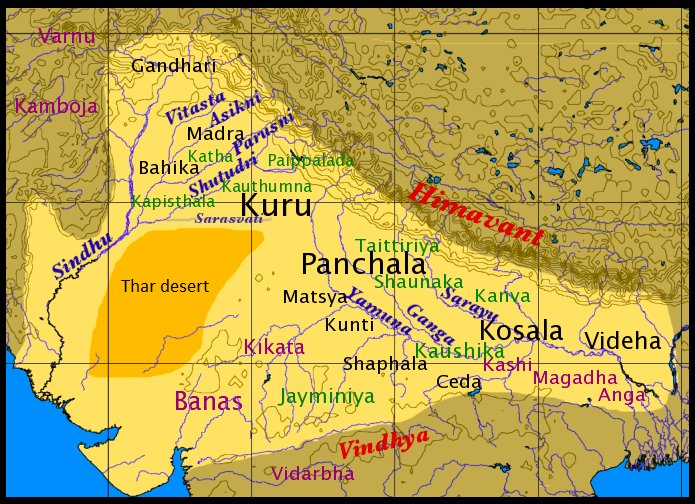


Back in the Vedic and even Epic period the term "Madhya Desha" referred not to the area that constitutes Madhya Pradesh today, but to the Ganga - Yamuna Doab - the great plains of present UP and Bihar


The Vindhya territory marked the southern frontier of the Aryan cultural zone


Nowhere is this more evident than in the Manu-smriti, which clearly is a post-Vedic, post Epic period text (maybe in the centuries just preceding the common era). But even in this text, Aryavarta ends with the Vindhyas


आ समुद्रात् तु वै पूर्वादा समुद्राच्च पश्चिमात् ।
तयोरेवान्तरं गिर्योरार्यावर्तं विदुर्बुधाः


"The country extending as far as the Eastern Ocean and as far as the Western Ocean, and lying between the two mountains (Himalaya and VIndhya),—the learned know as ‘Āryāvarta.’


Having said that Aryanization of the Deccan had started happening even before the time of Manu Smriti. Even a territory to the south of the VIndhyas like "Vidarbha" features in the Mahabharata. Even very early Sangam literature in Tamil country already refers to Brahmins


Ofcourse during the classical period (by the time we reach about 3rd / 4th cen or so), Aryan culture had engulfed the whole of subcontinent and beyond.


Vindhya territory was now no more the southern frontier, but the geographical centroid.


But despite being viewed as the southern frontier, the Vindhya region and the territory just to its south played a major role in North Indian geopolity during the Vedic period


Major late Vedic kingdoms included


Chedi (modern Bundelkhand) (Shishupala of MB fame)
Avanti kingdom (modern Malwa) (with its two great cities of Ujjaini & Mahishmati)


Both kingdoms are mentioned in the 4th c BCE Buddhist text Anguttara Nikaya (in its list of 16 Mahajanapadas)


There is also a legendary kingdom of "Haihaya" with its capital at Mahishmati in modern MP that features in Mahabharata and Puranic literature. Possibly also belonging in some form to the Vedic period


Its major king was the great Kartavirya Arjuna


The Haihayas were most likely overthrown by Brahmins of the Bhargava clan - as indicated by the legend of Parashurama avenging his father Jamadagni's death by killing the Haihaya king - Kartavirya Arjuna


In later periods, the territory of what we call MP today, became a part of the great Mauryan Empire which united much of India.


Ashoka was in fact the governor of Ujjain as per some Ceylonese Buddhist sources, during his father Bindusara's reign


He married a merchant's daughter "Devi" during his stay in that region. The lady was a native of Vidisha (Besnagar in modern MP)


Vidisha a few centuries later became home to the famous Heliodorus pillar - erected in honor of vAsudeva by a Greek ambassador to Shunga court)


In the early centuries of the common era, many parts of Malwa actualy came under the rule of the Deccan based kingdom of Shatavahanas, during the reign of the great Gautamiputra Satakarni


This distinguishes the Malwa region from the rest of north India in that it was often under the rule of Deccan based kingdoms - first briefly during Satavahana period, and later during Rashtrakuta period


In the height of the classical era (3rd - 5th cen), much of modern MP came under Guptas - an empire headquartered in Pataliputra


Then there was a period of chaos. A period of repeated invasions of Shweta Huna foreigners (from the North West), causing the decline of the Guptas


This was when the Malwa reglion came to the fore, and did BhAratavarsha a great service


The great Malwa king Yashodharman of Aulikara dynasty was instrumental in defeating the Huna warlord - MihirAkula (known in later Persian tradition as Mehr Gul), and driving Huns out of India


Who were the Aulikara kings? Were they just feudal lords owing their allegiance to Guptas? Or were they independent kings? I am not sure.


But Yashodharman's place (500 to 550 AD roughly ) in Indian history should be very exalted.


His great victory is commemorated in the great Mandsaur stone inscription in western Madhya Pradesh today


There is also a separate Mandsaur pillar inscription which explicitly declares Yashodharman's victory over Mihirakula (which you don't find in the stone inscription)


But the persistent invasions of the White Huns and the Alchon Huns did take a toll eventually leading to the decline of the Gupta empire in Northern India.


With the exception of pan-North Indian rule of Harsha, the region of MP during the centuries 7th to 9th, was influenced greatly by kingdoms to its south in the Deccan - particularly the Rashtrakutas.


Post 9th century, the Rajput dynasts extended their sway over the regions of Malwa and Bundelkhand - the Paramaras in Malwa (Western MP) and the Chandelas in Bundelkhand (Northern / eastern MP)


Today we remember the Chandelas the best for the marvelous, if somewhat lurid, temples of Khajuraho in northern MP.


Sculpture of Harihara From Khajuraho, MP, 10th century AD. Built under the rule of Chandel Rajputs of Jejabukti.


Harihara:


The composite form of Shiva and Vishnu. The left part (viewer's pt. of view) is of Lord Shiva and Right part is of Lord Vishnu with a Chakra in hand. By the sixth century AD the sects of both Shiva and Vishnu were well developed, icons such as this synthesised the two deities. The sculpture is one of the treasures looted from India and currently resides in British Museum, UK.


This Mother and Child sculpture from 12th cen (Khajuraho, Chandela dynasty) is absolutely stunning n strengthens our ancient cultural heritage.


The Paramaras are remembered somewhat differently. Through the memory of a single individual - their greatest king - the erudite Raja Bhoja


Bhoja ruled from his capital in Malwa - the town of Dhara nagara - known as Dhar today.


His reputation is one of the greatest among all Indian kings in our 3000+ years of history


He was a veritable polymath, a great Shiva bhakta, a renowned warrior, a patron of the arts, and a fine litterateur himself.


While many works are attributed to him, the book he is best known for is "Shringara Prakasha" - a treatise on poetry and drama


Bhoja's influence was so great on succeeding centuries, that many a fine king in later years has attempted to emulate him.


The great Krishna Devaraya of Vijayanagara Kingdom in early 16th century fashioned himself as "Abhinava Bhoja" (the new Bhoja).


Eventually the Delhi Sultanate did gain political control over these regions in the 13th/14th centuries.


Until the rise of the Mughals 2 centuries later, the sovereignty rested with the Sultanates of Malwa, Delhi and also the Hindu Tomara dynasty of Gwalior


The Mughals then ruled over the region for a good part of 2+ centuries. But after the fall of Aurangazeb, several Maratha dynasts became dominant


The Shindes (Scindias) of Gwalior
The Holkars of Indore (Malwa)
And at the NE and SW frontiers of the state you've Jhansi & Bhonsles


However the region in and around Bhopal was a separate princely state, ruled by Muslim dynasts.


It was founded in late 17th century. For much of the British period in the 19th century, this princely state was nominally reigned over by several Muslim Begums


As far as the rest of the region is concerned, the Maratha influence waned near-terminally, after the great Anglo-Maratha war of 1818, which was disastrous for the Marathas.


By the mid-to-late 19th century, much of what we call Madhya Pradesh became to be known by two provinces -


Central Provinces
Central India Agency (comprising of the different princely states owing allegiance to the British)


When India turned independent, we ended up with a plethora of new states in the region -


Central Provinces was rechristened Madhya Pradesh
While the princely states in the Central India Agency were split into three states - Madhya Bharat, Vindhya Pradesh, Bhopal


It was only in 1956 with the lingual reorganization of states, that the predominantly Hindi speaking portions of all these different states were unified and constituted the new "MP" - the largest state in India


The Marathi speaking regions of Vidarbha were ceded to Bombay state


How has the politics of the region shaped up?


Perhaps in part owing to its legacy of princely rule right up to the 20th century, Madhya Pradesh politics has been marked by remarkable continuity and political dynasties


The Congress Party has retained its influence in Madhya Pradesh for far longer than in most other parts of North India, excepting Rajasthan.


The curious non-emergence of localized caste based parties in Madhya Pradesh is also very striking - in sharp contrast to UP and Bihar


Here's an examination of Congress vote shares in MP over the years in Vidhan Sabha elections -


1957: 49.8%
1962: 38.5% !!!!
1967: 40.6%
1972: 47.9%
1977: 35.9%
1980: 38.5%
1985: 48.9%
1990: 33.4%
1993: 40.7%
1998: 40.6%
2003: 32.4%
2008: 32.4%
2013: 36.4%


Madhya Pradesh, like most other parts of Northern India, reacted viscerally to the Ayodhya Movement. No doubt.


Having said that the Jana Sangh has always had a fairly strong presence in MP. So it is worthwhile to track the vote shares of Jana Sangh (BJS) and BJP over the years


BJS / BJP vote shares in assembly elections (BJP post 1984)


1957: 9.9%
1962: 16.7% !!!!
1967: 28.3%
1972: 28.6%
1977: NA (47.3% for Janata Party)
1980: 30.3%
1985: 32.4%
1990: 39.1%
1993: 38.8%
1998: 39.3%
2003: 37.6%
2008: 37.6%
2013: 44.9%


So what you see is a very healthy and significant right wing presence right from the inception of the state.


SInce 2003, the BJP has been in power in the state - for over 15 long years (mostly under the helm of Shivraj Singh Chauhan)


A very remarkable achievement in 21st century multi-polar Indian politics


Who have been some of the leading lights of MP politics over the years.


As remarked, the politics in the state has long had a dynastic feel to it.


The state's first CM was Pandit Ravi Shankar Shukla, a stellar personality from the decades of the freedom movement


He was succeeded by one Mr Bhagvant Rao Mandloi of Khandwa, CM for a brief period


Also strangely a recipient of Padma Bhushan. Not sure about the citation


He was succeeded from 1957 to 1962 by Kailash Nath Katju, a Kashmiri Pundit, whose family included Dewans in one of the princely states


Next came the distinguished Dwarka Prasad Mishra, a literary figure, father of Brajesh Mishra, the National security advisor in Vajpayee govt


In the early 70s, the CM was Shyam Charan Shukla, the son of Ravi Shankar Shukla whom we have alluded to.


CMs in the 80s included Bjp Sundarlal Patwa, Motilal Vora and Arjun Singh - both Congressmen


Digvijay Singh, who was CM for much of the 90s was himself of princely lineage


The two most recent CMs, Uma Bharti and Shivraj Singh Chauhan, mark a break from the past, in that they are from humbler backgrounds relative to the nepotistic high connections that characterize many of the state's early politicians


So that's the end of the post.


This is a fascinating region of the country, that is much overlooked. Many of its ancient towns have exerted a great influence on Indian life over millennia - Ujjaini, Mahishmati, Dharanagara


Today, we tend to not think of them much


It is also a state that has proved exceptional in its politics. Often deferring to dynastic leaders. And often surprising us with the curious lack of anti-incumbency in its politics


Why is that the case needs to be a subject of some investigation.


Sunday, November 17, 2019

RAO SATAL SINGH RATHORE & SARANG KHICHI - IMMORTAL RAJPUTS


हिन्दुत्व को बचाने के लिये आपके द्वारा इस सत्य से हिन्दुओं को अवगत कराना आवश्यक है नही तो कालांतर मे अर्थ का अनर्थ हो सकता है।

मारवाड़ में होली के बाद एक पर्व शुरू होता है ,जिसे *घुड़ला पर्व* कहते है,

कुँवारी लडकिया अपने सर पर एक मटका उठाकर उसके अंदर दीपक जलाकर गांव में घूमती है और घर घर घुड़लो जैसा गीत गाती है।

अब यह घुड़ला क्या है ?

कोई नहीं जानता है ,

घुड़ला की पूजा शुरू हो गयी

यह भी ऐसा ही घटिया ओर घातक षड्यंत्र है जैसा की अकबर को महान बोल दिया गया।

दरअसल हुआ ये था की घुड़ला खान अकबर का मुग़ल सरदार था और अत्याचारऔर पैशाचिकता मे भी अकबर जैसा ही गंदा पिशाच था। ज़िला नागोर राजस्थान के पीपाड़ गांव के पास एक गांव है कोसाणा। उस गांव में लगभग 200 कुंवारी कन्याये गणगोर पर्व की पूजा कर रही थी ,वे व्रत में थी उनको मारवाड़ी भाषा में तीजणियां कहते है।

गाँव के बाहर मौजूद तालाब पर पूजन करने के लिये सभी बच्चियाँ गयी हुई थी उधर से ही घुडला खान मुसलमान सरदार अपनी फ़ौज के साथ निकल रहा था ,उसकी गंदी नज़र उन बच्चियों पर पड़ी तो उसकी वंशानुगत पैशाचिकता जाग उठी। उसने सभी बच्चियों का बलात्कार के उद्देश्य से अपहरण कर लिया , जिस भी गाँव वाले ने विरोध किया उसको उसने मौत के घाट उतार दिया ! इसकी सूचना घुड़सवारों ने जोधपुर के राव सातल सिंह जी राठौड़ को दी। 


राव सातल सिंह जी और उनके घुड़सवारों ने घुड़ला खान का पीछा किया और कुछ समय मे ही घुडला खान को रोक लिया , घुडला खान का चेहरा पीला पड़ गया उसने सातल सिंह जी की वीरता के बारे मे सुन रखा था। उसने अपने आपको संयत करते हुये कहा , राव तुम मुझे नही दिल्ली के बादशाह अकबर को रोक रहे हो इसका ख़ामियाज़ा तुम्हें और जोधपुर को भुगतना पड़ सकता है? राव सातल सिंह बोले , पापी दुष्ट ये तो बाद की बात है पर अभी तो मे तुझे तेरे इस गंदे काम का ख़ामियाज़ा भुगता देता हुँ। 


राजपुतो की तलवारों ने दुष्ट मुग़लों के ख़ून से प्यास बुझाना शुरू कर दिया था , संख्या मे अधिक मुग़ल सैना के पांव उखड़ गये , भागती मुग़ल सैना का पीछा कर ख़ात्मा कर दिया गया। राव सातल ने तलवार के भरपुर वार से घुडला खान का सिर धड़ से अलग कर दिया। राव सातल सिंह ने सभी बच्चियों को मुक्त करवा उनकी सतीत्व की रक्षा करी।

इस युद्दध मे वीर सातल सिंह जी अत्यधिक घाव लगने से वीरगति को प्राप्त हुये। उसी गाँव के तालाब पर सातल सिंह जी अंतिम संस्कार किया गया, वहाँ मौजूद सातल सिंह जी की समाधि उनकी वीरता ओर त्याग की गाथा सुना रही है। गांव वालों ने बच्चियों को उस दुष्ट घुडला खान का सिर सोंप दिया। बच्चियो ने घुडला खान के सिर को घड़े मे रख कर उस घड़े मे जितने घाव घुडला खान के शरीर पर हुये उतने छेद किये और फिर पुरे गाँव मे घुमाया और हर घर मे रोशनी की गयी।

यह है घुड़ले की वास्तविक कहानी।

हिन्दु राव सातल सिंह जी को तो भूल गए

और पापी दुष्ट घुड़ला खान को पूजने लग गये ! अब बताओ कैसे हो हिन्दुओं का उद्गार ?

इतिहास से जुडो और सत्य की पूजा करो।

सातल सिंह जी को याद करो घुड़ले खान को जूते मारो ....

आज भी राजस्थान में होली के बाद, गणगौर के दिनों में शाम को गली-मोहल्लों में घुड़ला  घुमाने की प्रथा  है। 

म्हारो तेल बले री मायं, घड़ूल्यो घूमेला जी घूमेला ।

लडकियाँ जो घुडला (earthen pot with holes) लेकर घुमती हैं।
 
Famous folk song “ घुड़लो घूमेला” sung by maidens is a tribute to Rao Satal for Celebrating 

A VICTORY OF GOOD OVER EVIL

Rajputana, Circa 1890's.


Gangaur observed by women in worship of Isar Gauri ( Shiv-Parvati) after Holi in Rajasthan has a special place in our lives. But Jodhpur Royal family worship only Gangaur and not Isar, as Rao Satal sacrificed his life on the same day at Battle of Peepar (Chaitra Sudi 3, 1548 VS).

What one love about Jodhpur is that there are so many interesting story left by their ancestors. One is about a brave king, the successor of Jodhpur founder, Rao Satal Ji Rathore, son of Rao Jodha Ji descended upon the throne of Marwar in 1488.  his bravery & saving the life & honour of 140 maidens abducted by Afghan raiders from Merta & Peepar.

Mallu Khan, governor of Ajmer, under Sultan Nasir of Mandu. He, Mir Ghudla, renowned warrior raided Rathore kingdom in retaliation of raid by Duda & Bar Singh, brothers of Satal. Mallu Khan attacked Merta, Duda & Bar Singh retreated to Jodhpur. Mallu & Ghudla moved towards Jodhpur, Rao Satal moved to face the muslim raiders, who attacked & looted Peepar on way.


It was Gangaur day, maidens had come to worship were abducted by Mlechas & taken to Kosana, Rao Satal alarmed, knew honour of Hindu maidens was at stake. He forced marched to Kosana & attacked Mallu at night, Mallu Khan got defeated and fled. Ghudla Khan who faced Rao Satal in mortal combat & was killed by Rao Satal.

The Afghan warlord Gudhla Khan had Herculean strength and the armour he wore was so heavy that no weapon could pierce it, Rao Satal was fatally wounded while fighting Gudhla but he was able to kill him by severing his head through an opening in his armour. Rao Satal saved the girls and personally escorted them to their village, but he succumbed to his wounds and died that night. his Hero Stone stands in memory.

Sarang Khichi drilled holes in the head of Ghudla Khan & presented it to maidens to roam with his head in the villages around as a reminder. The head of Gudhla was then taken by one of the girls and it was paraded around the town to show that Gudhla had been slain by the brave Rathore chieftain and that their honour remained untarnished. 

It was 13 March 1491, Rao Satal & Sarang Khichi are immortals in history !

In commemoration of this event, a festival is held in Marwar in March. At sunset, on the appointed day, young married girls make their way to the local potter’s home to get an earthen pot, which is riddled with holes. The girls place an oil lamp in the earthen pot and the procession wends its way through the streets with the pot held high midst a chanting of folk song Gudhla ghoomelaji. The lamp is paraded in a similar manner as to how Gudhlas's head was paraded by the maidens after they were saved and reached their village. After sunset, the pot is taken to the nearest lake and gently cast away.

The riddled pot symbolises the head of Gudhla Khan and the festival acknowledges the long-dead king who lost his life in the protection of his subjects


RAO GODJI ll OF KUTCH AND HIS COMMANDER THAKUR LAKHAJI JADEJA OF VINZAN / BATTLE OF JARA ( KURUKSHETRA OF KUTCH) - IMMORTAL RAJPUTS


Hero stones of Thakur Lakhaji Jadeja of Vinzan and other martyrs Who Fought with Gulamshah Kalhora of Sindh 2nd siege in battle of Jara and became martyr showing magnificent Valor..!!


Godji was the son of Rao of Cutch state, Lakhpatji. At the age of sixteen, he demanded from his father a share in the management of the state as his father did with his grandfather Deshalji I. He was stirred by his mother and Punja, the former minister of his father. Godji was refused by his father and he retired to Mundra with his mother leaving Bhuj. Before moving to Mundra, Punja planned to ruin his rival minister Gordhan Mehta who was later executed under suspicion of treachery.

Rao LakhpatJi Ruler Of Kutch


Godji lived in Mundra independent of his father. Though chiefly advised by Punja, he trusted much to one Mirza Amir Beg whom he made his army chief. About this time, a certain Shah Madanji, a very rich merchant, died in Mundra, and to his funeral ceremonies some of the wealthiest men in Cutch came. Acting on his Jamadar's advice, Godji, who was badly off for funds, shut the city gates and refused to let the merchants go till they paid large sums of money. Enraged at his son's conduct, Lakhapatji sent a force against Mundra. Godji fled to Morbi, and being supplied with troops, came back, drove off the attacking force, and relieved the town. The Rao at length compromised with his son allowing him to keep Mundra on condition that he would dismiss Punja. To this Godji agreed, and in 1758 Punja retired to Mothala in Abdasa, on a monthly pension of about £25 (1000 koris).


Rule

In 1760, Lakhapatji who had been suffering from leprosy and other diseases, died. On his death-bed Lakhpatji tried to induce the officers of his troops to appoint one of his six illegitimate sons. They refused sent message to Godji who came and succeeded without opposition and began to rule at the age of twenty-six. In vikram samvat 1817, Godji-2 was throned as maharaja of Kutch at capital Bhuj on 6th day Jyestha month Sukla paksha, just few days after the death of Lakhpatji (maharaja of Kutch). He continued as minister a Lohana named Jivan Seth, who had held the post during the last years of his father's reign and refused Punja the post who had hurried from his retirement in Junagadh with expectation of reward of his former help. After denied entry at various places and saving his life from cavalary troops in Jativada, he retired to Virawah in Parkar, Sindh.

Punja corresponded with Gidomal, the minister of Sindh, who was of his own caste. Mian Ghulam Shah Kalhoro, then reigning in Sindh, had invited Hyderabad; sent him £1500 (1000 mohars) for his expenses and a palanquin with an escort of 100 men; and on his arrival received him with every honour. Kalhora explained his wish to conquer Kutch, and gain the Rao's sister in marriage.

Punja was not encouraged by the idea of conquest but agreed to the idea of marriage. He advised that his proposal would be entertained only if he defeat the Rao of Cutch. Rao heard about the incoming army and directed Jivan to summon the Abdasa and Vagad Girasias to defend the country. The whole Bhayat, except the Mothala chief who was friendly to Punja, readily answered the summons, and took the field under the minister. Godji remained in command at Bhuj which he garrisoned with 1000 men from Navanagar and a body of Radhanpur troops.


First Sindh invasion and Battle of Jara

Ghulam Shah and Punja, at the head of the Sindhi army, quit Hyderabad accompanied by an immense body of followers, who, it is said, raised the strength of the expedition to about 70,000 men. Crossing the Rann, the Sindh army, after a heavy march of twenty seven miles, found Nara deserted, and the wells filled with stones. So great was their distress from thirst and fatigue, that had Jivan marched against them, they would have fallen an easy prey. But the minister was no general, and, quietly encamping in a strong position close by on the Jara hills, allowed the Sindh troops to refresh themselves.

After two days' rest Ghulam Shah marched to Jara and attacked the hill in vikram samvat 1819 in month of Margashish. The approach was defended by a large gun round which the Cutch army were gathered. At the first shot the gun burst doing much injury and causing great confusion in the Kutch ranks. Taking advantage of the disorder, the Sindh soldiers climbed the hill sword in hand, A fierce battle between Gulamshah Kalora and army of Godji-2 was fought on 11th lunar day of margashirsh 1819 on the hills of Zara, some 26 k.m. from Mata No Madh (which is a very holi place having Main temple of Goddess Ashapura, the Kuldevi of Jadeja Rajputs, and is 100 km from Bhuj).

The army of Godji -2, fought under the commandership of Thakor Lakhaji of Vinzan. Thousands of soldiers of Bhuj army, thousands of Rajputs, few Brahmins also under the leadership of Jivram Joshi and sheth Jivan had become Martyrs.
, leaving among the slain Jivan the minister, three sons of the Thakur of Nara, and many other leading chiefs. According to Cutch accounts their total loss was not less than a hundred thousand slain. 

Prominent martyrs in battle of Jara were;

Lakhaji Jadeja of Vinzan (commander general called sar-senapatiji) & his son Raolji, 
Amarji Bhanji, 
Ramsngji Meramanji,
Jesangji Jivanji,
Ravdasji Ramsangji,
Tugmalji Jetaji, 
govindsinh Rathore,
Jehaji Chauhan,
Amarji Bhanji,
RanmaljiJunaji, 
Kalaji akhamalji.
Others who joined battle and became martyrs were Visaji, Rajaji, alaiyaji, Osman,Jadoji, khimaji, Radhoji, Panchanji, Sujaji,Halaji, Lakhiyarji , Reladiyaji, Raghoji,Jagmalji, Ladhoji Zala, Varjang Chauhan,Kaloji Hothee, osman Bhatti, abado ransinhji, Sanghar Jafer, Jivandas sadhu,and their supporters in thousands. Four Charans namely punjo,sujo, laxman, and kalian had also joined and becam martyrs.
The small Thakors of Village Zara, Bhumji and Visaji had fought with great bravery. Their Mother had supplied food to all soldiers for the mother land for many days. In spite of fierce battle with thousands of soldiers, Gulamshah could not out rightly win the battle of Jara. So he had to return back to Sindh without attacking the Capital city Bhuj.


The battle Of Jara is traditionally called “Kutchha jo Kurukshetra Zaro” ! It was one of the biggest battle in history of Kutch.


From Jara, Ghulam Shah, marching to Tera, levied a heavy fine, and plundered and burned the country. Learning of this crushing defeat, the Rao, sending a private agent to Punja, confessed his unjust conduct, stated that he had been deceived by Jivan, and entreating Punja to arrange that the Sindh army should be withdrawn, invited him as his minister to Bhuj, and promised to ratify any agreement he should make with Ghulam Shah. His return to favour at Bhuj secured, Punja was not less anxious than the Rao to get rid of the Sindh army.

To arrange this without losing credit with Ghulam Shah seemed well high hopeless. But affairs took a turn that made his part easier to play. News that the wells on the straight road to Bhuj had been poisoned led Ghulam Shah to advance by a longer route. As he went, he succeeded in levying sums of money from several chiefs. But a force sent against Sandhan was repulsed. The place is probably the Sindhan described by Arabs. It was the Jagir or bhayat(brotherhood in kutchhi language) of 12 villages in princely kutch state. Due to its geographical importance ra (king) Tamachiji of kutch started to built fort of sandhan. Later ra Godji continued the construction of fort. The fort of sandhan is one of the high wall forts of kutch. The sandhan jagir had actively participated under the leadership of kudadharji in the war of zara against the Gulansha kalora, the king of sindh region. The ruins of cannon strike on the fort during the battle can be seen even today.the sandhan jagir has the cannons of gulamsha's army as the proof of winning.the armour of dariyakhan who was senapati of gulamsa kalora, is still provide evidence of victory of sandhan jagir against the king of sindh region.

When the news of this check reached Ghulam Shah, Punja was with him. Affecting a keen alarm, he warned Ghulam Shah that there were 360 forts each as strong as Sandhan, and that Bhuj itself was guarded by the choicest troops of Navanagar and Radhanpur. So far, he urged, Ghulam Shah's success was complete, and he engaged that if Ghulam withdrew, he would go to Bhuj and arrange the marriage with the Rao's sister.

To this Ghulam Shah agreed, and, taking with him Punja's son as a hostage, retired to Sindh. On reaching Bhuj the Rao received Punja with every sign of respect, and at once made him minister. After fulfilling his preliminary agreement with Ghulam Shah, Punja's first measure was, partly by firmness and partly by paying their arrears, to dismiss the Radhanpur army which held the gates, and in defiance of Godji showed every wish to remain masters at Bhuj. During the next two years Punja was occupied in an expedition into Vagad where he levied a fine on Kanthkot and the chiefs of the district. All this time, though Punja never ceased urging him, the Rao had failed to give his sister in marriage to Ghulam Shah. From this constant subject of dispute, and perhaps from the manner in which he had regained his post, the Rao was never well disposed to Punja; and, when he had repaired his forts, raised a militia, and established his power, he determined to rid himself of his minister. By his order Punja was seized, confined in irons for ten days, and, by the Rao himself, was presented with a cup of poison.


Second Sindh invasion

On hearing of Punja's murder, Ghulam Shah gathered another army of 50,000 men, and re-entered Kutch by the Nara route. Nara he again found deserted, and except at the small fort of Muru, where a Rajput garrison of eighty men resisted and were all massacred, he advanced unopposed within sight of Bhuj. Encamping at Rodar Mata within five miles of the town, he despatched his minister, Gidomal, with some men of distinction to demand, as had before been promised, the Rao's sister in marriage. Godji, well supplied with troops and resources, received the envoys with little courtesy, and refused to give any satisfactory answer. During the night the envoys passed in Bhuj, the Rao ordered that, at the same moment, every gun in the city should be fired. This caused the strangers such alarm that they took back with them the most exaggerated accounts of the height of the walls and the strength of the town.

After a few days skirmishing, Ghulam Shah was induced to listen to a compromise, by which, instead of the Rao's sister, he received in marriage the daughter of the chief of Khakhar, a near kinsman of the Rao. After remaining for some time inactive he recrossed the Ran, leaving at Lakhpat a post of 5000 men. About this time by building at Ali Bandar a bank across the Kori mouth of the Indus, Ghulam Shah stopped the source from which the great rice-lands of Lakhpat drew their water supply; and the rice tract gradually became a salt waste like the rest of the Rann, leaving the Cutch state poorer by a yearly sum of about £20,000 (8 lakhs of koris). In 1772, seven years after his return to Sindh, Ghulam Shah died, and was succeeded by his son Sarfaraz. This prince was soon involved in troubles at his own court, and was obliged to withdraw his outpost from Lakhpat. At the same time he allowed Devji, the son of Punja, to leave his court and return to Bhuj. Devji was well received by the Rao, and offered employment. But warned by the fate of his father and grandfather, he asked leave to retire and re-people Lakhpat. This was granted, and from the respect in which his family was held, he succeeded so well that the Rao, having the highest opinion of his abilities, anxious to get him as minister, ordered him to Bhuj. He started for the capital, but, on his way, was poisoned by some of the Darbar people who dreaded his influence.


After Punja's death a succession of ministers followed, most of whom were murdered and their property seized by the Rao. During these changes the Rao, without a struggle, lost Balamba in Kathiawar. Godji, naturally of a suspicious temper, had for some time entertained a continued dread of assassination. This fear led him to collect a small body of Sidis who continued to increase in number till all the power of the Darbar rested with them. So overbearing were they that, at last, the ladies and principal officers of the palace, to free the Rao from their power, seized his person and kept him in confinement till the whole body of Sidis, more than 400 in all, were driven from Kutch. Enraged at this insult Godji retired in disgust to Mandvi where he stayed building a palace and paying no heed to public affairs.


Third Sindh invasion

About 1775, Miyan Sarfaraz Khan (1772-1777), Ghulam Shah's son, the Kalhora ruler of Hyderabad in Sindh, entering Cutch, took the route of Khavda and Sumrasar, intending to march to Bhuj, but the accounts of its strength frightened him, and leading the army to Chobari and Kanthkot, he married the daughter of the Thakor, and levying fines at Adhoi and other places returned to Sindh.


Fourth Sindh invasion

At this time (1776-1786), in Sind, the struggles between the Kalhoras and Talpuras divided the country into two factions. Abdul Nabbi Khan, who succeeded in 1771, had appointed Mir Bijr his minister. On Mir Bijr's elevation to power, two Beluchis, who had assassinated his father, sought refuge in Kutch, and, as the Rao refused to give them up, the province was again invaded and much of Abdasa plundered and laid waste. The Rao's mercenaries, at this time a very formidable body, sent under the command of one Mirza Kurpa Beg against the Sindh army, fell in with a detachment of it and cut it to pieces, and the people of the country aiding the Rao's troops, the invaders were forced to retreat across the Rann with considerable loss and disgrace. Elated by his success, Mirza Kurpa Beg, upon his return to Bhuj, threw off all subjection to the Rao and began to act with great insolence, especially towards the two Sindh refugees. Complaining to the Rao, the refugees were encouraged, if the chance offered, to assassinate Mirza Beg. Not many days after the Mirza sent for them and being refused a sum of money, ordered their wives and children to be sold. Enraged at this insult the Beluchis attacked him and slew him on the spot. For this deed of valour the Rao rewarded them with handsome grants of land.

Soon after this Godji sickened, it was said of leropsy, and died at the age of forty-four, in 1778. He left two sons, Rayadhan III who succeeded, and Prithvirajji. He had married one of his sisters to Damaji Gaekwad of Baroda State.


To remember the martyrs at least once in a year, and to preserve the great history and culture of Rajputs, Akhil Gujarat Rajput Yuva Sangh organizes a huge “Zara Saheed shradhanjali samaroh” every year on 11 th lunar day first fortnight of Margashirsh since last 10 years. Thousands of Rajputs and others from Kutch attend the program.


Saturday, November 16, 2019

GAURAKSHAK THAKUR DEEP SINGH SHEKHAWAT - IMMORTAL RAJPUTS


 अंग्रेजो ने दिल्ली के अंतिम मुगल बादशाह बहादुर शाह जफर को बन्दी बना लिया और मुगलो का जम कर कत्लेआम किया । सल्तनत खत्म होने से मुगल सेना कई टुकड़ो में बिखर गयी और देश के कई हिस्सों में जान बचा कर छुप गयी । पेट भरने के लिए कोई रोजगार उन्हें आता नही था क्योंकि मुगल सदैव चोरी लूटपाट और बलात्कार जेसे गन्दे और घ्रणित कार्यो में ही व्यस्त रहे इसलिए वो छोटे गिरोह बना कर लूटपाट करने लगे।

बीकानेर रियासत में न्याय प्रिय राजा गंगा सिंह जी का शासन था जिन्होंने गंग नहर(सबसे बड़ी नहर) का निर्माण करवाया जिसको कांग्रेस सरकार ने इन्दिरा गांधी नहर नाम देकर हड़प लिया बनवाई थी। 

उन्ही की रियासत के गाँव आसलसर के जागीरदार श्री दीप सिंह जी शेखावत की वीरता और गौ और धर्म रक्षा के चर्चे सब और होते थे ।

"तीज" का त्यौहार चल रहा था और गाँव की सब महिलाये और बच्चियां गांव से 2 किलोमीटर दूर गाँव के तालाब पर गणगौर पूजने को गयी हुई थी और तालाब के समीप ही गांव की गाये भी चर रही थी उसी समय धूल का गुबार सा उठता सा नजर आया और कोई समझ पाता उससे पहले ही करीब 150 घुड़सवारों ने गायों को घेर कर ले जाना शुरू कर दिया । चारो तरफ भगदड़ मच गयी और सब महिलाये गाँव की और दौड़ी , उन गौओ में से एक उन मुगल लुटेरो का घेरा तोड़ कर भाग निकली तो एक मुसलमान ने भाला फेक मारा जो गाय की पीठ में घुस गया पर गाय रुकी नही और गाँव की और सरपट भागी। 

दोपहर का वक्त था और आसल सर के जागीरदार दीप सिंह जी भोजन करने बेठे ही थे की गाय माता की करुण रंभाने की आवाज सुनी , वो तुरन्त उठे और देखते ही समझ गए की मुसलमानो का ही कृत्य है उन्होंने गाँव के ढोली राणा को नगारा बजाने का आदेश दिया जिससे की गाँव के वीर लोग युद्ध के लिए तैयार हो सके पर सयोंगवश सब लोग खेतो में काम पर गए हुए थे , केवल पांच लोग इकट्ठे हुये और वो पाँच थे दीप सिंह जी के सगे भाई।

सब ने शस्त्र और कवच पहने और घोड़ो पर सवार हुई तभी दो बीकानेर रियासत के सिपाही जो की छुटी पर घर जा रहे थे वो भी आ गए , दीप सिंह जी उनको कहा की आप लोग परिवार से मिलने छुट्टी लेकर जा रहे हो ,आप जाइये ,पर वो वीर कायम सिंह चौहान जी के वंशज नही माने और बोले हमने बीकानेर रियासत का नमक खाया है हम ऐसे नही जा सकते | युद के लिए रवाना होते ही सामने एक और वीर पुरुष चेतन जी जाट भी मिले वो भी युद्ध के लिए साथ हो लिए। इस तरह आठ "8" योद्धा 150 मुसलमान सेनिको से लड़ने निकल पड़े और उनके साथ युद्ध का नगाड़ा बजाने वाले ढोली राणा जी भी।

मुस्लिम सेना की टुकड़ी के चाल धीमी पड़ चुकी थी क्योंकि गायो को घेर कर चलना था । और उनका पीछा कर रहे जागीरदार दीप सिंह जी ने जल्दी ही उन मुगल सेनिको को "धाम चला" नामक धोरे पर रोक लिया , मुस्लिम टुकड़ी का नेतृत्व कर रहे मुखिया को इस बात का अंदाज नही था की कोई इतनी जल्दी अवरोध भी सामने आ सकता है ? उसे आश्चर्य और घबराहट दोनों महसूस हुई , आश्चर्य इस बात का की केवल आठ 8 लोग 150 अति प्रशिक्षित सैनिको से लड़ने आ गए और घबराहट इस बात की कि उसने आसल सर के जागीरदार दीप सिंह जी की वीरता के चर्चे सुने थे, उस मुसलमान टुकड़ी के मुखिया ने प्रस्ताव रखा की इस लूट में दो गाँवों की गाये शामिल है अजितसर और आसलसर , आप आसलसर गाँव की गाय वापस ले जाए और हमे निकलने दे पर धर्म और गौ रक्षक श्री दीप सिंह जी शेखावत ने बिलकुल मना कर दिया और कहा की "" ऐ मलेच्छ दुष्ट , ये गाय हमारी माता के सम्मान पूजनीय है कोई व्यपार की वस्तु नही ,तू सभी गौ माताओ को यही छोडेगा और तू भी अपने प्राण यही त्यागेगा ये मेरा वचन है " मुगल टुकड़ी के मुखिया का मुँह ये जवाब सुनकर खुला ही रह गया और फिर क्रोधित होकर बोला की "मार डालो सबको"।

आठो वीरो ने जबरदस्त हमला किया जो मुसलमानो ने सोचा भी नही था कई घण्टे युद्ध चला और 150 मुसलमानो की टुकड़ी की लाशें जमीन पर आठ वीर योद्धाओ ने बिछा थी।

सभी गऊ माता को गाँव की और रवाना करवा दिया और गंभीर घायल सभी वीर पास में ही खेजड़ी के पेड़ के निचे अपने घावों की मरहमपट्टी करने लगे और गाँव की ही एक बच्ची को बोल कर पीने का पानी मंगवाया ,.| सूर्य देव रेगिस्तान की धरती को अपने तेज से तपा रहे थे और धरती पर मौजूद धर्म रक्षक देव अपने धर्म से।।

सभी लोग खून से लथपथ हो चुके थे और गर्मी और थकान से निढाल हो रहे थे,

आसमान में मानव मांस के भक्षण के आदि हो चुके सेंकडो गिद्द मंडरा रहे थे ., इतने ज्यादा संख्या में मंडरा रहे गीधों को लगभग 5 किलोमीटर दूर मौजूद दूसरी मुस्लिमो की टुकड़ी के मुखिया ने देखा तो किसी अनहोनी की आशंका से सिहर उठा ,उसने दूसरे साथियो को कहा " जरूर कोई खतरनाक युद्ध हुआ है वहां और काफी लोग मारे गए है इसलिए ही इतने गिद्ध आकाश में मंडरा रहे है " उसने तुरन्त उसी दिशा में चलने का आदेश दिया और वहां का द्रश्य देख उसे चक्कर से आ गए, 150 सेनिको की लाशें पड़ी है जिनको गिद्ध खा रहे है और दूर खेजड़ी के नीचे 8 आठ घायल लहू लुहान आराम कर रहे है। 

'"अचानक दीप सिंह शेखावत जी को कुछ गड़बड़ का अहसास हुआ और उन्होंने देखा की 150 मुस्लिम सेनिक बिलकुल नजदीक पहुँच चुके है । वो तुरन्त तैयार हुए और अन्य साथियो को भी सचेत किया , सब ने फिर से कवच और हथियार धारण कर लिए और घायल शेर की तरह टूट पड़े ,, 

खून की कमी तेज गर्मी और गंभीर घायल वीर योद्धा एक एक कर वीरगति को प्राप्त होने लगे , दीप सिंह जी छोटे सगे भाई रिड़मल सिंह जी और 3 तीन अन्य सगे भाई वीरगति को प्राप्त हुए पर तब तक इन वीरो ने मुगल सेना का बहुत नुकसान कर दिया था । 

"7 " सात लोग वीरगति को प्राप्त कर चुके थे और युद्ध अपनी चरम सीमा पर था , अब जागीरदार दीप सिंह जी अकेले ही अपना युद्ध कोशल दिखा कर मलेछो के दांत खट्टे कर रहे की तभी एक मुगल ने धोखे से वार करके दीप सिंह की गर्दन धड़ से अलग कर दी। 

और और मुगल सेना के मुखिया ने जो द्रश्य देखा तो उसकी रूह काँप गयी । दीप सिंह जी धड़ बिना सिर के दोनों हाथो से तलवार चला रहा था धीरे धीरे दूसरी टुकड़ी के 150 मलछ् में से केवल दस ग्यारह मलेच्छ ही जिन्दा बचे थे । बूढ़े मुगल मुखिया ने देखा की धड़ के हाथ नगारे की आवाज के साथ साथ चल रहे है उसने तुरंत जाकर निहथे ढोली राणा जी को मार दिया । ढोली जी के वीरगति को प्राप्त होते ही दीप सिंह का शरीर भी ठंडा पड़ गया।

वो मुग़ल मुखिया अपने सात" 7" आदमियो के साथ जान बचा कर भाग निकला और जाते जाते दीप सिंह जी की सोने की मुठ वाली तलवार ले भागा। 

लगभग 100 किलोमीटर दूर बीकानेर रियासत के दूसरे छोर पर भाटियो की जागीरे थी जो अपनी वीरता के लिए जाने पहचाने जाते है। मुगल टुकड़ी के मुखिया ने एक भाटी जागीरदार के गाँव में जाकर खाने पीने और ठहरने की व्यवस्था मांगी और बदले में सोने की मुठ वाली तलवार देने की पेशकश करी ।। भाटी जागीरदार ने जेसे ही तलवार देखी चेहरे का रंग बदल गया और जोर से चिल्लाये ,,"" अरे मलेछ ये तलवार तो आसलसर जागीरदार दीप सिंह जी की है तेरे पास कैसे आई ?" 

मुसलमान टुकड़ी के मुखिया ने डरते डरते पूरी घटना बताई और बोला ठाकुर साहब 300 आदमियो की टुकड़ी को गाजर मूली जेसे काट डाला और हम 10 जने ही जिन्दा बच कर आ सके । भाटी जागीरदार दहाड़ कर गुस्से से बोले अब तुम दस भी मुर्दो में गिने जाओगे और उन्होंने तुरंत उसी तलवार से उन मलेछो के सिर कलम कर दिए ।।

और उस तलवार को ससम्मान आसलसर भिजवा दिया।।

ये सत्य घटना आसलसर गाँव की है और दीप सिंह जी जो इस गाँव के जागीरदार थे आज भी दीपसिंह जी की पूजा सभी समाज के लोग श्रदा से करते है। और हाँ वो "धामचला " धोरा जहाँ युद्ध हुआ वहां आज भी युद्ध की आवाजे आती है और इनकी पत्नी सती के रूप में पूजी जाती है और उनके भी चमत्कार के चर्चे दूर दूर तक है। 

आज जो टीवी फिल्मो के माध्यम से दिखाया जाता है किसी भी गाँव के जागीरदार या सामंत सिर्फ शोषण करते थे और कर वसूल करते थे उनके लिए करारा जवाब है । गाँव के मुखिया होते हुए भी इनकी जान बहुत सस्ती हुआ करती थी कैसी भी मुसीबत आये तो मुकाबले में आगे भी ठाकुर ही होते थे। गाँव की औरतो बच्चो गायों और ब्राह्मणों की रक्षा हेतु सदैव तत्पर रहते थे। सत् सत् नमन है ऐसे वीर योद्धाओ को अपनी प्रजा के लिए अपने प्राणों का बलिदान कर देते थे।


THE IMMORTAL LEGENDS OF HOLY KASHI VISVESVARA


भारतीय संस्कृति में प्राचीन कालसे ही काशी की अनुपम, अप्रमेय, अप्रितम विशिष्ट स्थिति रही है। काशी सर्वक्षेष्ठ शैवतीर्थ है, किंतु इसके साथ-ही-साथ यह वैष्णव, जैन और बौद्ध तीर्थों के रूपमें भी श्रधेया रही है। समीप ही तथागत बुद्धने सारनाथ में प्रथम धर्मचक्र-प्रवर्तन किया। जैन धर्मके २३वें तीर्थंकर श्रीपाश्वंनाथ जन्मभूमि होने का श्रेय काशिको ही है। शैवधर्ममें तो काशीकी महिमा अपरम्पार है। किवदन्ती है कि काशीमें तिलभर भी भूमि लिंगरहित नहीं है। इसे वाराणसी, अविमुक्तेश्वर, विश्वेश्वर आदि पदों से भी व्यवहृत किया जाता है। स्वयं भगवान शंकरने इसकी महिमा में कहा है - 

इदं गुह्मतमं क्षेत्रं सदा वाराणसी मम।
सर्वेषामेव भूतानां हेतुमोक्षस्य सर्वदा।। 
               (मत्स्यपुराण १८०|४७)

अर्थात - 'मेरा यह वाराणसी-क्षेत्र परम गुह्य है एंव सर्वदा सभी प्राणियोंके लिए मोक्षका कारण है।'

पुराणों में तो काशिकी महिमापर पूरे-पूरे खण्डों और अध्यायों की रचना की गई है। यहाँ लिंग-रूपमें शिव साक्षात विराजमान हैं। शिवपुराण की चतुर्थ कोटिरुद्र संहिता में वर्णित द्वादश ज्योतरिलिंगोंमें विश्वेश्वर ज्योतिर्लिंग भगवान शंकर का सातवाँ अवतार है (शिवपुराण ३|४२) काशीपुरी शिवक गुह्यतम क्षेत्र है।


प्रलयकालमें भी इसका नाश नहीं होता। उस समय भगवान शंकर इसे अपने त्रिशूल पर धारण कर लेते हैं और सृष्टिकालमें भूतलपर स्थापित कर लोगों के उद्धार के लिए स्थित हो जाते हैं। इस जगत में जो लोग अनेक प्रकार के दुःख-परम्परासे पूर्ण संसार-समुद्रके प्रवाह में पतित होकर पुनः उससे निकलना चाहते हैं वे विचारशील पुरुष अन्य मार्गों के होते हुवे भी काशी-निवासरूपी मार्गका ही अनुसरण करते है-

 असारे खलु संसारे सारमेतच्चतुष्टयम्।
काश्यां वासः सतां संगो गङ्गाभ्यः शिवपूजनम्।।

अर्थात इस संसार में यही चार बातें हैं- 'काशीवास, महात्माओं का साथ,गंगाजल-सेवन और शिवपूजन।' इनमें किसी भी उपाय को अपनाकर साधुजन काशीकी ही शरण लेते हैं।

काशीकी तुलना गायत्री से करते हुवे कहा गया है कि गायत्री के समान कोई मन्त्र नहीं है और काशीके समान अन्य कोई पूरी नहीं है। काशी ही ऐसी पूरी है जो साक्षात मोक्ष प्रदान करनेवाली है-

न गायत्रीसमो मन्त्रो न काशीसदृशी पुरी।
न विश्वेशसमं लिंगं सत्यं सत्यं पुनः पुनः।।
अन्यानि मुक्तिक्षेत्राणि काशीप्राप्तिकराणी वै।
काशीं प्राप्य विमुच्येत नान्यथा तीर्थकोटिभिः।।


काशी में तारकमंत्र द्वारा मुक्ति मिलती है। भगवान शंकर मृत्युको प्राप्त होनेवाले प्राणी को अंत-समयमें तारक मंत्र का उपदेश देते हैं, जिस से वह तत्काल मुक्त हो जाता है-

ब्रह्मज्ञानं तदेवाह काशीसंस्थितिभागिनाम् ।
दिशामि तारकं प्रान्ते मुच्यन्ते ते तु तत्क्षणात् ।।

काशी सप्त पुरियोंमें प्रधान पूरी है। अन्य छः पुरियाँ सम्यक प्रकारसे ज्ञानोउत्पादन द्वारा सालोक्य-मुक्ति प्रदान करती है। परंतु काशीमें जाने-अनजाने अथवा किसी कारणसे मृत्यु हो जाने पर मुक्ति ही मिलती है, पुनः गर्भवास की यातना नही भोगनी पड़ती। मत्स्यपुराण अनुसार वाराणसी पितृप्रिय नगरी है। यहाँ अविमुक्त के निकट किया गया श्राद्ध भुक्ति-मुक्तिप्रदायक है-

तथा वाराणसी पुण्या पितृणां वल्लभा सदा ।
यात्राविमुक्तसांनिध्यं    भुक्तिमुक्तिफलप्रदम् ।।
                                  ( २२ | ७ )

पदमपुराण के अनुसार नैमिषारण्य, कुरुक्षेत्र, गंगाद्वार तथा पुष्कर आदि क्षेत्रों स्नान करने या निवास करनेसे मनुष्य को मोक्ष नहीं मिलता है। इसलिए काशी समस्त तीर्थोंमें श्रेष्ट है। यह धर्मक्षेत्र तथा तीर्थक्षेत्र है।

शिवपुराण के अनुसार काशी लोकमें कल्याण देनेवाली कर्मनाशिनी, मोक्ष-प्रकाशिका और ज्ञान देनेवाली नगरी है। काशीसे अन्यत्र जीवोंको सारूप्य-मुक्ति प्राप्त होती हैं। किंतु काशीमें सायुज्य-मुक्ति प्राप्त होती है। जिनकी कहीं गति नही उनकी वाराणसी पुरीमें गति होती है। महापुण्यमयी काशी परिक्रमा-पंचकोसी-यात्रा कोटि हत्याओंका नाश करने वाली है-

...


शिवपुराण में शिव जी स्वयं पार्वतीजी से कहते हैं कि मेरा परम ग्रहक्षेत्र वाराणसी मुक्ति देने वाला है। सिद्ध पुरुष मेरे व्रतका आश्रय कर लोकोपकार की इच्छासे नानारूप धारण करते है, जितेन्द्रिय आत्माको वशमें कर महायोग का अभ्यास करते है तथा मुक्तिफल देनेवाले योगमें तत्पर होते हैं। भक्त तथा विज्ञानी दोनों ही मुक्तिके भागी हैं। वे जीवन्मुक्त जहाँभी मरते हैं, तत्काल मोक्ष प्राप्त करते है-

...

परम उत्तम अविमुक्त तीर्थमें सभी वर्ण, आश्रम,बालक, युवा, वृद्ध कोई भी मृत्यु को प्राप्त हो, वह मुक्त हो जाता है। इस क्षेत्रमें ज्ञान, कर्म, दान, संस्कार, ध्यान, श्रेष्ठ जाती किसीकी अपेक्षा नहीं है। यहाँ जो भी मरता है निश्चय ही मोक्ष प्राप्त करता है।

गरुड़पुराण अनुसार जो मनुष्य काशीमें रहकर सदैव पापोंमें रत रहता है, वह तिस हज़ार वर्षतक पिशाचयोनि को भोगता है, तत्पश्चात वहीं उसे ज्ञानकी प्राप्ति होती है और उसके बाद मोक्ष मिल जाता है-

...

लिंगपुराण के अनुसार काशीमें पिशाच-जन्म स्वर्गवास से श्रेष्ठतर है-

कृत्वा पापसहस्त्राणि पिशाचत्वं वरं नृणाम् ।
न तु शक्रसहस्त्रत्वं स्वर्गे काशीपुरीं विना ।।
तस्मात् संसेवनीय हि अविमुक्तं हि मुक्तये ।
जैगीषव्यः परां सिद्धिं गतस्तत्र महातपाः ।।

काशीमें मरने के अनन्तर चार प्रकार की मुक्तियाँ क्रमशः होती हैं-
सालोक्य मुक्ति अर्थात शिवलोक में निवास करना,
सारूप्य मुक्ति अर्थात शिव के समीप रहना और,
सायुज्य मुक्ति अर्थात शिवसे मिल जाना।

काशी-क्षेत्र में सालोक्य मुक्ति, वाराणसी-क्षेत्रमें सारूप्य मुक्ति, अविमुक्त-क्षेत्रमें सामीप्य तथा अन्तर्गृही-क्षेत्रमें सायुज्य मुक्ति प्राप्त होती है।


काशी-क्षेत्रमें भक्तोंद्वारा स्थापित लिंग सर्वकामप्रद तथा मोक्षदायक है। पांच कोसतक विस्तृत इस क्षेत्रमें मरनेवाला प्राणी अमृतत्व प्राप्त करता है-

अत्र लिंगान्यनेकानि भक्तैः संस्थापितानि ह।
सर्वकामप्रदानीह।  मोक्षदानि   च पार्वति ।।
पञ्ञक्रोशचतुर्दिक्षु      क्षेत्रमेतत्प्रकीर्तितम् ।
समेताच्च  तथा जन्तोर्मृतिकाले ज् मृतस्रदम् ।।

अविमुक्तेश्वर में दिए गए विविध, दानोसे शुभ गति मिलती हैं। यहाँ उपवास रहनेसे सौत्रामणि यज्ञ का फल मिलता है और निराहार से सैंकड़ो-करोड़ों कल्पोंमें भी पुनः संसारमें आगमन नहीं होता। अविमुक्त-क्षेत्र में पापशय, कर्मबन्धनोंसे मुक्ति, अभीष्ट फलकी प्राप्ति, प्राप्ति, परागति और अपुनभरव सुनिश्चित है।


कर्मकांड तीन प्रकार के बन्धनमें डालनेवाले कहे गये हैं- संचित कहते हैं, जो शरीर से फलरूपमें भोगे जाते है वह प्रारब्ध है और जो शुभ -अशुभ कार्य इस जनममें किये जाते हैं और उनको क्रियमाण कहते हैं। इन कर्मोमें प्रारब्धका विनाश केवल भोगसे होता है। संचित तथा क्रियमाण-इन दोनों कर्मोंका शय पूजन आदि विधिसे भी हो सकता है। समस्त कर्मोंका विनाश काशी बिना नहीं हो सकता। सब तीर्थ सुलभ हैं, किंतु काशीपुरी दुर्लभ है। यदि पूर्वजन्ममें आदरपूर्वक काशीका दर्शन किया गया हो तो काशीमें आकर मनुष्य मृत्यु को प्राप्त हो जाता है। जो काशीमें जाकर गंगाजीमें स्नान करता हैं उसके क्रियमाण तथा संचित कर्मोंका विनाश हो जाता है। यह भी निश्चित है कि काशीमें मरोत्यु हो जाये तो उस कर्मका शय हो जाता है।

इस प्रकार  काशी सत्यपुरुषों को भुक्ति-मुक्ति देनेवाली है-

इत्यादि बहुमाहात्म्यं काश्यां वै मुनिसत्तमाः ।
तथा विश्वेश्वरस्यापि भुक्तिमुक्तिप्रदं सताम् ।।
                            (शिवपुराण)


कलियुगमें पापी मनुष्योंको मुक्ति देनेके लिए काशी ही एकमात्र शरण है। आध्यात्मिक उन्नति चाहनेवालोंको काशी का सेवन अवश्य करना चाहिए। यहाँ निवास करनेसे और तत्वज्ञानसे परा उन्नति होती है-

काशीवसत्या तत्वस्य संवित्या चोन्नतिः परा।
जायते सज्जना नूनं काशी संसेव्यतां मुदा ।।

भगवान शंकर पार्वती जी से कहते हैं- 

जन्मान्तर सहस्रेषु युञ्ञन् योगमवाप्रुयात्।
तमिहैव   परं   मोक्षं   मरणादधिगच्छति ।।
                      ( मत्स्यपु० १८० | ७४ )

हे देवी ! ' हजारों जनमोंमें योगका अभ्यास करने से जो मोक्ष प्राप्त होता है, वह परम मोक्ष यहाँ मरने से ही प्राप्त हो जाता है।'

उपर्युक्त संक्षिप्त विवेचनमें काशी का सर्वविध मोक्षदायिनी होना स्पष्ट है। अतः मोक्षप्रदायक सर्वकल्याणप्रद इस काशी-क्षेत्र का सेवन प्राणिमात्र को अवश्य करना चाहिये। स्वयं भगवान शंकर भी काशी का त्याग कभी नहीं करते,

विमुक्तं न मया यस्मान्मोक्ष्यते वा कदाचन।
महत् क्षेतरमिदं तस्मादविमुक्तमिदं स्मृतम्।।
                       ( मत्स्यपु० १८० | ५४ )

इसलिए इसे महान अविमुक्त-क्षेत्र कहा जाता है।


Varanasi on the banks of the river Ganges is one of the oldest continuously inhabited cities in the world. Also known as Benares, it lies about 64 km east of Vidhyachal and about 322 km south of Lucknow. A major religious hub in India, it is the holiest of the seven sacred cities in Hinduism and Jainism, and played an important role in the development of Buddhism and Ravidassia. Varanasi grew as an important industrial centre famous for its muslin and silk fabrics, perfumes, ivory works, and sculpture. Buddha is believed to have founded Buddhism here around 528 BC when he gave his first sermon, The Setting in Motion of the Wheel of Dharma, at nearby Sarnath. The city’s religious importance continued to grow in the 8th century, when Adi Shankara established the worship of Shiva as an official sect of Varanasi. During the Muslim rule through the Middle Ages, the city continued as an important centre of Hindu devotion, pilgrimage, mysticism and poetry which further contributed to its reputation as a centre of cultural importance and religious education. Tulsidas wrote his epic poem on Rama’s life called Ram Charit Manas in Varanasi. Several other major figures of the Bhakti movement were born in Varanasi, including Kabir and Ravidas. The Sikh guru, Guru Nanak visited Varanasi for Maha Shivaratri in 1507, a trip that played a large role in the founding of Sikhism.


As per the 13th c. text, it was at that place that Shiva took the form of liquid ज्ञान (i.e. the water in the well) for the destruction of dullness of intellect. Hence the etymology.


ज्ञानरूपोऽहमेवात्र द्रवमूर्तिं विधाय च।
जाड्यविध्वंसनं कुर्यां कुर्यां ज्ञानोपदेशनम्॥ 


The chapter immediately preceding also discusses Gyanvapi (Jnanavapi/Jnanoda Tirtha) but it also goes off topic and discusses many other Tirtha sites in Kashi as well. However, what's important to note is that the footnote on the first page associates it with the mosque. 


It's divided into 20 volumes (Skanda Purana is the 2nd longest Hindu text after Mahabharata, as far as we know) in the Ancient Indian Tradition and Mythology Series.
The 10th volume is the one which contains the Purvardha of Kashi Khanda, which we quoted.


Traditional etymology links Varanasi to the names of the two Ganges tributaries forming the city’s borders: Varuna, still flowing in northern Varanasi, and Assi, today a small stream in the southern part of the city, near the Assi Ghat. The old city is located on the north shores of the Ganges, bounded by Varuna and Assi. In the Rigveda, the city is referred to as Kasi or Kashi from the Sanskrit verbal root kas which means to shine, making it known as the City of Light. The name was also used by pilgrims dating from the Buddha’s days.

काल भैरव शिव at बनारस | Lord of time, destiny
Kal Bhairav, Shiv at Kashi Varanasi 10th century.


Holds 5th head of Brahma, do you know Why?

According to Hindu History, Varanasi was founded by Lord Shiva. During a fight between Brahma and Shiva, one of Brahma’s five heads was torn off by Shiva and as was the custom, the victor carried the slain adversary’s head in his hand and let it hang down from his hand as an act of ignominy, and a sign of his own bravery and also put a bridle into the mouth, dishonouring Lord Brahma’s head, and kept it with him at all times. When he came to the city of Varanasi in this state, the hanging head of Lord Brahma dropped from Lord Shiva’s hand and disappeared in the ground. Varanasi is therefore considered an extremely holy site.

महादेव की नगरी काशी में पंचक्रोशी यात्रा को दर्शाता 200 वर्ष पुराना चित्र 18th century schematic map of Varanasi made in Rajasthan, as a guide for pilgrims. V&A Museum 

turtles, gharials, dolphins, visible in the Ganga river.

Closely associated with the Ganges, Hindus believe that dying here and getting cremated along the banks of the holy Ganges allows one to break the cycle of rebirth and attain salvation. Kashi Naresh or the King of Kashi is the chief cultural patron of Varanasi, and an essential part of all religious celebrations. Varanasi was also where the Benares gharana form of Hindustani classical music was developed and it is also home to one of Asia’s largest residential universities, Banaras Hindu University or BHU. Excavations in 2014 led to the discovery of artefacts dating back to 800 BC with further excavations at Aktha and Ramnagar unearthing artefacts dating back to 1800 BC, supporting the view that the area was inhabited by that time.

Manasara, an ancient text of Shilpa-sahstra, recommends that if a town has to be located along a river bank, it should then be at a height sloping towards the east or north (praganutham uttara natham samam va bhumi); and, it should be situated on the convex side of the river bend. The text mentions Varanasi as a classic example that satisfies this norm; the other instance being the ancient city of Madurai along the convex side of the Vaigai.


Situated on the western bank of the Ganga, the Kashi Vishveshvar Temple is one of the 12 Jyotirlingas or temples dedicated to Lord Shiva. The main deity of Kashi Vishveshvar Temple is Lord Shiva, also known as Vishwanatha or Vishweshwarar meaning the ruler of the universe. The very first mention of the temple can be found in the Puranas including the Kashi Khanda section of the Skanda Purana.

Kashi is Varanasi ; because, the city included the land bound between two rivers the Varana and the Asi. The Varana is a rivulet, which rises to the north of Prayaga (Allahabad) ; and, has a course of about hundred miles; while Asi  a mere brook , which , as Ether says,  is now reduced to a lamentable nullah. The Varana joins the Ganga at the north of the city, while the Asi joins the Ganga at its south. The distance between these two confluences is around 2.5 kosas (One Kosa is about 1 ½ miles; making 2.5 kosa to about 3.75 miles); and, the round trip is known as Pancha-koshi –yatra (about 7.5 miles). The great city of Kashi lies on a higher ground at the confluence of three rivers, metaphorically a trident.

Kashi is a city of contradictions. It is Anandavana the grove of happiness as also Rudravasa or Maha-shmashana the great cremation ground. The cycle of life and death is nowhere more pronounced than in Kashi; for , this is the ‘City of Good Death’ to where people come to die, to rid themselves of the cycle of birth and death. The fires of cremation burn here ceaselessly; and, Lord Shiva whispers the sacred verse of liberation to the departing.

Kashi was the ancient name of the kingdom; one of the sixteen Maha-janapadas of ancient India. It was also the name of its chief city, which was also called as Varanasi or Baranasi.  Since the arrival of the British in India , the city has also come to be known as Banaras or Benares.

The name Kashi is derived from the root kash meaning light (kashate pra-kashate iti kashihi). Kashi , literally means the city of lights. It is said; as one sails up the river Ganga at night, the city with myriad temples, mansions (prasada) and palaces glows like festival of lights.


Right from the ancient times, Kashi was reckoned among the seven primer sacred cities (Saptapuri) that granted liberation (moksadayikah). Its name also suggests that Kashi was the ‘luminous’ or pre-eminent of all the seven great and holy cities of ancient India: Ayodhya, Mathura, Maya (Haridwar), Kashi (Varanasi), Kanchi, Avanthika (Ujjain), Puri, and Dvaravathi (Dwaraka) .

Ayodhya Mathura Maya Kashi Kanchi Avantika | Puri Dvaravati chaiva saptaita moksadayikah ||

Some scholars opine that Kashi is in fact a later name; its earlier name being Varanavati. Through the ages, the city had various other names such as: Avimuktaka, Anandakanana, Mahasmasana, Surandhana, Brahma Vardha, Sudarsana and Ramya; besides Kashi and Varanasi. But in most legends and lore , the city is celebrated as the holy city of Kashi or Varanasi.


A holy well, Gyaan Vapi here is believed to be where the Shivalinga was hidden to protect it from foreign invaders.


This well is only accessible to Hindus. The structure of the temple is composed of three parts with the first part a spire, the second, a golden dome and the third a gold spire atop the temple carrying a flag and a trident. On the outside, the temple is adorned with intricate carvings. It is widely believed that a visit to the temple followed by a dip in the Ganges is the way to attain liberation or moksha and another belief states that Lord Shiva himself whispers the mantras of salvation into the ears of the people who die naturally at the temple.


In ancient times, on special occasions, the King of Kashi or Kashi Naresh used to pray first when the temple was closed to devotees who could only enter the temple after the king had finished his prayers.


Ramnagar Fort


Located on the eastern banks of the river Ganga, opposite Tulsi Ghat, Ramnagar Fort is a stunning 18th century historical monument built by Raja Balwant Singh in 1750 according to the Mughal style of architecture. The current King of Benaras, currently resides in the Fort. The fort features carved balconies, open courtyards, and scenic pavilions.


Sankat Mochan Hanuman Temple


The Sankat Mochan Hanuman Temple is situated by the Assi river and was built in the 1900s by Pandit Madan Mohan Malviya and is dedicated to Lord Rama and Lord Hanuman. Everyone visiting the city does not fail to visit this temple. The laddoo offered at this temple as an offering is amous among the locals and one needs to be aware of the monkeys who throng the temple premises and try to steal away the offerings, but are said to be harmless.


Sarnath Temple


Located 10 km north-east of Varanasi, near the confluence of the Ganga and the Varuna rivers, Sarnath was variously known as as Mrigadava, Migadāya, Rishipattana and Isipatana throughout its history. The Deer Park in Sarnath is where Gautama Buddha first taught the Dharma, and where the Buddhist Sangha came into existence through the enlightenment of Kondanna. Singhpur, a village approximately one km from Sarnath, was the birthplace of Shreyansanath, the eleventh Tirthankara of Jainism with a temple dedicated to him an important pilgrimage site. As Isipatana, Sarnath is mentioned by the Buddha as one of the four places of pilgrimage his devout followers should visit.


It was also the site of the Buddha’s Dhammacakkappavattana Sutta, which was his first sermon after attaining enlightenment, in which he explained the four noble truths and the teachings associated with them.


Revered for being spot or Rishipattana where Lord Buddha revealed his first eightfold path sermon, the Dhamek Stupa is the main stupa in Sarnath.


King Ashoka renovated the existing pre-Buddhism structure in the 3rd century BC and the cylindrical stupa is made entirely out of bricks with a diameter of 28 metres. Elaborate murals, wall carvings and a small museum after the entrance provide insights into the monument’s details and the Buddha’s teachings. Halfway across Dhamek Stupa, there are arched niches and dilapidated statues of the...

The above picture was clicked in 1905 at the initial stage of excavation in Sarnath. One can spot the parts of the Ashoka pillar in the picture. Today you can see this piece of marvel everywhere from the museum of Sarnath to the money you carry in your wallet.

The Sarnath Archaeological Site is where the Buddha began to preach his sermons and is built around the main Dhamek Stupa and its gardens. It is also home to the legendary lion memorial pillar built by King Ashoka, the current Indian national emblem, both of which are maintained by the ASI as well as the Sarnath Museum across the road. Over the centuries, various Buddhist kings have added small and large temples built with exceptionally well-preserved Chunar sandstone. Buddhist monks would worship the exquisite statue of the seated Buddha, the first idol ever built. When villagers started stealing bricks and stones from this seemingly endless source, British officials protected the area in 1904.


Banaras Hindu University


Established by Madan Mohan Malviya in 1916, 


Banaras Hindu University is a 5.3 sq. km campus with about 30,000 students residing in campus and is the largest residential university on the continent. With many notable alumni, the Indo-Gothic architecture and sprawling lawns add to the beauty of the place.


The New Vishwanath Temple is dedicated to Lord Shiva on the premises of the Banaras Hindu University. The temple also consists of nine other temples within it incorporating elements from the Hindu cosmos. The foundation of the temple was laid down in 1931 and the temple was completed in 1966. The path leading to the temple is lined with dense trees and offers marvellous views of the architecture with each part of the temple designed intricately including the balconies, pavilions and spires. Several sculptures of various animals like the bull, crocodile, lion and are dotted in the area of the temple. The richly decorated hall has pillars and is mostly made of lambent marble and stands at 77 meters high. Its tower, the shikhara, are said to the tallest in the world with the Bhagavad Gita and other scriptures, are engraved in the marble walls and the idol of Lord Shiva rests on the upper floor in a marble room with the balcony on the upper floor offering a beautiful view.


Tulsi Manasa Temple


Constructed in 1964, the Tulsi Manasa Temple is dedicated to Lord Rama and is named after the saint poet Tulsidas. It displays the Shikhara style of architecture and exhibits various inscriptions from the Ram Charit Manas on the walls of the temple. Various episodes of Ramayana have also been depicted on the upper storey of the temple in the form of carvings. The temple is a must visit during the months of Saawan which happens in July – August when it opens up a special display of puppets, related to the Ramayana, and is a wonderful experience.


Durga Kund & Temple


Located near the Durga Ghat on the banks of the Ganga, the Durga Temple was built in the 18th century and houses an imposing idol of Goddess Durga and is one of the main temples in Varanasi.


Nepali Temple, Kath Mandir


One of the oldest temples in the city, the Nepali Temple is a 19th century shrine dedicated to Lord Shiva.


It was established by the King of Nepal and is a spitting image of the Pashupatinath Temple in Kathmandu. The architecture of the temple is traditional and is made of stone, terracotta and wood carvings.


Batuk Bhairav Mandir


Famous for being a place of worship for the aghoris and tantriks, the Batuk Bhairav Mandir is dedicated to Batuk Bhairav, an incarnation of Lord Shiva. An interesting feature of the temple is the sacred Akhand Deep which is believed to be burning for ages with the oil from this lamp said to have healing powers.


Bharat Mata Mandir


The Bharat Mata Mandir is a unique shrine dedicated to the country in the incarnation of Mother India. The temple does not have any deity, but a relief map of the country carved in marble. The brainchild of Babu Shiv Prasad Gupta, a freedom fighter, the temple was built in 1936 and inaugurated by Mahatma Gandhi and is the only one dedicated to a country in the world.


Dashashwamedh Ghat


It is believed that the Dashashwamedh Ghat was where Lord Brahma performed the Dasa Ashwamedha sacrifice. A visit during Kartik Purnima, about November/December, is when the Ghat is lit up for the Dev Diwali festivities. The Ghat is famous for the Ganga Aarti conducted every evening, with thousands visiting it daily.


The Ganga Aarti is an important ritual held every morning and evening on the banks of the Ganga. priests perform the Aarti at the Dashashwamedh Ghat and the entire ghat is illuminated. The ritual involves huge brass lamps lit with oil with the priests chanting holy mantras.


Assi Ghat


The Assi Ghat is located at the confluence of the Rivers Assi and Ganga and is famous for the large Shiva Lingam installed under a peepal or sacred fig tree. It has immense religious importance and has been mentioned in the Puranas and various legends. The ghat is the heart of Varanasi and has amazing views of the sunset and sunrise over the Ganges. The Ghat has started a morning aarti which is a must watch. According to an ancient legend, Assi Ghat came about when Goddess Durga threw her sword in the river after killing a demon and the spot where she stood became the ghat.


Kedar Ghat


Kedar Ghat is one of the oldest ghats in Varanasi and is considered cleaner for bathing and offering prayers to Lord Shiva at the Kedareshwar Temple. The Shivala Ghat has a number of historic monuments around. The mansion of the King of Nepal, is located next to the Ghat, also is the Chet Singh Fortress with stunning views of the river from the ghat. 


Manmandir Ghat

Built by Maharaja Mann Singh of Jaipur in the early 17th century, the Manmandir Ghat is famous for the palace built by him and an observatory built in 1710 by Savai Jaisingh II.


On the northern side of the Ghat is a stone balcony from where visitors can get a beautiful view of River Ganga.


Manikarnika Ghat

Manikarnika Ghat is considered as a gateway to the next and it is believed that spending the last few days of life at the ghat and completing the rituals of cremation here will ensure a painless passing and also a way to attain freedom from the endless cycle of birth and death.


Alamgir (Aurangzeb) Mosque


Alamgir Mosque is a 17th century structure built by the Mughal Emperor Aurangzeb, on land which once had a Shiva Temple and was demolished by him. The mosque is an architecturally stunning building built according to the Indo-Islamic style of architecture with beautiful minarets and high domes.


Gyan Kup

Well of Knowledge, 1870


The Gyan Vapi Well is a sacred well located inside the Kashi Vishwanath Temple. The water of the well was considered to be holier than the water of the River Ganga before it was polluted by offerings made by pilgrims. It is said that when Emperor Aurangzeb attacked the old temple, the temple priest threw the Shivalinga into the well and jumped inside to protect it.


History


Kashi mentioned in Vedas, Epics, Purana, Buddhist & Jain literature was a substantial settlement by 9 Century BCE. First seals with Shaivite symbols were found in 1 century CE. Mahabharat mentions Vrsadhwaja, a Shiva sanctuary with a bathing tank (Kapilaharada). Seals of 4-6 Century, mostly by Shaivite shrines, particularly of Avimukteshwara were found.
Vaishnavism too flourished in early Christian century, an image of Balarama too was found.
Sarnath stone inscription of Prakataditya speak of a Vishnu temple built named Muradvis !

Huein Tsang travelling in 7 Century recorded that Banaras has hundreds of Deva temples.

The first half of the 10th century is remembered in Indian history for Mahmud Ghaznavi's constant invasions in present india and the destruction of countless temples. These raids caused extensive damage to the Indian economy, looting the wealth of many temples. But despite wreaking havoc in almost the whole of northern India, Mahmud Ghaznavi was never able to destroy the shrines at Holiest Varanasi, as the powerful Emperor Mahipal of Pala Empire crushed the Ghaznavid invaders in the northwestern region. ● Sources :

* Muhammadan Historians of India Vol ll, Henry Miers Elliot, pp- 531-532

* Tarikh-i-Bayhaqi, Abul-Fazl Bayhaqi.

* Banger Jatiya Itihash, Nagendra Nath Basu, pp- 160- 161

● 1st Pala-Gaznavid War (1018-1019 AD):-


In 1013 AD, Mahmud attacked the Pala Hindu Shahi kingdom under Anandpala and he lost the Battle of Waihind, the Hindu shahi capital near Peshawar. Then returned again in 1014 AD he captured Thaneswar & attacked Kashmir in 1015 AD. In 1018, he attacked Mathura and fought the Maharaja Hardatt Dor of Baran & Kol. The mighty barbarian forces of Gajanvi under the direction of Sultan Mahmud destroyed the grand Krishna temples of Mathura and later Kannauj. Pala Emperor Mahipal Deo marched to Kashi with a huge Gaur Rajput army to protect the sanctity of Varanasi Sarvoch Dham. Samrat Mahipal defeated Mahmud Ghaznavi in a devastating battle. As a result, Gajanvi's tyranny was confined to Kanauj, & Varanasi was not the victim of his destruction.

● Later to celebrate victory over Mahmud Ghajni Established 100 Temples:-


After expelling Ghaznavids, Samrat Mahipal Deo re-established Dharma by constructing 100 temples at Varanasi. Sarnath inscription mentions, Gaudādhipa Samrāṭa Mahīpāla established a hundred temples of Īśhāna-Chitraghanṭā (Śhiva-Śhakti) at Varanasi.

"वाराणसीसरस्यां गुरव श्रीबामराशिपादाब्जं । आराध्य नमितभूपति-शिरोरुहै: शैवलाधीसं ।। ईशानचित्रघण्टादिकीर्तिरत्नशतानी यौ । गौड़ाधिपो महीपाल: काश्यां श्रीमानकार्येत ।।"

- Saranatha inscription of Gaudeshwar Samrat Mahipal Devasya .


● Pala- Chola War (1019 AD):-

In such hard times when King Mahipal Deo was busy fighting the Ghaznavids, Rajendra Chola l of the Chola Dynasty started invasion towards Bengal. In 1019 CE, Rajendra's forces marched through Kalinga towards the river Ganga. Cholas were also a mighty Hindu power, but instead of resisting Gaznavid invaders, they attacked Hindu kingdoms of east & entered Rāṛhadēśha. In such situation, Baṅgādhipa Rājā Gōvinda Chandra resisted Cholas at his best destroying Chola warships with Baṅghāl-Ḍiṅghi boats. Getting the news of the Chola raid on Rarh, Samrat Mahipal Deo hurried back to Gauda and stopped the Cholas on the banks of the Ganges. Recognizing the power and strength of Samrat Mahipala, the Chola king did not dare to cross the Ganges and fled from Takkanalāṛama immediately.

● 2nd Pala- Gaznavid War:-


According to the Persian chronicles "Tārikha-i-Bā'yhāqī" (تاریخ بیهقی) Mahmud's son Masud Ghaznavi and ruler of Lahore Ahmed Nialtigin attacked and looted Kashi in 1033 AD. The Gajnavids after the second prayer of noon started looting Kashi.

In the afternoon, the Pala army entered Kashi and crushed down the Ghaznavid looters. Masud was engaged in conversation with Sarfu-l Mulk when Kunwar Gopala, son of Samrat Mahipal Deo charged him and aiming with his mace at his head, wounded him on the nose, struck out two of his teeth.


Gajanvi was forced to flee from Kashi by the immense attack of the Pala army. For the reason of protecting Kashi Dham from terrorists, Emperor Mahipala Deo was felicitated with honour from all over Bhāratavarṣha.

Āryakṣhēmīśhwara in his "Chaṇḍakauśhika" (চণ্ডকৌশিক/चण्डकौशिक) nāṭaka compared Gaudadhipati Samrat Mahipal as "Chandragupta- swarupa" (চন্দ্রগুপ্ত-স্বরূপ/चन्द्रगुप्त-स्वरूप).


Chandradeva, founder of the Gahadavala dynasty made Banaras a second capital in 1090 and after fall of the Pala Rajput Empire.

Tarikh-i-Yamini of Utbi, written in early 11th century calls Varanasi a city of “seven forts” and “ten thousand temples” under the reign of imperial Rajapala of Pratihar Rajaput dynasty. This was around the period which marks the end of Imperial Pratiharas.

After the disintegration of Pratihara Dynasty, Varanasi was ruled by Kalchuri Rajput dyansty of Tripuri for a brief period. Gangeydeva Kalchuri established his rule over it, his son Lakshmikarna Kalchuri was famous as a great warrior and a patron of arts, architecture & culture. The image above depicts the Karna Temple at Amarkantak, built by Lakshmikarna Kalchuri.


Lakshmikarna also built the Karna-meru shiva temple at Varanasi. He commissioned the Karna-tirtha ghat at Prayaga (Allahabad) & also established the Karnavati agrahara (village) for Brahmins. 

The Chero dynasty ruled Varanasi till the Mughal rule. In the 16th century, Varanasi had a cultural revival under the Mughal emperor Akbar who patronised the city, and built two large temples dedicated to Lord Shiva and Lord Vishnu.


The  Gyanvapi mosque in Varansi U.P. standing on the ruins of an older temple AviMukteshwar now known as Kashi Vishwanath is 1 of 12 jyotirling of Shiva, the temple was demolished by Mughal emperor Aurangzeb in 1696.

The temple was destroyed several times between the 12th and 16th centuries by!!  Kashi Vishwanath was first destroyed by Aibak in 1194 after his victory over Maharaja Jaichand who Attained martyrdom at Battle of Chandawar.

It was rebuilt by a Gujarati merchant during Illtutmish’ reign 1211-66.

Again destroyed by Hussain Shah Sharqi (1447-58) or Sikander Lodhi (1489-1517).


Hindu Rulers after Islamic Invasion


Varanasi first suffered Islamic bigotry in 1033 when Nialtagin, son of Mahmud attacked the city. al Baihaqi says that army stayed there for only few hours. Salar Masud’s General Mohd Alavi was defeated near Varanasi, his entire army wiped out by Pala Rajput Emperor Mahipala Deo. 

Site of battle is Masjid-i-Ganj-i-Shahidan & the women, children with the army were allowed to settle nearby, they survives even today as Alavipura.

Gahadvals shifted their capital to Varanasi & levied tax, Turushkadanda on Muslims. They called themselves as Protectors of Holy Places in India. Gahadval Chandradeva built many temples including the 

Adi-Kesava !

In 1194 CE Aibak led a force which attacked Banaras after Maharaja Jaichand died at Battle of  Chandawar.

Nizami says, a thousand temples destroyed including the ancient temple of Sri Vishvanatha, said to have been built during the reign of the King Vinaya Gupta (505-508 AD). Aibak, it is said, carried away about 1,400 camel loads of wealth from Kashi. Aibak’s blitz didn’t serve as deterrent 

1212 CE inscription of Sena King speaks of a sacrificial post & victory pillar at centre of Banaras & named it Kshetra of Shiva Visweshwara.

Later, Razzia Sultana (1236 -1240) raised the Bibi Razziya mosque over the site of the temple destroyed by Aibak , using the pillars rescued from the ruins.

Again, during the thirteenth century a temple of Sri Vishvanatha was erected by the local Hindus, near the adjoining Avimuktesvara temple. This temple too was destroyed , but  partially,  by the Sharqi kings of Jaunpur (1436-1458). Sikandar Lodi, however, completed the job during 1490, by destroying it entirely.

Sharqi Sultans continued in the iconoclastic zeal of Delhi Sultanate. Ibrahim Shah built many masjids over temples raised by Vijaychandra Gahadval.

Sikander Lodhi ordered destruction of all temples in his campaign of 1496 CE. Next 80 years no temples were rebuilt.


Narayan Bhatt (head of Banaras's most-famed Brahman family) , 16 Century scholar & religious leader in his Tristhalisetu speaks of ruins of Visweshwara & consoled devotees after which Rebuild by MahaRaja Maan Singh of Jaipur in late 16th century.

Rajput Ruler Raja Bir Singh Bundela, a close associate of Jahangir, was patron in 17th century and also refurbished the temples in Varanasi to some extents.


Last round of desecration was under orders of Aurangzeb, net result was sacrilege that started with Nialtagin was that Banaras of Puranic mahatamyas was lost.


Kritivasweshwara, Omkara, Mahadeva, Madhyameshwara, Visweshwara, Kal Bhairava, Bindu Madhava & hundreds others were destroyed & mosques built.


In 1656, the Mughal Emperor Aurangzeb ordered the destruction of many temples and the building of mosques, causing the city to experience a temporary setback. However, after Aurangzeb’s death, most of India was ruled by a confederacy of pro-Hindu kings and much of modern Varanasi was built during this time, especially during the 18th century.

The painting is from Mewar and is one of the oldest paintings of original kashi vishwanath which was demolished by Aurangzeb.


The incident mentioned here reminds me of an instance of year 1669 in Benaras,& role of House of Kacchwahas for the cause of Kashi Vishwanath.


After destruction of Vishwanath Temple,Benaras, construction of a mosque was initiated.


The temple has seen complete annihilation and rebuilding many times. In 1669, Emperor Aurangzeb destroyed the temple and built the Gyanvapi Mosque in its place.


https://lifeispreciousnotrace.blogspot.com/2017/09/turk-lutera-mughal-looted-india.html?m=1

Aurangzeb ordered the destruction due to following reasons(Quoted by Asher): 

1. To teach a lesson to rebellious Rajput zamindars of Benaras

2. Religious teachings inculcated by Brahmins of Benaras hampered the cause of 'X'.

3. Another important one was to teach a lesson to Rajput zamindars who facilitated the escape of Shivaji M from Aurangzeb's custody.

**The temple structure that existed prior to the construction of Gyanvapi mosque was built by Raja Man Singh of Jaipur, yes the same Man Singh who is cursed by everyone today. Jai Singh I, the grandson of the temple's builder Raja Man Singh, was widely believed to have facilitated Shivaji's escape from Agra.*


Area around the temple was inhabited by Rajputs. The local Rajput inhabitants of the Kashi(not the royalty) decided that the mosque shouldn't be built at that place & called for a meeting, where it was unanimously decided that they won't let the mosque be built in an area which was inhabited only by Hindus.

So, after the unanimous decision at meeting of Rajput, it was decided that the mosque shouldn't be allowed to build & should be razed to ground.


They decided to attack the mosque in night, when the Mughal artisans reached the site, the walls of mosque were demolished, next day the wall was rebuilt but it was again destroyed the same night.

This happened 3-4 times. At last, one day Sayyid hid himself in a corner in night. When, Abdul Rasul gave the alarm, Mughal forces came out of hiding and began to fight and the mughal forces were routed at night by the strike of rajputs of Benaras.

Later, faujdar ShahYasin sent a Mughal force to detroy temples, where 100s of Rajputs were killed defending them. That day around 500 temples were destroyed, and a large scale massacre followed.

In 1671, a Mughal faujdar was sent to Ujjain to destroy the temples, he was able to destroy some, until a Rajput Zamindar ( Name Unnknown ) overpowered him, killed the faujdar and routed his army.


In 1698 Maharaja Bishan Singh ruler of Amber surveyed the site and mapped Gyanvapi to lie at a temple site and purchased  much territory on site around Gyanvapi, including from muslim habitants to establish vishweshwar temple without demolishing mosque but failed. In 1698, Raja Bishan Singh of Amer, grandson of Raja Ram Singh launched an initiative to build the Vishwanath temple, Benaras(Yes again a Kacchwaha). His agents surveyed the surrounding land, & detailed various claims  on the topic.

His court purchased land around Gyanvapi precinct to build a grand temple, but Sadly, he couldn't fulfill his wish & was unable to rebuild the temple as he died in the following yr.


In this old map/painting the old temple of Bishwanthji is the one which was built by Sawai Jai Singh in 1680. Later even his son Ishwari Singh also shown interest in rebuilding Kashi Vishwanath but couldn't materialize. 


Sawai Jai Singh II made several Jaishinghpuras throughout the majour pilgrims of India.

Forced Mughals to remove Jaziya & bathing tax on Hindus at Kashi, Prayag & Gaya. Mughal policy of taking over of a Mathas property after death of the Mahant, was also banished by Maharaja Sawai Jai SIngh II.


Raja Jai Singh of Amer built a school nearby the Kashi Vishwanath temple, ans also built the nearby Annapurna temple. Sidenote: Bir Singh also rebuilt the Krishna Janmbhoomi temple ie Keshavdev temple which was also demolished by Aurangzeb later and still the mosque stand at its place. And Bundelas are descendants from Gahadavalas, who has their capital at Kashi itself and one of the Gahadavala vassal also rebuilt Mathura temple after it was destroyed by Mahmud Ghazni. Anyway so after the Vishwanath temple was demolished by Aurangzeb, during the life time of Aurangzeb, Bishan Singh of Amer, father of Sawai Jai Singh planned to rebuilt the temple at Kashi, he purchased quite a land around the precinct even from muslim owners nearby but the building of Vishwanath temple could not be started as he died quite early. His son later Sawai Jai Singh took the project and carried out extensive survey of the land around the newly built mosque.


Original Viśveśvara was replaced by Razia mosque, it was shifted to the site Avimukteśvara down the hillock (Bakker).


Avimukteśvara was located just to the north of the sacred well, Gyanvapi, where the mosque sits today (Kṛtyakalpataru of Lakṣmīdhara).


This site where an older of Vishwanath over which a mosque was built during Sultanate period. That was considered the original location of Kashi Vishwanath and was called Adi-Vishweshwar.


Sawai Jai Singh built a temple at that location even when Aurangzeb was alive he wanted to pull down the Gyanvapi mosque too but couldn't complete this project. 

A painting from the early eighteenth century, with a giant Nandi statue built by the Maharaja of Nepal in the courtyard of the Vishwanath temple.


Vishwanath was destroyed at least Thrice. First by Aibak in 1194, soon Razia (1236-40) appropriated the ruined site & constructed a mosque there. 

Hans Bakker, “further history of Visweshwara is ‘one of stubbornness & bigotry’…” 


A Vishwanath temple was rebuilt adjacent to Bibi Razia mosque in early 18 century, in 1725 by Sawai Jai Singh, it was named Adi Visweshwara, Adi denoting the site of original temple. Traditions hold that Argha, avoid seat on which rests the Linga was from original Vishweshwar temple & obtained by Sawai Jai Singh from Mughals for his services. Desai writing in 2017, 

“the site shows prior location of Visweshwara Linga may have existed in collective memory”.

आदि विश्वेश्वर मंदिर में श्रृंगार गौरी का मूल विग्रह मौजूद है। यह करीब एक हजार साल पुराना बताया जाता है।

Since Razia Mosque was the original site, the Visweshwara Linga was consecrated at Avimukteshwara at foot of original Vishweshwar mound.


Avimukteshwara was shifted a bit north to accommodate Visweshwara between its former resting place & Gyanvapi. With Avimukteshwara destroyed & original Visweshwara site occupied by Razia Masjid, Hindus decided to construct a new sanctuary at the site of Avimukteshwara & referred it as Visweshwara.


Avimukteshwara & Vishweshwara came to known as one. Soon Avimukteshwara lost its identity & became another name for Vishweshwara, who became holiest of the holy.
Even religious authorities believed that both were names of same Linga.

Mittra Mishra of Orchha in his book ‘Viramittrodaya-Tirath Prakash Khand (1620) showed that according to Kashi Khand itself both Lingas were not the same & Visweshwara worshipped the Avimukteshwara.


After demolition of Vishweshwar during Aurangzeb’s reign, the Linga was reinstalled in an inconspicuous corner south of Gyanvapi well. 

According to the diaries of the Tirtha Purohits, Maharaja Bhav Singh, Rewa, Maharana Jagat Singh & Maharaja Anirudh Singh, Rewa worshipped at the Linga at Gyanvapi.

In 1734 Maharana Jawan Singh consecrated a Linga near Vishweshwara, which survived under the name of Jawaneshwara. In 1749 Maharana Sangram Singh II offered his veneration, in 1765 Maharana Ari Singh worshipped at the Shiva Linga at Gyanvapi and, in 1777 Ahilya Bai built the small temple over Linga consecrated by Maharana Jawan Singh!


In 1839 Maharaja Ranjit Singh wife draped the spires with gold. Maharaja Ranjit Singh wife Datar Kaur's donated around 800 Kg of Gold for Kashi Vishwanath Temple..


Adi Visweshwara was built by Sawai Jai Singh in 1725 !


The original Linga at New Vishwanath Temple too was consecrated by Maharana Jawan Singh in 1734 over which Ahilya Bai built that Temple in 1777 & the golden sheets draped by Maharaja Ranjit Singh Wife in 1839.


However, new narrative peddlers can’t digest the Truth is so obvious but certainly a sad part of history !

Bindu Madhav Mandir

Also visible is the red-bricked Alamgir mosque, not disputed Gyanvapi, but this was also built by demolishing temples and Just Like Kashi Vishwanath, this Bindu Madhav Mandir was rebuilt by Raja Man Singh of Amber in the 16th century. Both were eventually destroyed by Aurangzeb, rebuilt again but not at their previous sites.

From "HISTORY OF INDIA" book by JOHN CLARK MARSHMAN, 1873. Describing how Aurangzeb destroyed temples in Banaras and used the idols as stairs of the mosques.

The French traveler Jean-Baptiste Tavernier, who came to India in the 17th century, was awestruck by the beauty of the temple. He describes the temple as “the great pagoda” in his travel accounts, with towers on each of the four arms and a large spire rising from the sanctum.

The installed deity was six feet tall and garlanded with pearls, diamonds and rubies. Sant Tulsidas also spent time here and wrote “Oh Bindu Madhav ! You are like a cloud which pours rains of happiness and joy. You are the one who purifies the symbolic forest called Varanasi, a forest which is very pleasant by the virtue of your presence."


Which also narrates story that lord Krishna is in exile not only in Mathura but also in Kashi too. Our Temples are a symbol of resilience of Hindu civilization. They survived not because of benevolence of 'Mughals' but we kept rebuilding them. Story of this sacred space has nothing new to it.


Aurangzeb captured Kashi in 1663 and destroyed much of its sacred geography. Like Kashi Vishwanath, Bindu Madhav was destroyed and Alamgir mosque built over it.

(Sherring in 1868, “… all buildings of antiquity have been appropriated by Musalmans; being used as mosques, tombs & dargahs” !)


When invaders attacked the temples, priests were able to save the 'shaligram' vigrah of vishnu, carved from shaligram stone from river Gandaki in Nepal. The Vigrah was kept hidden in Ganga, waiting for his new abode that was built by Maratha ruler Bhawan Rao in the nineteenth century, 


next to the Alamgir mosque, at the Panchganga Ghat


The original temple of Bindu Madhav has a recorded history that goes back to the Fifth century A.D. Today. The temple is mentioned in the Matsya Purana, it was one of the most important Vishnu temples in Kashi, along with Adi Keshav.


औरंगज़ेब ने काशी विश्वनाथ और बिंदु माधव के मंदिर तोड़ डाले। एक और मंदिर जिस पर मुगलों ने हमला किया था: राम घाट पर स्तिथ राम मंदिर। 1708 के सांभर युद्ध में राजपूतों ने मुगलों को हराया और सवाई जय सिंह ने फिर इस मंदिर का पुनर्निर्माण किया। 

Ram Ghat 1869 British Library

The Kashi Khanda enumerates 72 Devi mandirs. Of these the Bhavani Gauri deity was worshipped until 16th c. as Annapurna & Bhuvaneshwari was worshipped in the Annapurna temple. Both were demolished in 1496 by Lodi, & the Bhavani temple lay ruined.


A new temple was built by Jai Singh II at the site of the Bhuvaneshwari temple, under the name of Annapurna & the new Annapurna deity continued to be worshipped in the way prescribed for Bhavani Gauri.


The Adi Vishwanath temple is the older temple of Vishwanath which was rebuilt by Sawai Jai Singh. all the temples built by Rajputs were maintained by their states until 1947, and later by the Rajasthan Devasthan vibhag. The list of Kashi temples, including Annapurna Mata, constructed by Rajput rulers is given in their website.


मुगलों को हराकर जयपुर का निर्माण करने वाले, जयपुर राज्य का विस्तार करने वाले, काशी मथुरा गोकुल वृन्दावन और अन्य धर्मतीर्थों में मंदिरों का जीर्णोद्धार करने वाले महाराजा सवाई जय सिंह जी। Maharajadhiraj Sawai Jai Singh portrait Rijkmuseum.

The map is now in Sawai Man Singh II Museum at City Palace, Jaipur.

Ayodhya Map of Jaisinghpura is quite known since the court case and all. Here is a Map of Gyanvapi Mosque and nearby Gyanvapi well surveyed by Kachhwaha surveyor under orders of Sawai Jai Singh which less known. At the time the map was drawn of there was no Ahilyabai holkar temple as she wasnt even born then. Sawai Jai Singh carried out extensive and highly detailed survey of the site for purpose of rebuilding the temple. Sawai Jai Singh's cartography was quite modern for that time, and unlike anything that was prevalent at that time in india.


We are sure this map just like Ayodhya's map will be used in future court case but Kachhwaha Rajputs just like now will never get single credit for their dedication towards the holy sites of hindus and ungrateful people will keep on ranting against them. Nonetheless the dedication of Kacchwaha Rajas from Raja Man Singh to Raja Jai Singh, Bishan Singh, Sawai Jai Singh and till Ishwari Singh towards Kashi Vishwanath temple was enormous and apart from that they also built many temples in Kashi. One Vedhshala ie Jantar Mantar at Man Mandir was also built by Sawai Jai Singh.

Clicked in 1890 this frame shows how the landscape of Ghats has changed within a century. The Mann Mandir(on right) is restored and is in better condition today. The empty space on the left to Mann Mandir is converted to Rajendra Prasad Ghat.


Manmandir Ghat, surmounted by the Man Mandir, a palace built by Maharaja Man Singh of Amber. Built before 1585 C.E. One of the oldest living structures in Varanasi.


Incidentally, it was in this place that Sawai Jai Singh constructed Jantar Mantar Observatory in 1737 C.E. 

Rana Mahal Ghat, Vārāṇasī

Rana Mahal is the Sisodiya mansion in Vārāṇasī, marked with the affluence of Rajasthani sthāpatya (स्थापत्य).


Mewari tradition maintains that the palace was built in 1641 CE by Mahārāṇā Jagat Singh.

In 1780, Holkar Rajmata Ahilyabai constructed the present Kashi Vishwanath Temple adjoining the mosque.


Finally Holkar Regent Ahilyabai constructed the present Kashi Vishwanath Temple to the immediate south of the mosque which now known as Kashi Vishwanath temple.


जब अहिल्याबाई ने काशी विश्वनाथ का निर्माण किया तब वहां ब्रिटिश राज था।


Why Ahilyabai did not rebuild the temple at the original site is a real mystery? Original Somnath, where there was only the piddly little nawab of Junagadh, was also not reclaimed..


MahaRaja Man Singh of Amber had reconstructed the Kashi Vishwanath during Akbar’s reign. No Hindu tried to stop him.


Here they must be talking about 1748 when Malhar Rao wanted to do it but Nawab of Oudh put paid to his fantasy. Peshwa could have demolished the mosque & rebuilt the Temple, who could have stopped him ?

Specious argument !

The Base Of A Shivling (Yoni)  At Dargah Of Shaikh Shah Jalaluddin near Pariyon Ka Talab , Aurangabad, Maharashtra.

Is anyone Aware Of this? 

Naib, Vakils of Mughals, Peshwa were Secular Leaders ! They failed even to rebuild temples in their own city of Pune!


The Puneshwar and Narayneshwar temples presently occupied by dargahs instead peshwa donated grants to this encroaches in 1768.. 

Jodhpur a comparatively small principality than the Maratha Confedracy broke down each & every Mosque built over Temples in Marwar by Aurangzeb & rebuilt Temples.
Not one Masjid stands in Jodhpur of yore.

Spot the Difference !

JODHPUR, capital of one Rajput clan Rathores, was liberated by them in the heart of Mughal Empire in 1708 !

RAIGAD, capital of Maratha Empire was under the lowly Siddis till 1733 when they proclaimed to be Emperors of Hindustan !

The entire town of Raigad was abandoned, Chhatrapati Shivaji's chhatri was not built, and meanwhile tombs of izlamic invaders are standing all across Maharashtra ..... built by whom?


Supposedly the evidence of Brahmins of Kashi not allowing  Subahdar Malhar Holkar & Peshwa Balaji Bajirao to rebuild the Vishweshwar or Kashi Vishwanath in June 1742 when Malhar Rao camped at Mirzapur, of Vindhyavasini Temple fame.

Summary found in diary of Peshwa by Parasnis.
Date is important, June 1742. Peshwa has literally forced the Mughal Emperor to sign on dotted lines with condition that he will be loyal to Mughals. 

Marathas were paramount power, no debate on  it. Who was their rival ?

Nawab of Oudh, a formidable but not enough to thwart Peshwas


Entry in diary says, “बादशाह क्रुद्ध होकर ब्रह्मणो को मारेगा” if permission to demolish the Masjid wasn’t taken.

Who believes this claim in 1742 ?
They are talking about Mohd Shah who was moribund.


Diary presupposes that this proposition by Marathas wasn’t liked by Brahmins. “And, thus temple should be constructed at a different place. Coz they’d face the ire of Emperor & to refuse प्रतिष्ठा would be against the wishes of Lord Shiva.”

Hence, from this entry in diary unsubstantiated by any other sources is taken as gospel by Maratha Revisionists ! 


Benares Maharaja Ishwari Prasad Narayan Bahadur, 19th century Christies: 


Under British Rule:-

In 1764 the Mughals were defeated in the Battle of Buxar by the EIC.


काशी मंडलेश्वर जिनके पूर्वज मुगलों की नौकरशाही मैं थे और जिन्हें 1738 में राजा की उपाधि मिली। They continued to wield power and importance through much of the British Raj period right up to India’s independence in 1947 when the kingdom of Benaras was ceded to the Union of India.


Struggle of local rajputs even during British times


The history of making and breaking of Kashi Vishwanath goes back a thousand years, rarely we see a correct timeline of these events.


In 1828, Baiza Bai, widow of the Maratha ruler Daulat Rao Scindhia, constructed a colonnadeto support a roof over the Gyan Vapi well.


Salt Lake Herald, 1906 “Absurd Religious Practices in India” 
Most British officials were properly shocked by the “impurity and extravagance” of the superstitious reverence of the Hindus for all sorts of idols”. They gave, in their letters to family and friends back home, the  graphic descriptions of “hosts of hideous beggars, cripples, and hunchbacks, assembled here (who) torment you with their lamentable cries; and, will not leave you until they have extorted a few coppers.”

*On the bottom left in the picture, one can spot a hand-painted double haul boat. These were hired by aristocrats and were pretty common at that time. Today all we see are diesel boats with ugly branding of telecom companies.*

“Although England has ruled here for more than a century, and the Protestant missionary societies have spent upwards of a hundred million gold dollars in trying to make converts to Christianity, the mass of people still adhere to the ridiculous practices of the ancients”


Hindu philosophy is so evolved that it will take very long for newer faiths to understand the timeless beauty of this philosophy.


We should not be negligent as the culture is slowly disappearing from the new generations with the systematic decimation of education and native languages and that makes them easily susceptible to conversions. This is the long term plan of conversion and is that’s why rampant now,


They ridicule what they can't understand. And then preach values to others. Hindu journalism have still to get courage to write a similar article on Abrahamic, but as their master it is in thier ideology that abuses Raja Man Singh & Raja Jaichand day in and day out but creates political carrers on the reclaiming of temples built by them.


On other hand Left coalition attacks Hinduism but leaves the genocidal ideologies out of such debate. 


Where these Malech cults ravaged city of light; the City of delight ; the abode of Visveswara; the city of the well of knowledge – Jnanavapi ; the City of purity, where the Mother Ganga purifies all who surrender to her in love and reverence;  the City of Maha-smashana the ultimate end of all; and, above all, which is home of the graceful and loving Mother Annapurna.