Monday, July 20, 2020

MARTYRDOM OF RIFLEMAN GABAR SINGH NEGI EARNS VICTORIA CROSS FOR VALOUR IN THE BATTLE OF NEUVE CHAPELLE - IMMORTAL RAJPUTT

The role of the Indian Army in World War has often been forgotten. Over one million Indian troops served in the war: over 70,000 were killed, and nearly that many were wounded.

Indian soldiers at Neuve Chapelle, 1915. 
(Official British Military painting published in "The Great War" Ed. H.W. Wilson, 1916)

In the Battle of Neuve Chapelle, the 7th Meerut Division of the Indian Corps led the attack, suffering over 4,200 casualties.
Gabbar Singh Negi was one of those who died in the battle; he was posthumously awarded the Victoria Cross for "his conspicuous acts of bravery and devotion to duty." His body was never found, but his name is recorded on the Neuve Chapelle Indian Memorial that lists the 4,742 Indian soldiers of the war who have no known grave.

H.W. Garrod wrote a poem on the battle (published in Worms and Epitaphs, 1919).  It's brevity and directness need no comment: they shape the meaning of the poem.


Epitaph: Neuve Chapelle

Tell them at home, there's nothing here to hide.
We took our orders, asked no questions, died. 


captionThe Victoria Cross won by Gabar Singh Negi (left) was proudly worn by his wife Satoori (right) six decades after his death in the battle of Neuve Chapelle in 1915

He died aged 22 in the battle of Neuve Chapelle - one of the biggest battles that the Indians fought as a united corps. Gabar's wife, a 13-year-old child bride, wore his Victoria Cross on her sari all her life until her death in 1981. Gabar Singh Negi's VC was sent to the India Office to be sent to his closest relative, Satoori Devi, his better half. The VC was gained by his regiment which orchestrated an imitation to be sent to Devi. A letter of sympathy from Queen Mary was additionally sent to Satoori Devi wife of Gabar Singh. The award was a wellspring of pride for Gabar Singh Negi's widow, who might wear it until her passing in 1981.


Gabar Singh Negi has no known grave; his name is recorded on the Neuve-Chapelle Memorial, as Gabar Singh Negi. His name was one of those remembered for the vault of the Memorial Gates in London, revealed in 2002. The Gabar Singh Negi Fair held annually in his memory in Chamba. In 1971, the Garhwal Rifles adopted the Fair, to give it a much-needed boost. A memorial was constructed; and with the inclusion of army traditions in the ceremonies, the Fair started attracting villagers from far and near to pay their homage to this brave soldier. Every year, on 20 or 21 April (depending on the Hindu calendar), the area around the Negi Memorial in Chamba comes alive with many kiosks being set up. This is the only fair of its kind in the state. The other feature of the fair is the recruitment rally conducted by the Garhwal Rifles Regimental Centre. The villagers, especially the youths, attend this fair because of the recruitment rally. Gabar Singh Memorial was built in 1925, to honour Gabar Singh Negi who served as a Rifleman in the Garhwal Rifles. The memorial is a popular tourist attraction of Chamba. During World War I, Singh and his battalion won the battle at Flanders in Germany. After his death, he was rewarded with the highest gallantry award, the Victory Cross. The Garhwal Regiment, on every April 21, pays tribute to this brave warrior. 


The saga of Negi’s bravery continues to inspire the hill folk of Uttarakhand to join Indian Army.Gabar Singh Memorial was built in 1925, to honour Gabar Singh Negi who served as a Rifleman in the Garhwal Rifles. The memorial is a popular tourist attraction of Chamba. During World War I, Singh and his battalion won the battle at Flanders in Germany. After his death, he was rewarded with the highest gallantry award, the Victory Cross. The Garhwal Regiment, on every April 21, pays tribute to this brave warrior. The saga of Negi’s bravery continues to inspire the hill folk of Uttarakhand to join Indian Army.


Gabar Singh Negi was born at Manjood village near Chamba, Tehri Garhwal district, Uttarakhand India. The region is in the Himalayas and was a part of the first Kingdom of Garhwal, Uttarakhand. He joined The Garhwal Rifles in October 1913. He was 21 years old and a Rifleman in the 2/39th Garhwal Rifles, On the flare-up of the First World War, the 39th Garhwal Rifles was among the regiments chosen for the Indian Expeditionary Force A, bound for the Western Front in France.


By October 1914, the regiment, as a major aspect of the seventh (Meerut) Division, was in the cutting edges during the First Battle of Ypres and later in the Pas-de-Calais part where it would stay until going into saving toward the finish of that year. In March 1915, the seventh Division was chosen to be engaged with the Battle of Neuve Chapelle, which required an ambush on the German lines at Neuve Chapelle. 

Entry from the 2/39th Garhwal Rifles war diary for 29th April 1815, detailing the names of those from the regiment who had received gallantry awards for their actions at Neuve Chapelle.

The 2/39th Garhwalis, played an important role in at Neuve Chapelle, and their actions were typical of the bravery shown by the Indian Corps. The units’ war diary entries of 10 March, as well as a narrative account of the battalion’s actions written up by their commanding officer (CO) DB Brockman, a few days later, give a fascinating account of the assault, and the courage and discipline of its troops. The success of the first day of the battle of Neuve Chapelle has been credited to its careful planning, the element of surprise the British had, and the accuracy of the preceding artillery bombardment. The 2/39th Garhwalis were essential to this surprise, their commanding officer having a shallow trench cut next to their ‘jumping off’ point on the Estaires – La Bassee road, to conceal them and protect them from artillery.


The attack was set to begin at 8.05am, the first two assaulting companies of the Garhwalis lying under their greatcoats in the newly cut trench. At 7.30am the preparatory artillery bombardment, designed to cut the German wire and weaken the defences of their advance trenches, started up. The 2/39th Garhwal Rifles’ diary describes this as a ‘terrific bombardment, every kind of gun being used’, making a ‘deafening’ noise. The bombardment is noted as being accurate; the German wire being ‘cut a good deal by the fire of the guns’, but it was not without mishap. Stray British shells fell short, and the German guns also replied, one shell falling close to the Garhwalis’ commanding officer, as he, his adjutant, his orderly and a man of the Infantry sat up on the British parapet watching the bombardment. The CO notes that a German high explosive shell fell close to their seat, sadly killing the orderly and solider, but the CO and adjutant were left unhurt, beyond a ‘covering of green and a mouthful of green sulphurous smoke’.


At 8.05am sharp the Garhwalis began their advance, the artillery lengthening their range so as to open up space for the men to move toward the German line. This combined with the concealment provided by the hastily cut trench next to their ‘take off’ point, allowed the German line, according to the Garhwalis’ CO to be ‘nearly reached before the enemy was fully aware of the fact and could open as hot a fire as he might have done’. Reaching the main German line, the Garhwalis met at first with little resistance, which their commander credits to his troops ‘rising without hesitation” to advance’. The unit’s war diary entry then recounts that ‘bombing and bayonet parties worked down the main [German] fire trench’ as well as communication trenches, reporting that ‘several casualties occurred here’ but that the ‘line pressed on and reached their objective'.


One of these casualties was the greatest tribute to the valour and bravery of the Garhwali men that day. Rifleman Gabar Singh Negi (often erroneously referred to as Gobar Sing Negi in contemporary British sources) led one of the bayonet parties who bombed and charged their way through the main German trench that day. Showing bravery and leadership one would usually associate with an officer, he led his comrades in charge, the London Gazette recording that he ‘was the first man to round each [German] traverse, driving back the enemy until they were eventually forced to surrender’. 

Rifleman Singh Negi was sadly killed during this action, but his bravery allowed the Garhwalis to take 187 prisoners and three machine guns in their attack, the battalion quickly sending two companies forward to occupy the village of Neuve Chapelle and the Smith-Dorrien line beyond. Singh Negi was posthumously awarded the Victoria Cross for his actions – ‘For valour’ is the inscription that appears on the front of a Victoria Cross. Unfortunately few records of him survive in Britain, other than the Gazette entry for his medal and a brief mention in the April 1915 war diary of his battalion.


His activities on 10 March prompted him to be after death granted the Victoria Cross (VC). 
On 10 March 1915, during the First World War, 

"For most obvious grit on 10th March 1915, at Neuve Chapelle. During our assault on the German position, he was one of a pike party with bombs who entered their fundamental channel and was the primary man to go round each cross, driving back the adversary until they were in the long run compelled to give up. He was murdered during this commitment."
—  London Gazette, 28 April 1915

He was 21 years old and a Rifleman in the 2/39th Garhwal Rifles, Indian Army, when he performed the deeds at Neuve Chapelle, France which led to his being awarded the Victoria Cross. The VC, founded in 1856, was the most noteworthy honour for bravery that could be presented on a fighter of the British Empire.

-×-×-×-×-×-×-×-


गबर सिंह नेगी का जन्म उत्तराखंड भारत के तेहरी गढ़वाल जिले चंबा के पास मंजुद गांव में हुआ था। वह अक्टूबर 1 9 13 में गढ़वाल राइफल्स में शामिल हो गए। 10 मार्च 1 9 15 को, प्रथम विश्व युद्ध के दौरान, वह 21 वर्ष का था और 2/39 वें गढ़वाल राइफल्स, भारतीय सेना में एक राइफलमैन, जब उन्होंने फ्रांस के न्यूव चैपल में किए गए कार्यों का प्रदर्शन किया, जिसके कारण उन्हें विक्टोरिया क्रॉस से सम्मानित किया गया। चंबा में उनकी याद में सालाना गबर सिंह नेगी मेला आयोजित किया गया।


1 9 71 में, गढ़वाल राइफल्स ने मेला को अपनाया, ताकि इसे बहुत आवश्यक बढ़ावा दिया जा सके। एक स्मारक बनाया गया था; और समारोहों में सेना परंपराओं को शामिल करने के साथ, मेले ने ग्रामीणों को इस बहादुर सैनिक को श्रद्धांजलि अर्पित करने के लिए दूर और करीब से आकर्षित करना शुरू कर दिया।


हर साल, 20 या 21 अप्रैल (हिंदू कैलेंडर के आधार पर), चंबा में नेगी मेमोरियल के आसपास का क्षेत्र कई कियोस्क स्थापित किए जाने के साथ जीवित आता है। यह राज्य में अपनी तरह का एकमात्र मेला है। मेले की दूसरी विशेषता गढ़वाल राइफल्स रेजिमेंटल सेंटर द्वारा आयोजित भर्ती रैली है। ग्रामीणों, खासकर युवाओं, भर्ती रैली के कारण इस मेले में भाग लेते हैं।


Thursday, July 9, 2020

PARAMVEER CHM PIRU SINGH SHEKHAWAT - IMMORTAL RAJPUTS

टिथवाल री घाटियां, विकट पहाड़ा जंग।
सेखो कियो अद्भुत समर, रंग पीरूती रंग।।


कंपनी हवलदार मेजर (CHM) पीरू सिंह शेखावत
परमवीर चक्र (मरणोपरांत)
20 मई 1918 - 18 जुलाई 1948
शेखावत राजपूत परिवार में जन्म
यूनिट - 6 राजपूताना रायफल्स
लड़ाई - टीथवाल की लड़ाई
युद्ध - भारत - पाक कश्मीर युद्ध 1947-48
======जन्म=======
CHM पीरू सिंह का जन्म 20 मई 1918 को गाँव रामपुरा बेरी, (झुँझुनू) राजस्थान में हुआ | वह 20 मई 1936 को 6 राजपुताना रायफल्स में भर्ती हुए |

======वीरगाथा=====


राजस्थान में झुंझुनू जिले के बेरी गांव में 20 मई 1918 को ठाकुर लालसिंह शेखावत के घर जन्मे पीरूसिंह चार भाईयों में सबसे छोटे थे।

पीरूसिंह राजपूताना राईफल्स की छठी बटालियन की डी कम्पनी में हवलदार मेजर थे। १९४७ के भारत- पाक विभाजन के बाद जब कश्मीर पर कबालियों ने हमला कर हमारी मातृभूमि का कुछ हिस्सा दबा बैठे तो कश्मीर नरेश ने अपनी रियासत को भारत में विलय की घोषणा कर दी। १९४८ की गर्मियों में जम्मू & कश्मीर ऑपरेशन के दौरान पाकिस्तानी सेना व कबाईलियों ने संयुक्त रूप से टीथवाल सेक्टर में भीषण आक्रमण किया | इस हमले में दुशमन ने भारतीय सेना को किशनगंगा नदी पर बने अग्रिम मोर्चे छोड़ने पर मजबूर कर दिया | इस झटके के बाद भारतीय सेना ने टीथवाल पहाड़ी पर मोर्चा संभाल लिया |

इस परिस्थिति में इस सेक्टर में आसन्न हमलों को देखते हुए १६३ ब्रिगेड को मजबूती देने के लिए ६ राजपुताना रायफल्स ने उरी से टीथवाल की तरफ कूच किया | भारतीय हमले ११ जुलाई १९४८ को शुरू हुए | यह ऑपरेशन १५ जुलाई तक अच्छी तरह जारी रहे | इस इलाके में दुश्मन एक ऊँची पहड़ी पर काबिज था, अत: आगे बढ़ने के लिए उस जगह पर कब्जा करना बहुत ही आवश्यक था | उस के नजदीक ही दुश्मन ने एक और पहाड़ी पर बहुत ही मजबूत मोर्चाबंदी कर रखी थी | ६ राजपुताना रायफल्स को इन दोनों पहाड़ी मोर्चों पर फिर से काबिज होने का विशेष काम दिया गया |
६ राजपुताना रायफल्स की "D" कंपनी को पहले अपने लक्ष्य पर हमला कर वहां ये दुश्मन को खदेड़ना था | जबकि "C" कंपनी को अपने लक्ष्य पर तब हमला करना था, जब "D" कंपनी अपने लक्ष्य पर अच्छी तरह काबिज हो जाए | "D" कंपनी ने १८ जुलाई १९४८ को दोपहर १:३० बजे अपने लक्ष्य पर हमला किया | उस पोस्ट की तरफ जाने वाला रास्ता लगभग मात्र एक मीटर ही चौड़ा था, व इस के दूसरी तरफ गहरे खतरनाक दर्रे थे | यह संकरा रास्ता दुश्मन के गुप्त बंकरों की जद में भी था | इस रास्ते में आगे बढ़ने पर "D" कंपनी दुश्मन की भीषण गोलाबारी की चपेट में आ गई, व आधे घंटे में ही कंपनी के ५१ सैनिक शहीद हो गए |


इस हमले के दौरान CHM पीरू सिंह इस कंपनी के अगुवाई करने वालों में से थे, जिस के आधे से ज्यादा सैनिक दुश्मन की भीषण गोलाबारी में मारे जा चुके थे | पीरू सिंह दुश्मन की उस मीडियम मशीन गन पोस्ट की तरफ दौड़ पड़े जो उन के साथियों पर मौत बरसा रही थी | दुश्मन के बमों के छर्रों से पीरू सिंह के कपड़े तार - तार हो गए व शरीर बहुत सी जगह से बुरी तरह घायल हो गया, पर यह घाव वीर पीरू सिंह को आगे बढ़ने से रोक नहीं सके | वह राजपुताना रायफल्स का जोशीला युद्धघोष " राजा रामचंद्र की जय" करते लगातार आगे ही बढ़ते रहे | आगे बढ़ते हुए उन्होनें मीडियम मशीन गन से फायर कर रहे दुश्मन सैनिक को अपनी स्टेन गन से मार डाला व कहर बरपा रही मशीन गन बंकर के पूरे दल को मार कर उस पोस्ट पर कब्जा कर लिया | तब तक उन के सारे साथी सैनिक या तो घायल होकर या प्राणों का बलिदान कर रास्ते में पीछे ही पड़े रह गए | पहाड़ी से दुश्मन को हटाने की जिम्मेदारी मात्र अकेले पीरू सिंह पर ही रह गई | शरीर से बहुत अधिक खून बहते हुए भी वह दुश्मन की दूसरी मीडियम मशीन गन पोस्ट पर हमला करने को आगे बढ़ते, तभी एक बम ने उन के चेहरे को घायल कर दिया | उन के चेहरे व आँखो से खून टपकने लगा तथा वह लगभग अँधे हो गए | तब तक उन की स्टेन गन की सारी गोलियां भी खत्म हो चुकी थी | फिर भी दुश्मन के जिस बँकर पर उन्होने कब्जा किया था, उस बँकर से वह बहादुरी से रेंगते हुए बाहर निकले, व दूसरे बँकर पर बम फेंके |

बम फेंकने के बाद पीरू सिंह दुश्मन केे उस बँकर में कूद गए व दो दुश्मन सैनिकों को मात्र स्टेन गन के आगे लगे चाकू से मार गिराया | जैसे ही पीरू सिंह तीसरे बँकर पर हमला करने के लिए बाहर निकले उन के सिर में एक गोली आकर लगी फिर भी वो तीसरे बँकर की तरफ बढ़े व उस के मुहाने पर गिरते देखे गए |

तभी उस बँकर में एक भयंकर धमाका हुआ, जिस से साबित हो गया की पीरू सिंह के फेंके बम ने अपना काम कर दिया है | परतुं तब तक पीरू सिंह के घावों से बहुत सा खून बह जाने के कारण वो शहीद हो गए | उन्हे कवर फायर दे रही "C" कंपनी के कंपनी कमांडर ने यह सारा दृश्य अपनी आँखों से देखा | 


अपनी विलक्षण वीरता के बदले उन्होने अपने जीवन का मोल चुकाया, पर अपने अन्य साथियों के समक्ष अपनी एकाकी वीरता, दृढ़ता व मजबूती का अप्रतिम उदाहरण प्रस्तुत किया | इस कारनामे को विश्व के अब तक के सबसे साहसिक कारनामो में एक माना जाता है।

तत्कालीन प्रधानमंत्री जवाहर लाल नेहरू ने उन की ७५ वर्षीय माता श्रीमती तारावती को लिखे पत्र में लिखा कि "देश कंपनी हवलदार मेजर पीरू सिंह का मातृभूमि की सेवा में किए गए उनके बलिदान के प्रति कृतञ है।


पीरूसिंह को इस वीरता पूर्ण कार्य पर भारत सरकार ने मरणोपरान्त ’’परमवीर चक्र’’ प्रदान कर उनकी बहादुर का सम्मान किया। अविवाहित पीरूसिंह की ओर से यह सम्मान उनकी मां ने राष्ट्रपति डॉ. राजेन्द्र प्रसाद से हाथों ग्रहण किया। परमवीर चक्र से सम्मानित होने वाले हवलदार मेजर पीरूसिंह राजस्थान के पहले व भारत के दूसरे परमवीर चक्र विजेता सैनिक थे।


पीरूसिंह के जीवन से प्रेरित होकर राजस्थान का हर बहादुर फौजी के दिल में हरदम यही तमन्ना रहती है कि मातृभूमि के लिए जीने से बढ़कर और कोई काम नहीं होता है।

×वीर भोग्य वसुंधरा×
_/\_राजा रामचंद्र की जय_/\_

-×-×-×-×-


Remembering CHM Piru Singh Shekhawat, Param Veer Chakra

Enrolled in the army at the age of 18 he went to Japan to work with the Commonwealth occupational forces after the Second WW & sent to Rajputana Rifles after partition. Attained martyrdom at age of 30 during India-Pakistan War 1947-48. 

In 1947-48, CHM Piru Singh Shekhawat fought with Pakistan-backed Pathan tribesmen. Born in Beri village of Jhunjhunu district in Rajasthan on 20 May 1918 to Thakur Lal Singh Shekhawat, Pirusingh was the youngest of four brothers. Enrolled in the army on 20 May 1936, at the age of 18.His training took place in Punjab & was posted at Jhelum for training before being transferred to 5/1 Punjab. It was amazing that the boy who had no interest in studies, kept clearing all army examinations one after the other. He just took a year to become Naik from the rank of Lance Naik. He became a Havildar in 1945. He also went to Japan to work with the Commonwealth occupational forces after the Second World War. The country was divided into two parts when he came back. He was sent to Rajputana Rifles thereafter. He was Havildar Major in the D Company of the 6th Battalion of the Rajputana Rifles. After partition when the tribals attacked Kashmir and occupied a part of our motherland, the Kashmir King announced the merger of his princely state with India.


Government of India sent an army there to protect its land. In this connection, D Company of the 6th Battalion of Rajputana Rifles was also stationed in the south of Tithwala. On 5 November 1947, this battalion reached there by air during the severe winter weather. After defending Srinagar, this battalion had done a brave act in driving out the Pakistan-backed tribesmen from the Uri sector. They remembered that a region of Kashmir was to be set free from Pakistani infiltrators.

In that lethal war of April 1948, Pakistan had to face great loss. The Indian soldiers had captured a Pakistani post. The credit for this victory was given to Dhonkal Singh. Piru Singh remembered that how Dhonkal Singh had fought like a tiger in spite of an injured shoulder. While Piru Singh remembered everything, he was not aware that the whole thing would repeat itself one day with him. He moved forward remembering his mate with a lot of respect. He was at an altitude of 10,264 feet at Nastachun Pass.

While Piru Singh remembered everything, he was not aware that the whole thing would repeat itself one day with him. He moved forward remembering his mate with a lot of respect. He was at an altitude of 10,264 feet at Nastachun Pass. They were at Kafir ridge point which was captured by Pakistani soldiers, & they were supposed to reach at Baniwala Dana ridge in 24 hours. There was a small river between Kafir Khan ridge & Baniwala Dana ridge. A team of engineers started building a bridge on the river at night. But they did not succeed which forced Piru Singh and his mates to create a passage through the river with wooden logs. They reached the area on 12 July 1948 and captured the opponent’s location in the morning. Thereafter, they moved towards another location.


The location of Darapari had to be captured under any circumstances. On 18 July, the battalion attacked the sharp ridge of Darapari. When they reached there, Piru Singh & his mates were not aware that the Pakistani soldiers had built five bunkers from where they could monitor the movements of Indian soldiers. When the Indian soldiers moved forward, they were volleyed with grenades which caught them by surprise. It was a cold winter night and the path was narrow. India lost fifty-one soldiers. It was difficult to understand the situation or be sure of the next move. This was when Piru Singh exhibited exceptional courage. The opponent thought that their victory was certain. But Piru Singh wisely kept moving with the forward most Section of the Company dodging the bullets fired at him.

The cries of his mates filled him with determination & forced him to move faster as if he was alive to avenge his mates. The opponent was not ready for this. Piru Singh bayonetted a Pakistani soldier’s operating machine gun. Suddenly, the opponent’s machine gun & his breathing — both were calm. Suddenly, Piru Singh realised that he was all alone. All his mates were either killed or wounded. But he kept on shouting, calling for life. He went to another bunker and was attacked with a grenade. But a grenade thrown at him badly wounded his face and he was in a state of semi-consciousness. With spectacular will power, he hurled grenades at opponent’s bunker. Suddenly, the Pakistani bunker became very quiet. There was a big explosion. Now Piru Singh began to become aware of his wounds. He was becoming unconscious. And thus, the dauntless warrior took his last breath.


Piru Singh was awarded the Param Vir Chakra posthumously. His unit, 6 Rajputana Rifles, commemorates the ‘Battle Honour of Darapari’ every year in remembrance of this brave soldier. CHM Piru Singh was awarded the Param Vir Chakra posthumously. His unit, 6 Rajputana Rifles, commemorates the ‘Battle Honour of Darapari’ every year in remembrance of this brave soldier. 


Saturday, June 27, 2020

SAVIOUR OF KASHMIR MAHAVEER GENERAL RAJINDER SINGH JAMWAL - IMMORTAL RAJPUTS


ब्रिगेडियर राज़ेन्द्रसिंह ज़म्वाल

( देश के पहले महावीर चक्र से सम्मानित हुए )

जम्मू के इस डोगरा राजपूत योद्धा ने बचाया था कश्मीर को
श्रीनगर। रावलाकोट, मुजफ्फराबाद और उसके बाद चकोटी तक कब्जा कर चुके छह हजार से ज्यादा कबाइलियों व छह जैक के गद्दार जवानों के संग 23 अक्टूबर 1947 को जब पाक सेना ने श्रीनगर की तरफ कदम बढ़ाए तो उन्हें जरा भी गुमान नहीं था कि आगे खून के आंसू रुलाने वाला खड़ा होगा।


उसी रणबांकुरे की याद दिलाता मूक स्मारक स्थल लाल चौक से करीब 60 किलोमीटर दूर श्रीनगर-उड़ी राजमार्ग पर है। ब्रिगेडियर राजेंद्रसिंह ने तीन दिन तक दुश्मन का कड़ा मुकाबला करते हुए कश्मीर पर रातोंरात कब्जा करने की उसकी मंशा पर पानी फेर दिया था। देश के पहले महावीर चक्र विजेता और कश्मीर के रक्षक कहलाने वाले ब्रिगेडियर राजेंद्रसिंह जंवाल ने 68 साल पहले 27 अक्टूबर 1947 को यहीं कबाइलियों का मुकाबला करते हुए शहादत पाई थी।

जम्मू के जीजीएम साइंस कालेज से ग्रेजुएशन करने वाले ब्रिगेडियर राजेंद्रसिंह ने 14 जून 1921 को जम्मू कश्मीर आर्म्ड फोर्स में कमीशन लिया था और वह मई 1942 में ब्रिगेडियर की रैंक पर पहुंचे थे। 25 सितंबर 1947 को मेजर जनरल रैंक के पदोन्नत हुए।

22 अक्टूबर को महाराज हरिसिंह ने जब मुजफ्फराबाद पर पाक सेना के कब्जे की खबर सुनी तो उन्होंने खुद दुश्मन से मोर्चा लेने का फैसला करते हुए सैन्य वर्दी पहनकर ब्रिगेडियर राजेंद्रसिंह को बुलाया। सिंह ने महाराजा को मोर्चे से दूर रहने के लिए मनाते हुए खुद दुश्मन का आगे जाकर मुकाबला करने का निर्णय लिया।

राजेंद्रसिंह महाराजा के साथ बैठक के बाद जब बादामी बाग पहुंचे तो वहां 150 के करीब सिपाही मिले। इनमें भी अधिकांश रसोइए, धोबी और सेना में अन्य सेवाएं उपलब्ध कराने वाले थे।
सभी साथी शहीद हुए, मगर हिम्मत नहीं हारी... पढ़ें अगले पेज पर...


23 अक्टूबर 1947 की सुबह तड़के उड़ी पहुंचे ब्रिगेडियर राजेंद्रसिंह ने उड़ी नाले पर एक प्लाटून को तैनात किया व उसके बाद खुद गढ़ी के लिए रवाना हो गए। गढ़ी में दुश्मन के साथ खूरेंज झड़प हुई। हालांकि दुश्मन को भारी नुकसान पहुंचा, लेकिन वह हावी होने लगा। स्थिति की विकटता को समझते हुए ब्रिगेडियर ने पीछे हटने और कबाइलियों को उड़ी के पास रोकने का फैसला किया। उन्होंने सैन्य मुख्यालय को संपर्क कर अपने लिए अतिरिक्त कुमुक मांगी, क्योंकि उनके साथ जो जवान आए थे उनमें से अधिकांश खेत रहे थे।

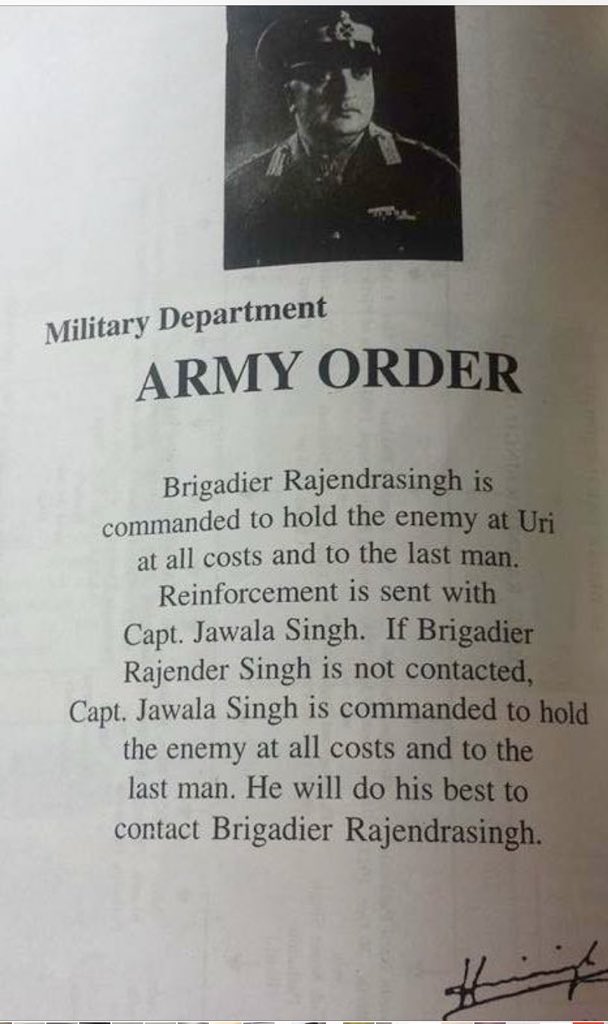
मुख्यालय में मौजूद ब्रिगेडियर फकीरसिंह ने उन्हें 70 आदमी भेजने का यकीन दिलाया। इसी दौरान महाराजा ने खुद मुख्यालय में कमान संभालते हुए कैप्टन ज्वालासिंह को एक लिखित आदेश के संग उड़ी भेजा। इसमें कहा गया था ब्रिगेडियर राजेंद्रसिंह को आदेश दिया जाता है कि वह हर हाल में दुश्मन को आखिरी सांस और आखिरी जवान तक उड़ी के पास ही रोके रखें। कैप्टन सिंह 24 अक्टूबर की सुबह एक छोटी सैन्य टुकड़ी के संग उड़ी पहुंचे। उन्होंने सैन्य टुकड़ी ब्रिगेडियर राजेंद्रसिंह को सौंपते हुए महाराजा का आदेश सुनाते हुए खत थमाया। 


हालात को पूरी तरह से विपरीत और दुश्मन को मजबूत समझते हुए ब्रिगेडियर ने कैप्टन नसीबसिंह को उड़ी नाले पर बने एक पुल को उड़ाने का हुक्म सुनाया, ताकि दुश्मन को रोका जा सके। इससे दुश्मन कुछ देर के लिए रुक गया, लेकिन जल्द ही वहां गोलियों की बौछार शुरू हो गई। करीब दो घंटे बाद दुश्मन ने फिर हमला बोल दिया।

इस पर राज्य के सैन्य प्रमुख ने महाराजा के आदेश को भुलाकर उड़ी से हटने और माहूरा में दुश्मन को रोकने का फैसला किया। वह 24 अक्टूबर की रात को 10 बजे माहूरा पहुंचे और वहां उन्होंने मोर्चाबंदी कर ली। अगली सुबह सात बजे दुश्मन ने फिर धावा बोल दिया, लेकिन जवाब इतना कड़ा मिला कि दुश्मन को अपने कुछ जवानों को झेलम के रास्ते आगे बढ़कर ब्रिगेडियर राजेंद्रसिंह पर नजदीक से हमला करने का आदेश देना पड़ा।

दुश्मन की इस चाल को भांपते हुए ब्रिगेडियर सिंह के आदेश पर कैप्टन ज्वालासिंह ने सभी पुलों को उड़ा दिया। यह काम शाम साढ़े चार बजे तक समाप्त हो चुका था। लेकिन कई कबाइली पहले ही इस तरफ आ चुके थे। इसके बाद ब्रिगेडियर ने रामपुर में दुश्मन को रोकने का फैसला किया और रात को ही वहां पहुंचकर उन्होंने अपने लिए खंदकें खोदीं।

रातभर खंदकें खोदने वाले जवानों को सुबह तड़के ही दुश्मन की गोलीबारी झेलनी पड़ी। मोर्चाबंदी इतनी मजबूत थी कि पूरा दिन दुश्मन गोलाबारी करने के बावजूद एक इंच नहीं बढ़ पाया। दुश्मन की एक टुकड़ी ने पीछे से आकर सड़क पर अवरोधक तैयार कर दिए, ताकि महाराजा के सिपाहियों को वहां से निकलने का मौका नहीं मिले।

ब्रिगेडियर राजेंद्र सिंह को दुश्मन की योजना का पता चल गया और उन्होंने 27 अक्टूबर की सुबह एक बजे अपने सिपाहियों को पीछे हटने और सेरी पुल पर डट जाने को कहा। पहला अवरोधक तो उन्होंने आसानी से हटा लिया, लेकिन बोनियार मंदिर के पास दुश्मन की फायरिंग की चपेट में आकर राज्य के सिपाहियों के वाहनों का काफिला थम गया।

पहले वाहन का चालक दुश्मन की फायरिंग में शहीद हो गया। इस पर कैप्टन ज्वालासिंह ने अपनी गाड़ी से नीचे आकर जब देखा तो पहले तीनों वाहनों के चालक मारे जा चुके थे, लेकिन उन्हें ब्रिगेडियर राजेंद्र सिंह नजर नहीं आए, वह अपने वाहन चालक के शहीद होने पर खुद ही वाहन लकर आगे निकल गए थे। सेरी पुल के पास दुश्मन की गोलियों का जवाब देते हुए वह बुरी तरह जख्मी हो गए।

उनकी दाई टांग पूरी तरह जख्मी थी। उन्होंने उसी समय अपने जवानों को आदेश दिया कि वह पीछे हटें और दुश्मन को रोकें। उन्हें जब सिपाहियों ने उठाने का प्रयास किया तो वह नहीं माने और उन्होंने कहा कि वह उन्हें पुलिया के नीचे आड़ में लिटाएं और वह वहीं से दुश्मन को राकेंगे। 27 अक्टूबर 1947 की दोपहर को सेरी पुल के पास ही उन्होंने दुश्मन से लड़ते हुए वीरगति पाई।

अलबत्ता, 26 अक्टूबर 1947 की शाम को जम्मू कश्मीर के भारत में विलय को लेकर समझौता हो चुका था और 27 अक्टूबर को जब राजेंद्रसिंह शहीद हुए तो उस समय कर्नल रंजीत राय भारतीय फौज का नेतृत्व करते हुए श्रीनगर एयरपोर्ट पर पहुंच चुके थे।

हालांकि कई लोग कहते हैं कि ब्रिगेडियर राजेंद्रसिंह ने उड़ी से हटकर महाराजा के आदेश का उल्लंघन किया था। युद्ध विशेषज्ञों का दावा है कि अगर वह पीछे नहीं हटते तो कबाइली 23 अक्टूबर की रात को ही श्रीनगर में होते। ब्रिगेडियर राजेंद्रसिंह ने जो फैसला लिया था वह कोई चालाक और युद्धक रणनीति में माहिर व्यक्ति ही ले सकता था। उनके इसी फैसले और शहादत के कारण कश्मीर पाकिस्तान का हिस्सा बनने से बचा है।

ब्रिगेडियर राजेंद्र सिंह को मरणोपरांत देश के पहले महावीर चक्र से सम्मानित किया गया। फील्ड मार्शल केएम करिअप्पा ने 30 दिसंबर 1949 को जम्मू संभाग में बगूना-सांबा के इस सपूत की वीर पत्नी रामदेई को सम्मानित किया था।


He immortalized fighting Pakistani raiders in 1947 and is the first recipient of any gallantry award in Independent India. With just 100 DOGRA troops, BRIGADIER RAJINDER SINGH defended Kashmir against 6000 Pakistanis at Uri for four days in 1947. 
Had he not been deceived by his own troops, who joined hands with the raiders, there would have been no POK today. 


Brig Rajinder Singh, India’s first MVC recipient was a rare military leader. In 1947, with 100 soldiers, the Dogra General stopped a 6000 strong Pak force from overrunning Kashmir. 


Brigadier Rajinder Singh was born on 14th June,1899 in Bagoona village (now re-named as Rajinderpura) of Samba district to Subedar Lakha Singh. He was Jamwal Rajput from Jammu who rose to command the State Forces of J&K. 
His heroic ancestor General Baj Singh Jamwal had sacrificed his life in the defence of Chitral. 

He was Chief of Military Staff of the JK State Forces, & the first Mahaveer Chakra Awardee of Independent India. Brigadier Rajinder Singh Jamwal was decorated with the second highest gallantry award the Mahavir Chakra posthumously and most deservedly so.

Brigadier Rajinder Singh Jamwal saved the Kashmir Valley from falling into the hands of Pakistani Raiders.

Brigadier Rajinder Singh Jamwal was one of the main reasons why Srinagar is today in India and not in Pakistan. He was a brave soldier.

Brigadier Rajinder Singh Jamwal's small contingent defended Jammu and Kashmir for four days and prevented it from falling into Pakistan's hands.

For the people of Jammu, Brigadier Rajinder Singh Jamwal is known as the ‘Immortal Dogra’ and the ‘Saviour of Kashmir’. He continues to be an inspiration for people across Jammu, and almost every household has one or two members serving in the armed forces, many defending the border and the Kashmir valley.


Immediately after the partition of the Indian Sub continent in 1947, thousands of raiders assisted by Pakistani regulars invaded the State of Jammu and Kashmir all along its border.

The Jammu and Kashmir State Forces, stretched along a 550-mile long border deployed in penn-packets with limited arms, ammunition and supplies, without road communications, and heavily-outnumbered, fought tenaciously holding on to their positions. Kohla-Domel garrison fell to the invaders on 22 October 1947. The fate of the Valley as of the whole State hung precariously on a slender thread.


When Brig Singh took over as chief of staff of Dogra state forces, Kashmir was going through its worst days kabali jihadis were making occasional raids into Kashmir, killing and raping non Muslims. Indian wouldn't send troops until instrument of accession was signed. Maharaja Hari singh was very happy to sign instrument of accession and merge Kashmir into India, provided Sheikh Abdullah not be made prime minister of Kashmir. Maharaja Hari Singh knew of Abdullah's treachery but Nehru would accept accession until his friend Abdullah wasn't made PM.

Under these conditions, Brig Rajinder Singh received the distressing news that


every single Muslim soldier of 4 JAK battalion, without a single exception, killed Hindu comrades while the latter were sleeping and joined hands with Pakistan. Such desertions happened everywhere. Due to desertion and cold blooded murder of their Gorkha and Sikh comrades by Muslim troops, Muzaffarabad was lost to Pakistan.


On the fateful night of 21/22 October 1947, the Muslim element of the 4th Jammu and Kashmir Infantry, located at Lohargali and Ramkot, swept by religious fanaticism, forgot their oath of loyalty toward their ruler and the state, joined hands with enemy and led him to pre-arranged positions in the area around Muzaffarabad and Domel, in what was to become most treacherous and dastardly act in the military history. Muslim companies of 4 JAK battalion defending Muzaffrabad switched sides, killing their commanding officer Lt Col Narain Singh Sambyal and all other Hindu officers and Jawans.

Very few survived to tell the tale. It was a severe treachery and a great blow to the defence of J&K. 


Brig Rajinder Singh decided he would himself face attackers and defend Uri. He had at his disposal only about 150 troops. Brig Rajinder Singh Jamwal and his 150 odd troops at Uri withstood a 8,000 strong Pakistani Qabali army and stopped their advances into Srinagar for 4 days, in addition to helping refugees cross the border and protecting civilians near the border. He fought last man & last bullet, caused famous delay of Pak Raiders, he held out despite odds  before Indian Army landed on 27 October1947 & Srinagar was saved.Brig Rajinder inspired his troops as the finest example of leading from front. The last sighting of him, lying wounded & alone with a pistol, his heroism of leading a 100 odd rif-raf army of brave Dogra men that kept the enemy at bay for 4 days, giving vital time for JK to be integrated with India. His heroism deserves a Bharat Ratna.


Brig Rajinder Singh Jamwal and his band of brave soldiers carried out the orders of the Maharaja Hari Singh to the letter and spirit. Fighting bravely for every inch of land. They delayed enemy advance by two crucial days during which important decisions were taken. 

The Indian Army joined the fight and the Jammu and Kashmir State was thus saved for India by Brave Soldier Brigadier Rajinder Singh Jamwal. Brig Rajinder Singh Jamwal made the supreme sacrifice of his life on the night of 26-27 October 1947 valiantly fighting the Pakistani raiders in Uri-Rampur sector.

He was promoted to the rank of Brigadier in the Indian Army after Jammu Kashmir state forces joined Indian Army. He had the rank of General in the state forces at the time of his martyrdom.

Actually, the rank of Brigadier was in the Indian army, but it was after the merger of state forces into the Indian army. It was after his martyrdom. He was General in Jammu Kashmir State Forces. We must remember the will and the sacrifice that has kept the Union of India together.

Our history is a testimony to how our country is a more enduring force than the blind fury of the misguided and the resolve of the cowards.


BRIGADIER RAJINDER SINGH when immortalized himself, he left behind his wife and five daughters.
Brigadier Rajinder Singh is rightly known as the saviour of Kashmir.


Smt Urvashi Pathania Ji, eldest daughter of Brig Rajinder Singh Jamwal with the family at the National War Memorial, New Delhi paying floral tribute to Father, the recipient of the first gallantry Award of independent India, the MVC posthumously, for saving Kashmir in 1947.


Smt Ram Dei, his wife received MVC on behalf of him from GENERAL K M CARIAPPA.

Brigadier Rajinder Singh Jamwal was the first war hero of independent India who sacrificed his life for Jammu and Kashmir while fighting Pakistani invaders.

Not only Jammu and Kashmir, but the entire nation should honor the sacrifice of Independent India’s first war hero. 🙏 Our homage to the saviour of Kashmir. 

Friday, June 26, 2020

SHER-E-JAMMU AND KASHMIR INDER MAHANDER RAJRAJESHWAR MAHARAJADHIRAJ SHRI GULAB SINGHJI - IMMORTAL RAJPUTS


(शाहमुखी: ﮔﻼﺏ ﺳﻨﮕﮫ ﮈﻭﮔﺮﺍ ; गुरुमुखी: ਮਹਾਰਾਜਾ ਗੁਲਾਬ ਸਿੰਘ) (१७९२-१८५७) डोगरा राजवंश एवं जम्मू और कश्मीर राजघराने के संस्थापक और जम्मू और कश्मीर रियासत के पहले महाराज थे।
उनका जन्म सन् १७९२ में जामवल कुल के एक डोगरा राजपूत परिवार में हुआ था, जो जम्मू के राजपरिवार से ताल्लुख़ रखते थें। 


उन्होंने अपनी क्षत्रिय जीवन की शुरुआत में एक पैदल सैनिक के रूप में की थी पर आगे चल कर वे स्वतंत्र जम्मू और कश्मीर रियासत के पहले स्वतंत्र नरेश बन कर उबरे थे उन्हें ,सिख साम्राज्य के अधिपत्य जम्मू के राजा का पद राजा जीत सिंह से उत्तराधिकृत किया था और प्रथम आंग्ल-सिख युद्ध में, जिसमें उन्होंने अंग्रेज़ों के साथ संधी कर ली थी सिख साम्राज्य की पराजय के बाद स्वतंत्र जम्मू और कश्मीर रियासत की स्थापना की और महाराज के पद पर ख़ुद को विराजमान किया था।
१८४६ की अमृतसर संधि के आधार पर आधिकारिक तौर पर महाराज ने ७५,००,००० नानकशाही रुपययों के भुकतान के बाद कश्मीर का पूरा भूखंड अंग्रेज़ों से खरीद लिया था जिसे अंग्रेज़ों ने लाहौर संधि द्वारा हासिल की थी इसके अलावा भी महाराज गुलाब सिंह ने अपनी जीवनकाल के दौरान कई प्रदेशों और रियासतों पर फ़तह हासिल किया था।
महाराज गुलाब सिंह, जम्मू और कश्मीर के महाराज


पूर्ववर्ती-

राजा जीत सिंह(जम्मू के राजा के रूप में

उत्तरवर्ती-

महाराज रणबीर सिंह

जन्म- 
१८ अकटूवर १७९२
जम्मू, साँचा:देश आँकड़े सिख साम्राज्य

निधन- ३० जून १८५७

संतान- रणबीर सिंह

घराना- डोगरा राजवंश

पिता- किशोर सिंह


सन् १८४६ की एक हस्थचित्र, महाराज गुलाब सिंह का गिरीदुर्ग

बचपन एवं प्राथमिक जीवन

गुलाब सिंह का जन्म १८ अकटूबर १७९२ में जम्मू के एक जामवल डोगरा राजपूत परिवार में हुआ था उनके पिता श्री किशोर सिंह जामवल, जम्मू के ततकालीन नरेशराजा जीत सिंह, जम्मू के राजा के दूरस्थ कुलसम्बंधी थे उनकी परवरिश उनके दादा श्री ज़ोरावर सिंह के मद्देनज़र हुआ था, जिनसे उन्होंने युद्धकला, तलवारबाज़ी और घुड़सवारी सीखी।

सन् १८०८ 

में जब महाराज रणजीत सिंह की सिख सेना ने जम्मू पर चढ़ाई की थी तब गुलाब सिंह की उम्र १६ साल थी जब उन्होंनें अपनी कुलवंशियों के कंधे से कंधा मिला कर जम्मू के बचाव की पुरज़ोर पर नाक़ामयाब कोशिश की थी इस हार के बाद जम्मू रियासत को सिख साम्राज्य के अधिराज्य में तब्दील कर दिया गया अर्थात जम्मू, सिख साम्राज्य के आधीन आ गया हालांकी जम्मू के राजा को क्षेत्रिय स्वायत्तता हासिल थी।

सन् १८०९ 

में गुलाब सिंह ने काबुल का रुख़ किया अफ़ग़ान राजा, शूजा शाह दुर्रैनी की फ़ौज में एक तनख़्वादार फ़ौजी के रूप में दाख़िला लेने के लिये जब उसकी फ़ौज ने सिंध को पार करने से इनक़ार कर दिया तब उन्होंने कुछ समय के लिये सरदार निहाल सिंह अटारिवाला के लिये भी काम किया, जिसके बाद उनका दाख़िला, महाराज रणजीत सिंह के दरबार में एक पैदल-सैनिक के रूप में हुआ अपने शौर्य एवं रणकौशल के बदौलत उन्होंने कई सैन्य-कार्रवाईयों में काफ़ी शौहरत एवं सम्माल हासिल किय विशेश रूप से मुलतान की चढ़ाई में। इसके दम पर उन्होंने सेना में खुद को एक विशिष्ट सैनिक के रूप में स्थापित कर लिया था यहां तक की उन्हों ने एक बार रेसाई पर किये गए फ़ौजी-कार्रवाई का स्वतंत्र नेत्रित्व भी किया था।

१८१६ 

में एक और टकराव के पश्चात, रणजीत सिंह ने जम्मू पर पूरी तरह कबज़ कर लिया और राजा जीत सिंह को साम्राज्य से बरख़ास्त कर दिया जीत सिंह ने दक्षिण में स्थित ब्रिटिश भारत पनाह ले लिया रणजीत सिंह ने इस नए इलाके की हुकूमत के लिए एक जागीरदार की नियुक्ती की और 

१८२० 

में गुलाब सिंह एवं उनके परिवार की मुलाज़मत का अभिमूल्यन करते हुए महाराज रणजीत सिंह ना जम्मू को एक वंशानुगत जागीर के रूप में किशोर सिंह को सौंप दिया।

सन् १८२१

में गुलाब सिंह ने राजौरी को अग़र ख़ान से और किश्तवाड़ को राजा तेग़ मुहम्मद ख़ान से कब्ज़ा किया। उसी साल गुलाब सिंह ने डेरा ग़ाज़ी ख़ान पर की गई सैन्य-कार्रवाई में भी भाग लिया। इतना ही नहीं, उन्हों ने अपने ही कुलवंशी मियां डिदो सिंह जामवल को, जो साम्राज्य के खिलाफ़ विद्रोह का नेत्रित्व कर रहा था, पकड़ कर प्राणदंड दे दिया था।

जम्मू रियासत की सत्ताप्राप्ति

जम्मू में चेनाब नदी के किनारे स्थित महाराज गुलाब सिंह का महल, मध्य १९वीं शताब्दी


किशोर सिंह के निधन के बाद, जम्मू के अधिपति, महाराज रणजीत सिंह ने जम्मू की सत्ता गुलाब सिंह को सौंप दी। तख़्त पर क़ाबिज़ होने के शीघ्र बाद गुलाब सिंह ने वंचित पूर्व शासक, राजा जीत संह से, सत्तापरिवर्तन की पुष्टिकर्ता, औपचारिक त्यागपत्र सुरक्षित किया। त्यागपत्र(सत्ता से सन्यास की औपचारिक घोषणा) का पृष्ठ फ़ारसी में यह था:
"من، رجا جیت سینگ، نوه رجا صاحب رانجیت برنامه نویس، در این مناسبت و خارج از تمایل داخلی و نعمت وقار، در طول عمر خود من، و به عنوان یک نشانه عشق ذاتی و محبت قلبی، بدین وسیله نفی مالکیت به تمام مناطق حفاظت شده از اجداد من، و ارث خود من، به نفع نجیب زاده مرفه من، رجا راج رجا گلاب سینگ، و راجا صاحب دهیدراسیون سینگ و رجا سو چت سینگ، از طریق دارام و قوانین، توافق دو جانبه و در سوگند از پیشینیان من و نجیب زاده و تجارت. "
हिन्दी में:
"मैं राजा जीत सिंह, राजा साहब रंजीत देवजी का पौत्र, इस अवसर पर एवं अपने स्वयं के जीवन में आंतरिक झुकाव और गरिमामय एहसान, के कारणस्वरूप, एवं आंतरिक प्रेम और हार्दिक स्नेह की निशानी के रूप में, मैं तथा, मेरी अपनी विरासत व मेरे पूर्वजों द्वारा संरक्षित सभी रियासतों पर स्वामित्व का त्याग अपने समृद्ध बर्ख़ुर्दार, राजा-ए राजगण, राजा गुलाब सिंहजी, और राजा साहब धियान सिंहजी और राजा सुचेत सिंहजी के पक्ष में, धर्म और नियमें के अनुरूप, आपसी समझौते के माध्यम से व अपने पूर्वाधिकारियों, ठाकुरों और गुरुों की शपथ पर, करता हूं।
इस त्यागपत्र ने जमाल कुल का नेत्रित्व जामवल वंश के ही एक पुर्वतः हीन शाखा की पास परिवर्तित कर दिया।
अफ़ग़ान आक्रमणकारियों से झड़प एवं कश्मीर और हज़ारा के मुस्लिम बाग़ी कबीलों से मुठभेड़।

महाराज गुलाब सिंह की मूर्ती, अमर महल

जमरूद की लड़ाई

१८३७ में अफ़ग़ानों ने सिखों के जमरूद क़िले पर हमला किया था, जिसमें महाराज रणजीत सिंह ने "राजा" गुलाब सिंह के नेत्रित्व में सहायक सेना भेजी थी कुछ दिनों की झड़प के बाद सिखों ने अफ़ग़ानों को रोक दिया, पर जमरूद की लड़ाई में हरि सिंह नलवा की हत्या हो गई, जिसके बाद कश्मीर और हज़ारा में कई मुस्लिम कबीलों ने राजविद्रोह की घोशणा कर दी। इनमें तनोली, कर्राल, धुन्द, साती और सुधान शामिल थे महाराज रणजीत सिंह ने गुलाब सिंह को विद्रोह और विद्रोहियों पर नकेल कसने का काम सौंपा था।
दस्तावेज़ों और प्रतिवेदनों के मुताबिक़ वे १०,००० सिख और डोगरा सैनिकों के साथ हज़ारा पहुंचे थे हज़ारा और मुर्री पहाड़ियों में विद्रोहियों को हराने के बाद, कश्मीर में बाग़ियों के खिलाफ़ अभियान के नेत्रित्व के लिये अपना मुख्य डेरा कठुआ को बनाया एक सुधान, शम्स ख़ान वहां विद्रोह का स्तर बढ़ा रखा था और कई सैन्य छावनियों और किलों पर कब्ज़ा भी कर रखा था ऐसा जाना जाता है की गुलाब सिंह ने विद्रोह से संबंधित प्रतायेक बाग़ी के सर के लिया एक रूपय का ईनाम" रखा था इसी प्रकार पहाड़ियों में करीब १२,००० सुधान, साती और धुन्द लोगों का संहार किया गया था साथ ही कुछ मुसलमान महिलाओं को बंदी बला कर यौनदासी के रूप में भी बेच दिया गया था।

लाहौर का षड़यंत्र


सन १८२४ में, गुलाब सिंह ने समरटाहके क़िले पर क़ब्ज़ा कर लिया।
१८२७ में वे सिख सेनाप्रमुख हरि सिंह नलवा के साथ अफ़ग़ान राजद्रोहियों के ख़िलाफ़ शैदू की लड़ाई में उन्होंने सैयद अहमद द्वारा नेत्रित एक विद्रोही क़बीले को हराया था।
१८३१ से १८३९ के बीच, रणजीत सिंह ने गुलाब सिंह को उत्तरी पंजाब की नमक खदानों की जागीर एवं भेड़ा, रोहतास, झेलम और गुजरात नगरों की जागीरदारी प्रदान किया था इसके बाद लाहौर में होने वाली घटनाएं काफ़ी महत्वपूर्ण हैं।
सन १८३९ में महाराज रणजीत सिंह के निधन के पश्चात, सिख साम्राज्य शक्ती व सत्ता के असंतुलन एवं केन्द्रिय अधिकार के ग़ैरमौजूदगी के कारण अव्यवस्था व अराजकता की स्थिती में चला गया था। इस उथल-पुथल की स्थिती में राजधानी लाहौर साज़िशों का केन्द्र बन गया।

कुंवर नौनिहाल सिंह को राजसत्ता पर विराजमान कर वे राजा धियान सिंह को प्रधानमंत्री बनाने में क़ामयाब रहे परंतू, उनके पिता, महाराज खड़क सिंह की अंतिम यात्रा के दौरान, नौनिहाल सिंह के साथ गुलाब सिंह के पुत्र, उधम सिंह की भी मृत्यू हो गई।


जनवरी १८४१ में रणजीत सिंह के पुत्र शेर सिंह ने लाहौर के तख़्त पर क़ब्ज़ा करने की पुरज़ोर कोशिश की पर "जम्मूई भाईयों" के कारण वह नाक़ामयाब रहा लाहौर के क़िले की सुरक्षा की ज़िम्मेदारी गुलाब सिंह के मद्देनज़र थी एसा जाना जाता हे की शेर सिंह अकालियों की बहुत बड़ी सेना के साथ हमला किया था उसने अपनी सेना से किले को चारो तरफ़ से घेर लिया था परंतू किले की तोपें और दीवारों को भेदने में असफ़ल रहे डोगराओं और शेर सिंह के दरमियां शान्ती समझौते के बाद गुलाब सिंह को हथियारों के साथ जम्मू वापस चले जाने की इजाज़त दे दी गई।

हिमालय-पार का अभियान


इस सारे वक़्त के दौरान डोगरा सेना का एक बहुत बड़ा हिस्सा उत्तरी हिमालय की पहाड़ियों पर चढाई में जुटी हुई थी किश्तवाड़ के जागीरदार, सेनापति ज़ोरावर सिंह की अघुआई में डोगरा सेना ने 1835 में करगिल और सूरु घाटी, और 1836 से 1840 के बीच बाकी के लद्दाख़ और बल्तिस्तान पर कब्ज़ा कर लिया लद्दाख़ और उत्तरी हिमालय में डोगराओं की बढ़ती ताक़त से चिंतित हो कर कश्मीर के सिख सूबेदार, मियान सिंह ने कुँवर नौनिहाल सिंह को ज़ोरावर सिंह और डोगराओं की सैन्य आभियानों की ख़बर से आग़ाह कर दिया डोगराओं के इन क़ामयाब अभियानों ने कश्मीर और गिल्गिट में तवालद सिख फ़ौज को अभित्रस्त व चौकन्ना कर दिया था ताकी बात और ना बिगड़ जाए इस लिये ज़ोरावर ने सेना का रुख़ पूर्व में तिब्बत की ओर मोड़ दिया।


मई 1841 में ज़ोरावर सिंह की सेना ने, 5000 डोगरा सिपाहियों, एवं किश्तवाड़ी, लद्दाख़ी और बाल्तीयों की सहायता से लैस, कुल 7000 फ़ौजियों की ताक़त के साथ तिब्बत पर चढ़ाई कर दी ताब्बतीयों द्वारा किये गए सारे प्रिरोधों, आक्षेपों और बाधाओं के परास्त करते हुए सेना तीन गुठों में पूर्व की ओर तब्बती ज़मीन में बढ़ती रही अंत्यतः उन्होंने तकलाकोट में अपना डेरा लगाया, पवित्र मानसरोवर के
पस, सितम्बर 1841 में। इस दौरान वे भारतीय सीमांचलों से दूर, तिब्बती भूमी के 450 मील भीतर प्रवेष कर चुके थे परंतू, भीशण तिब्बती सर्दकाल के आग़ास के पश्चात डोगरा सेना भीशण ठंड और सहूलियतों के आभाव के कारण, ज़ोरावर सिंह की पूर्वनिर्देशित प्रबंध के बावजूद, एक-एक-कर गिरने लगी जम्मू, कश्मीर, लद्दाख़ और बल्तिस्तानी मूल की सेना के लिये उचित प्रबंधों के आभाव में तब्बत की "हड्डियां जमा देने वाली ठंड" को सह पाना बहुत मुश्किल हो गया था ऐसा ज्ञात है की कईयों ने खुद को गर्म रखने की नाक़ामयाब कोशिश में सेना के असला और बारूद को भी जला दिया था।
भीशण ठंड एवं किराने और असला के आभाव के कारण कमज़ोर पड़ चुकी डोगरा सेना को 12 दिसम्बर 1841 को तिब्बती सेना के हाथों मात झेलनी पड़ी। इस अभियान में जो जीवित बच गए थे, वे दक्षिण दिशा की ओर बढ़ कर हिमालय पार कर ब्रिटिश-साशित इलाक़े में पहुंच गए राजा गुलाब सिंह, जो उस समय अंग्ल-सिख युद्ध का नेत्रित्व कर रहे थे को इस दुर्घटना की जानारी हेन्री लौरेन्स ने दिय था।
डोगरा घुसपैठ को परास्त करने के बाद आगे बढ़ रही तब्बती सेना ने लद्दाख़ पर हमला कर दाया, परंतू इस बार डोगराओं ने उन्हें चुशूल की लड़ाई में हरा दिया अंत्यतः लद्दाख़ और तिब्बत के बीच की सीमा को चूशूल समझौते द्वार तय कर दिया गया।

जम्मू और कश्मीर रियासत की स्थापना और महाराज के रूप में ताजपोशी
एक खूवसूरत श्वेत अश्व की सवारी करते, महाराज गुलाब सिंह का चित्र, 1840-45 इ॰, ब्रिटिश लाईब्रेरी


इस बीच, लाहौर में, साज़ीशों, हत्तयाओं और भ्रष्टाचार की घटनाओं की बढ़ती तादाद के कारण सिख साम्राज्य अत्यंत आर्थिक संकट की स्थिती में आ गया और हुक़ूमत के "शीर्षमंडल"(निर्देशकों) पर वित्तीय दबाव बहुत ज़्यादा बढ़ गया इस संकटपूर्ण एवं अराजक माहौल के बीच, खाल्सा(सेना) ने भी, वेतन ना मिलने के कारण, विद्रोह की चेतावनी दे डाली।
इस कठिन स्थिती के समाधान के लिये लाहौरी अदालत(महापंचायत) का गठन किया गया, जिसने जम्मू पर चढ़ाई के आदेश दे दिये, हालांकी, सिख फ़ौज जम्मू पर कब्ज़ा करने में नाक़ामयाब रही, पर उन्होंने गुलाब सिंह को काफ़ी बड़ी रक्म का भुकतान करने पर मजबूर ज़रूर कर दिया लाहौरी अदालत ने गुलाब सिंह पर कुल सत्ताईस लाख नानकशाही रुपयों का हर्ज़ाना लगाया था।
इस घटना के पश्चात गुलाब सिंह ने अंग्रेज़ों के साथ एक गुप्त समझौते पर बातचीत करने का फ़ैसला किया अंग्रेज़ों, जिनकी निगाह पंजाब पर काफ़ी समय से थी, ने, इस दौरान, सिख-प्रदेश और ब्रिटिश-प्रदेश की सीमा पर अपनी सैनिकों की संख्या बढ़ा दी।

1845 में, सरहद पर हुई झड़पों ने प्रथम आंग्ल-सिख युद्ध का रूप ले लिया, जो सिखों के लियो घातक साबित हुआ। पराजय होने के बाद, सिखो को शांती समझौते पर हस्ताक्षर करना पड़ा(लाहौर की संधी) 

अंग्रेज़, जिनके पास सिखों को पूरी तरह मशग़ूल रखने के लिए निशपरयाप्त सेना थी, ने राजा गुलाब सिंह को जम्मू और कश्मीर का महाराज नियुक्त करने का फ़ैसला कर दिया। इसी ऐलान के साथ संयुक्त जम्मू और कश्मीर रायासत की स्थापना अपने प्रथम महाराज के रूप में महाराज गुलाब सिंह के साथ हुई।

इस के बाद वज़ीर लाल सिंह ने, कश्मीर के सूबेदार को उकसाकर कश्मीर में विद्रोह फ़ैलाने की साज़िश रची परंतू हर्बर्ट बेन्जमिन एडवार्डस के अंतर्गत ब्रिटिश सैन्य तुकड़ियों की मदद से महाराज गुलाब सिंह ने कश्मीर में पनपे बग़ावतों और बाग़ियों को भी कुचल डाला, साल 1846 में आख़िरकार, अमृतसर की संधी ने "जम्मू और कश्मीर के महाराज" के रूप में उनके पद की संपूर्णतः पुष्टीकृती कर दी।


महाराज गुलाब सिंह की संप्रभुता के अंतर्गत प्रदेश की सरहदें चूशूल और अमृतसर की संधियों द्वारा संपूर्णतः परिभाषित थीं, पूर्व, दक्षिण और पश्चिम में, सिवाए, पश्चिमोत्तरिय सीमांचलों के हिस्से के अतः डोगराओं ने पश्चिमोत्तर की ओर बढ़ना शुरी किया, और चिलास, दर्द और गिलगिट जैसे क्षेत्रों पर कब्ज़ा कर लिया एक क्षुण्ण समय(2 वर्ष) के लिये गिलगिट को विद्रोहियों(राजा यासीन) के हाथों खो दिया गया था, परंतू 1852 में डोगराओं ने गिलगिट पर फिर से अपना कब्ज़ा जमा लिया।


महाराज गुलाब सिंह का निधन 1857 में हुआ उनके पुत्र रणबीर सिंह ने उनकी रियासत और विरासत को उत्तराधिकृत किया गुलाब सिंह की मृत्यू के बाद जम्मू और कश्मीर ने तकरीबन एक शताब्दी तक शान्तीपूर्ण और समृद्ध शासन का दौर देखा।
महाराज गुलाब सिंह द्वारा स्थापित डोगरा राजवंश ने 1948 तक जम्मू और कश्मीर पर राज किया 1947 में भारत का विभाजन, धारामिक मानकों पर हुआ उस समय इस जातिगत और धार्मिक रूप से अतीविविध जनसंख्या वाले क्षेत्र के किये सम्मिलन का दृढ़ निर्णय ले पाना मुश्किल हो गया ततकालीन महाराज, हरी सिंह ने स्वतंत्र रहने का फैसला किया।
इस फैसले ने गिलगित और बल्तिस्तान के मुसलमान वाशिंदों को ख़फ़ा कर दिया, वहां पाकिस्तान के पक्ष में विद्रोह प्रदर्शण शुरू हो गए इन्हें पाकिस्तानी सरकार का समर्थन हासिल था इन धटनाओं ने आगे चल कर प्रथम कश्मीर युद्ध की शकल ले ली, जिसने भारत और पाकिस्तान के बीज की मौजूदा तथ्यस्वरूप नियंत्रण रेखा स्थापित की।

------×-------×-------×-----


Weapons change, Warriors do not”


K M Panikkar in his bio of Maharaja Gulab Singh Jamwal said that:- 

18th century had produced men, who founded Kingdom & Dynasties, but this was the only case in 19th Century India, of a man, beginning as a small official in a court, who "conquered kingdoms and estd himself as the Sovereign".


Also adds that Maharaja Gulab Singh was the only one, who was able to manage and administer the hilly territories and he would have been "justly regarded as the most remarkable men of his times".


Maharaja Gulab Singh Jamwal of Jammu, Kashmir and the territories of Tibet offering worship to Bhagavān Shri Rama and Maa Sita.


Maharaja Gulab Singh was descended in the direct male line from the Raja Dhruv Deo of Jammu.
He was the founder of the Dogra dynasty and the first king of this princely state.

It was under the reign of Maharaja Gulab Singh that the boundaries of the state were demarcated and the state of Jammu and Kashmir was established.

Trade and commerce became safe under his rule as orders were restored.

The police and revenue administration was reorganised in the state.

The concept of rationing was introduced in the city.


The shawl industry was given importance and it was reorganised. Besides that, relief was given to weavers and others to free them from serfdom.

A photograph of Sharada Peeth in 1893 by the British archaeologist Sir Aurel stein. A Kashmiri Pandit stands at the entrance

The Dharmarth trust was founded by him with a motive to build temples in Jammu and Kashmir state.


MahaRaja Gulab Singh, who freed Muzaffarabad from Muslim rule, 


Repaired SharadaPeeth n 19th Cen which was later destroyed by Pak invaders in 1947.


The present complex of Purmandal shrine was built by Maharaja Gulab Singh,  the founder of Jammu and Kashmir state. He took lot of interest in the renovation of this holy place. He made the oblation of golden ewers to Lord Shiva. He also established a Sanskrit vidyalya on the banks of the river Devika. Havvelis constructed on Devika’s bank are still in prominence.
A special provision was made in Ain-I-Dharmarth to look after the shrine.


Jammu Bahu Fort Dating back to the 18th century was built by Raja Gulab Singh of Dogra Empire. It is located at the opposite of Jammu’s Old Town, at an elevation of 325 meters..


Bamu Temple in Bamu Chak Village in Jammu lies in ruins. It was constructed by maharaj Gulab singh ji. 


So if the local committee is not able to maintain it, then why not the grandsons of maharaja took the initiative to renovate it.


Or with earnest hope that the State Govt & ASI take a proactive approach to protect & preserve the temples, forts, palaces..heritage sites of Jammu 

The consolidation of the State of JK  under the leadership of Maharaja Gulab Singh and his Generals, began much before the Treaty of Amritsar, as he conquered territories, quelled anarchy and restored order in the State starting from the early 1800s.


Maharaja. Gulab Singh and his Dogra Generals like General Zorawar Singh, Gen Baj Singh, ADC Mehta Basti Ram extended the Dogra Sovereignty up to the Pamirs and Tibet. The consolidation of territories which later became the State of Jammu Kashmir began under Dogra Maharaja Gulab Singh, and was held together and governed ably by the Dogra Dynasty up until 1947.


Born: 18 October 1792 State Jammu
Reign: 1846-1857
Predecessor: Jit Singh As Raja of Jammu
Successor: Ranbir Singh
Son: Ranbir Singh
Dynasty: Jamwal
Father: Kishore Singh
Died: 30 June 1857 (aged 64)
Religion: Hinduism


Gulab Singh (1792–1857) was the founder and first Maharaja of the princely state of Jammu and Kashmir, the second largest princely state in British India. After the defeat of the Sikhs in the First Anglo-Sikh War, Gulab Singh, who served as Prime Minister of the Sikhs, received from the British all the lands in Kashmir that were ceded to them by the Sikhs by the Treaty of Lahore to Gulab Singh for 7,500,000 rupees.


The grand residence of the  Maharaja of Jammu Kashmir, Mubarak Mandi Palace can be spotted from a distance. The palace served as the resident of the royals till 1925, and today it is a major tourist attraction portraying a blend of Rajputana..


This beautiful Raghunath Mandir in Sui, Madh Jammu was built by Maharaja Gulab Singh in 1830. 


The Sui Temple has stunning murals depicting scenes from Ram Charit Manas. The Temple and its premises with royal quarters are not in a good shape and need attention. 


But Do u know an interesting thing about Ramban? Why it is called so? Here is a short story about it.


When Raja Gulab Singh of Jammu became the Maharaja of J&K State, he adopted Jammu-Udhampur-Banihal route to reach Srinagar for the movement of royal carvans. 


In his way to Srinagar Maharaja reached today's Ramban.Going by legends of history it is a fact which can be proved by revenue records tht before d formation of the J&K State in 1846, there ws a small village consisting of 15 houses on the ryt bank of Chenab river k/as "Nashban" 


The word "Nashban" sounded unpleasant to the delicate ears of Maharaja Gulab Singh because in Hindi "Nash" means "destruction". Spiritual to the core and indebted to Sanatan principles, Maharaja renamed this place on the name of Shri Ram. Thus, it came to be known as Ramban.


Ramban - one of the most beautiful yet mountainous, unexplored and underdeveloped district of Jammu region. Despite splitting from erstwhile Doda, Ramban is still waiting for development. E.g.According to 2011 census Ramban has the lowest literacy rate i.e 54%(Approx).


MahaRaja Gulab Singh was born on 18 October 1792 in a Hindu Jamwal Dogra Rajput family. His father, Kishore Singh Jamwal, was a distant kinsman of Jit Singh, the Raja of Jammu. Gulab Singh grew up in the care of his grand father, Zorawar Singh, from whom he learned the arts of horse riding and warfare. In 1808, when the Sikh army of Maharaja Ranjit Singh invaded Jammu, the 16-year-old Gulab Singh fought alongside his clansmen in the unsuccessful defense of Jammu. 


Following this defeat, the Raja of Jammu had internal autonomy of the principality, which became a tributary of the Sikh Empire. In 1809, Gulab Singh headed towards Kabul to join the army of the Afghan King, Shah Shuja as a mercenary. When his men refused to cross the river Indus, he gained employment with Sardar Nihal Singh Attariwala. Soon thereafter, Gulab Singh was found employed as a running footman in Ranjit Singh’s court. 


In 1813, Gulab Singh of Jammu captured Rajouri for the Sikh Empire of Maharaja Ranjit Singh, by defeating Raja Agar Ullah Khan. After this Rajouri became part of the Sikh Empire. But parts of it were given as jagirs to Rahim Ullah Khan and other parts to Gulab Singh.


About Incident which turned Mian Gulab Singh to Raja Gulab Singh


During the expedition of Multan one of Maharaja Ranjit Singh’s commanders approached the fort single handedly to explode its wall, but got unfortunately killed.

The dead body of the commander was likely to fall in the hands of the enemy as its retrieval was almost impossible.

Despite all, the Maharaja insisted on retrieving the body. The Maharaja overruled his senior commanders’ advice of not undertaking the almost impossible task. He also wanted a message to his soldiery of his commitment and concern for his fallen heroes.

When no one came forward for this undoubtedly a highly risk prone task, Mian Gulab Singh Dogra volunteered.

Showing a rare act of bravery and agility, Gulab Singh was able to bring back the dead body in the face of intense bursts of fire.

This rare act of bravery, of course, enhanced the esteem of this famous Dogra in becoming which also helped him subsequently to gain the Rajaship of Jammu in 1822.

He distinguished himself in several campaigns, including the conquest of Multan (1816). 

He also led an independent campaign in 1816 to conquer the hill-town of Reasi.

In 1816, following another conflict, Jammu was annexed by Ranjit Singh. Raja Jit Singh, who was expelled, found refuge in British India, and later received in appendage the estate of Akhrota. Ranjit Singh appointed a governor to administer the newly conquered area which was expanded in 1819 with the annexation of Kashmir by a Sikh force. In 1820, in appreciation of services rendered by the family, and by Gulab Singh in particular, Ranjit Singh bestowed the Jammu region as a hereditary fief upon Kishore Singh. Apart from their sterling services, the family's intimate association with the region commended Kishore Singh's candidature to the Lahore court.
In 1821, Gulab Singh captured conquered Rajouri from Aghar Khan and Kishtwar from Raja Tegh Muhammad Singh. That same year, Gulab Singh took part in the Sikh conquest of Dera Ghazi Khan. He also captured and executed his own clansman, Mian Dido Jamwal, who had been leading a rebellion against the Sikhs.


Raja of Jammu


Kishore Singh died in 1822 and Gulab Singh was confirmed as Raja of Jammu by his suzerain, Ranjit Singh at the historic town of Akhnoor.


Text from the Sanad of Maharaja Ranjit Singh acknowledging that Maharaja Gulab Singh's family had held Jammu for generations prior to his own ascension. The Dev Dynasty started around 9th century and they were contemporaries of hindu shahis. So actually they were much older.


which lies on the banks of River Chanderbhaga with a majestic range of mountains in the background. The Fort at Akhnoor was started by Raja Tej Singh and completed by his son Raja Alam Singh.


It was below this fort, under the majestic Jeo Pota Tree, Gulab Singh was anointed as the Raja of Jammu on 17th June 1822 and the foundation of the state of Jammu & Kashmir was laid. Under the yellow canopy is the ‘phalak’ showing the scene of the coronation ceremony. Shortly afterwards, Gulab Singh secured a formal declaration of renunciation from his kinsman, the deposed Raja Jit Singh. The declaration, drafted in Persian, reads:
"I, Raja Jit Singh, grandson of Raja Sahib Ranjit Devji, on this occasion and out of internal inclination and dignified favors, in my own lifetime, and as a token of intrinsic love and heartfelt affection, hereby renounce proprietorship to all the protected territories of my ancestors, and my own inheritance, in favor of my prosperous barkhurdar, Raja-i-Rajgan Raja Gulab Singhji, and Raja Sahib Dhian Singhji and Raja Suchet Singhji, by way of dharam and niyam, mutual agreement and on oaths of my predecessors and Thakurs and Gurus."
Thus, the declaration transferred the headship of the Jamwal Rajputs to a junior branch of that clan.


Intrigue at Lahore


In 1824 Gulab Singh captured the fort of Samartah, near the holy Mansar Lake. In 1827 he accompanied the Sikh Commander-In-Chief Hari Singh Nalwa, who fought and defeated a horde of Afghan rebels led by Sayyid Ahmed at the Battle of Shaidu. Between 1831-39 Ranjit Singh bestowed on Gulab Singh the jagir of the salt mines in northern Punjab, and the nearby Punjabi towns like Bhera, Jhelum, Rohtas, and Gujrat. Which also hrlps him to spread Dogra Influence Outside Jammu Kashmir.


This temple in West Punjab (in Pakistan) was built by Maharaja Gulab Singh Jamwal of Jammu in 1840s?


This is Sanatan Dharma Mandir or Bada Mandir in Chiniot, Punjab, Pakistan. 


This Hindu temple in Chiniot is dedicated to Sita Ram, Radha Krishna and Lakshmi Narayana.


Chiniot was a Hindu centre in the past with many Gupta age sculptures discovered there. 

Not Only this temple, Raja Gulab Singh ji also built some more temples in Punjab.
In 1830s he builta a Thakurdwara (Krishna temple) in Pind Dadan Khan. A village named Gulabgarh was founded there for upkeep of the temple.

He also got built a Shivala in Gujrat district of Punjab.


A Baradari (rest house with 12 doors) in Gujrat, West Punjab was also built/improved by Raja Gulab Singh and his revenue official in 1835. 

Clashes with the Afghan tribesmen

Raja Gulab Singh, c. 1830-1840 Miniature Art, Cleveland Museum of Art 


In 1837 after the Afghan armies attacked Sikh Fort of Jamrud in the Battle Of Jamrud, Maharaja Ranjit Singh sent Gulab Singh and his brother Dhyan Singh as reinforcement to the North West Frontier Province (in modern day Pakistan), Dhyan Singh proceeded towards the Khyber Pass, Prince Akbar Khan of Afghanistan fled with his armies back to Kabul on the arrival of Wazir Dhyan Singh, Raja Gulab Singh himself proceeded to Khyber Pakhtunwa region where Afghan tribesmen leader Painda Khan Afridi had raised revolt after the killing of Hari Singh Nalwa at the Khyber Pass. Maharaja Ranjit Singh ordered Rajah Gulab Singh to crush the revolt in the Khyber region. He proceeded with 10,000 Sikh and Dogra Rajputs troops towards Hazara, the revolting tribesmen fled to the mountains with their families and valuables, Raja Gulab Singh set his base camp in Hazara and looted almost whole of the North West Frontier Province and set on fire all the houses.


Trans-Himalayan adventure


On the death of Ranjit Singh in 1839, Lahore became a center of conspiracies and intrigue in which the three Jammu brothers were involved in which one side was led by the Sindhanwalias. They succeeded in placing the administration in the hands of Prince Nau Nihal Singh with Raja Dhian Singh as prime minister. However in 1840, during the funeral procession of his father Maharaja Kharak Singh, Nau Nihal Singh together with Udham Singh,son of Gulab Singh died when an old brick gate collapsed on them. In January 1841 Sher Singh, son of Ranjit Singh, tried to seize the throne of Lahore but was repulsed by the Jammu brothers. The defence of the fort was in the hands of Gulab Singh.

A History of the Reigning Family of Lahore by Major G. C. Smyth.

The efficiency of Dogra artillery was such that heavily outnumbered Dogra defenders of Lahore killed 4786 Sikhs (Infantry and Artillery) of Sher Singh when he laid the siege of city in 1840 while Dogra casualty was around 130 men.


According to his European artillery commander Alexander Gardner:

"The Dogras on the walls began to look over and were jeered at by Sher Singh’s troops, the Lahore fort was surrounded by a sea of human heads. Gulab Singh made contemptuous replies, and roared out to Sher Singh, demanding that he should surrender... With a wild yell some 300 Akalis swept up the Hazuri Bagh and crowded into the gate. Just at that moment, when the crowd was rushing in on us, their swords high in the air, I managed to fire the ten guns, and literally blew them into the air... Then Sher Singh fled and grievous carnage ensued. The Dogras, always excellent marksmen, seemed that day not to miss a man from the walls... we counted the bodies of no less than 2800 soldiers, 200 artillerymen, and 180 horses."

After peace was made between the two sides, Gulab Singh and his men were allowed to leave with their weapons. Subsequently, Gulab Singh conquered the fort of Mangla (near the present Mangla Dam on the Jhelum River).


In all this time a large part of the Dogra army had been engaged in trans-Himalayan conquests. General Zorawar Singh, governor of Kishtwar, had conquered the Suru valley and Kargil (1835), the rest of Ladakh (1836–40), and Baltistan (1840). These conquests had alarmed Mian Singh, the Sikh governor of Kashmir, who complained to Prince Nao Nihal Singh that “Zorawar Singh, agent of Raja Gulab Singh was obtaining complete possession of Baltistan” (Punjab Akhbars, 20 July 1840). The Dogra campaign threatened the Sikh position in Kashmir and Gilgit and so Zorawar Singh turned his attention east to the conquest of Tibet.


In May 1841, the 5000 strong Dogra army supplemented by contingents of Kishtwaris, Ladakhis, and Baltis (raising the strength of the army to 7000) advanced eastwards in three divisions. Overcoming all the Tibetan opposition they set up base at Taklakot near the holy Mansarovar Lake in September 1841, after traversing a distance of 450 miles from the Indian frontier. With the onset of severe winter the Dogras began falling one-by-one to the extreme cold and the lack of provisions, many burning the stocks of their muskets in futile attempts to warm themselves, and were overcome by a Tibetan force on 12 December 1841. Survivors of this campaign crossed over the Himalayas south to the British territories. Gulab Singh who was then in Peshawar leading the Anglo-Sikh campaign in Afghanistan was informed of this disaster by Henry Lawrence.
The Tibetans then invaded Ladakh but were defeated by the Dogras at the Battle of Chushul. The boundary between Ladakh and Tibet was finally settled by the Treaty of Chushul.

Recognition as Maharaja


Meanwhile in the continuing intrigues at Lahore the Sandhawalia Sardars (related to Ranjit Singh) murdered Raja Dhian Singh and the Sikh Maharaja Sher Singh in 1842. Subsequently Gulab Singh’s youngest brother, Suchet Singh, and nephew, Hira Singh, were also murdered. As the administration collapsed the Khalsa soldiery clamored for the arrears of their pay. In 1844 the Lahore court commanded an invasion of Jammu to extract money from Gulab Singh, reputed to be the richest Raja north of the Sutlej River as claim by apologist that he had taken most of the Lahore treasury. However the Gulab Singh a shrewd politician came before the army and appeased them by sweet talks and valuable gifts and the Khalsa made peace with Raja Gulab Singh and agreed to negotiate on his behalf with the Lahore court. These negotiations imposed an indemnity of 27 lakh Rupees on the Raja. In the subsequent Anglo-Sikh wars. Under the Treaty of Lahore the defeated Lahore was made to transfer Jammu to Gulab Singh.


But in reality it was when Jind Kaur and Lal Singh were working on the plot of the downfall of Sikh Kingdom, it was Rajput Gulab Singh Jamwal who warned Maharani but when she didn't paid heed to his advice then he went back to the Jammu and this silly mistake of Jind and Lal Singh led to death of hundreds of Sikh warriors. Your Lal Singh intrigued with Britishers and in the lust of power he opened all the secrets as well as strategic locations to them.


the role of Sardar Lal Singh to defeat Sikh forces. 

*(The treachery of Lal Singh is well narrated by Khushwant Singh in his book : The fall of kingdom of Punjab. Btw, Gulabnama is being used as source of this information.)*

After the defeat, Jind Kaur called Gulab Singh to help and it was he who went to Britishers to protect Sikh empire by coming into the mutual agreement.


Britishers demanded 2 crore rupees alongwith the annexation of Doaba territory. but Gulab Singh acted in efficient manner to reduce this war indemnity. But brits offered the territory of Kohistan for him and told him to stay away from matter.

But Gulab Singh being honest to his words told that it would be betrayal to the child king and he made them to agree on 1 crore and fifty lakh as war indemnity. It was Gulab Singh who made Daleep Singh to regain the title of Maharaja.


But Maharani Jind Kaur & Lal again conspired. She removed Raja Gulab Singh from the post and appointed Lal Singh on this place. 


Lal Singh held talk with British troops at lahore and offered them to pay 50 lakh rupees and annexation of Kohistan, Hazara, Chamba etc.


Rani Jindan's paramour intentionally did not pay war indemnity & sold territories between Indus and Beas to British.  This area included territories of Gulab Singh.


When this news reached to Gulab Singh, he acted and asked Sir Lawrence to protect the sovereignty of Jammu for his descendants. Sir Lawrence took up matter with the Mr. Currie. 


So, the money your Sikh empire had to pay had to be paid by Gulab Singh. And that happened because of your characterless Jindan Kaur's ambition & his treacherous Paramour Lal Singh.

Maharaja Gulab Singh Jamwal paid war reparations. That's totally different from buying something.


And the reason why there was peace negotiations were because your Charcterless Rani of Sikh empire had violated the 1st treaty of Lahore 1809 which Ranjit Singh had signed with British.  ..... characterfull Rani Jindan Kaur intentionally crossed Sutlej river. And peace negotiations had to be done due to blunder done by your Shameless Rani Jindan Kaur. War indemnity had to paid due to your Khalsa Sikh Lal Singh's trickery. 


They then made the separate treaty with Gulab Singh and he was entitled as the Maharaja of Jammu and Kashmir. 


On 16th March 1846, after the British annexed Punjab, they handed over the mountainous territory to the North of Punjab to Raja Gulab Singh. Dogra Cheiftain Raja Gulab Singh paid the war indemnity owed by Lahore Court to the British in return.

Lacking the resources to occupy such a large region immediately after annexing portions of Punjab, the British recognized Gulab Singh as a Maharaja directly tributary to them on payment of 75 Lakh of the war-indemnity (this payment was justified on account of Raja Gulab Singh legally being one of the chiefs of the Kingdom of Lahore and thus responsible for its treaty obligations). The angry courtiers of Lahore (particularly the baptised Sikh, Lal Singh) then incited the governor of Kashmir to rebel against Gulab Singh but this rebellion was defeated, thanks in great part to the action of Herbert Edwardes, 

This propaganda was given a lot of promotion by Sheikh Abdullah. Every single inch of Jammu and Kashmir came through military means.

It is very disgusting that some people accuse Maharaja Gulab Singh of 'buying Kashmir' from British. This claim is untrue. Let's dig into it :

1. To sell Kashmir to Gulab Singh, British need to own Kashmir. But Kashmir was sovereign territory of the Sarkar-i-Khalsa. British never ruled an inch of Kashmir.

2. Within the Sarkar-i-Khalsa, Gulab Singh was the feudal ruler of Jammu, Rajouri, Kishtwar, Suru, Kargil, Ladakh, Baltistan, and few territories in North and Central Punjab. Kashmir was surrounded from all sides by feudal territories under control of Gulab Singh and his brother.

3. Sarkar-i-Khalsa capitulated after the final Anglo-Sikh War. British annexed West Punjab as war reparation. West Punjab was valued at 10 million Nanak Shahi indemnity.

4. British defined territories as areas between two significant places. As a result of that, because of the virtue of being an island inside Maharaja Gulab Singh's feudal territory, it was defined as one entity along with other holdings of Maharaja Gulab Singh.

5. Maharaja Gulab Singh's holdings were considered equivalent for war indemnity worth 7.5 million Nanak Shahi.

Maharaja Gulab Singh paid the war reparations to deny British the ability to annex the land which became the Princely State of Jammu and Kashmir.

6. Gulab Singh's troops attacked the Sarkar-i-Khalsa forces in Kashmir and annexed it.

The conclusion is, Gulab Singh paid war reparations in return of not allowing the British to annex the land under his feudal control, and territories it surrounded.

That's totally different from buying something. It is like saying the Weimar Republic bought Germany from the allies! British never owned Kashmir to sell it.

Basically reparations for entire Sikh Empire was 1.75 crore rupees. 1 crore for occupied Himachal, East Punjab and entire West Punjab.

And 75 lakh for Jammu and Kashmir. As Maharaja Gulab Singh was able to pay only 75 lakh, rest of the Sikh Empire was annexed by the British, as additional 1 crore couldn't be paid.

This is more like Germany being forced to pay reparations when the first world war ended, instead of the US buying Alaska.

Assistant Resident at Lahore.


This arrangement was formalized in the Treaty of Amritsar in 1846. In the second Sikh War of 1849 he allowed his Sikh soldiers to desert and go to fight alongside their brethren in Punjab. The treaties of Chushul and Amritsar had defined the borders of the Kingdom of Jammu in the east, south and west but the northern border was still undefined. In 1850 the fort of Chilas in the Dard country was conquered. Gilgit was lost to rebellion in 1852 but was recovered ten years later by his son. Dogra Maharaja Gulab Singh consolidated territories from the Pamirs to Tibet to form the largest Princely states of the 19th century.

Maharaja Gulab Singh died on 30 June 1857 and was succeeded by his son, Ranbir Singh.


Real Sher-e-JammuKashmir "Maharaja Gulab Singh" who was headache for Britishers.


"Nails aren't made of good iron, soldiers aren't made from kind people."

Virtue signaling dharmik warriors distraught after been told some sad realities of war will faint if told about the acts of Maharaja Gulab Singh. His actions disgusted the Sikhs, horrified the Brits & terrorixed the Afghans & other mountain tribes, and none of them were saints.

There are many facts about Maharaja Gulab Singh that's unknown to public, we will try to bring some of them into limelight that how "Maharaja Gulab Singh" humiliated Britishers time to time soon after when he became Maharaja of state.

1. Maharaja levied duties and customs on the British subjects in order to distraught them.

2. Britishers has accused him for preventing commerce flowing in their dominion(British India) as he didn't allowed the traders of other countries to pass through his territory without paying tax.

3. He distracted the British trade that can be flowed to Yarkand, Khoten, Tartary and other places very easily. Because of his restrictions, it was unable to flourish.

4. When English resident was installed in JK, Maharaja made them to buy their provisions from himself at the exorbitant prices, getting them yearly to sign the tariff papers.

5. Europeans were not allowed to buy the commodities from people who can give those in the fair prices that was subjected for Jammu and Kashmir' s people. Maharaja had fixed different prices for Britishers which were higher than the real prices.

6. It was being a crime for people to accept the religion of Britishers.

7. British rupee 's value was less in his Kingdom.

8. British sepoy once entered into his territory was not allowed to go back to Hindostan(British India) without Maharaja 's permission.

9. Maharaja punished the British subjects several times for their crimes in Kashmir.

10. Once British resident tried to punish a Kashmiri. Maharaja punished those British subjects in return as he told that no one is allowed to punish his citizens other than him.

11. Maharaja didn't allowed private enterprises of Britishers in his Kingdom.

12. No British gentleman was allowed to stay in Kashmir for more than 6 months.

13. Britishers were allowed only as visitors - a treat for a time- the Maharaja fixing the their date of coming and going, and then sending spies to watch and report upon those visitors.

14. No English was allowed to build church in Kashmir.

15. No woman of state was being allowed to work as servant of Britishers.

16. No one was allowed to teach kashmiri, dogri or any language of Jammu and Kashmir to any Englishman.

17. Even British officer in Kashmir was not allowed to bury after death without Maharaja's special permission. The land given for their burial was never made British property.

18. Maharaja never tolerated the British interference in internal matters of state.


These are few points that shows that Maharajah was the independent ruler who never accepted the British suzeranity. Britishers wanted to annex Kashmir into British India because of this but Maharaja being a strong ruler destroyed every conspiracy of theirs.

Hail Maharaja!
Indras Mahasti ♥️
Jai Duggardesh.


Long Live National State of Jammu Kashmir and Aksai Tibetha Allied.