Friday, November 24, 2017

BRAVE RAO RAJA AMAR SINH RATHORE -IMMORTAL RAJPUTS

देखकर शाहजहाँ बादशाह भंवर हांकरे, 
कह सलबत खान नन: "करो काम हमारे" 
आयु औना ना कर, राजपूत रक्षा आँखर। " 
सलाबत खान अन बक्षी दादा तारे, 
"आडब मानके ख़ाहरो, राजपूत बिचारे! 
तेरी बंग दिगी दरबार पुरुष, मुख्य खड़ा सिधारे। " 
"मेरी तू क्या बन्त सान्वार्ड, करर सैनरवेयर!" 
अमर सिंह डिगेगा , कोई डिगे , जैस परभरण भरी 
"हेटे खारा गन्नवीर! क्या कर गन्नवी?" 
जबाल कढ़ी मिरी निकल करते हैं: 
मारे सलबत खान की जाली पारी: 
लगी मर्ड डी है दी ना राही वो धारी 
"एह ले आफ़ी सैक लाख, सलाबत पिएरे! 
कंटरे धरके जंच ले, होर घाट हैमरे! "


अर्थ: 

जैसे ही उसने उसे देखा, शाहजहाँ राजा ने पुकारा,
 और सलाबत खान से कहा: "मेरी बोली करो।
 राजपूत को आगे मत आने दो, उसे पीछे रखो।"
 नियंत्रक सलाबत खान ने उस पर अपनी दृष्टि डाली,
 (और कहा): "खड़े हो जाओ और सम्मान करो, राजपूत राजपूत!
तेरी कीर्ति दरबार में गिर गई है, और मैं (तेरे ऊपर) पहरा देता हूं।"
 "तुम मुझ पर कैसे नजर नहीं रख सकते? भगवान देखेगा!"
 अमर सिंह, एक महान पर्वत की तरह, पीछे नहीं रहना था।
 (सलबत खान ने कहा): "पीछे खड़े हो जाओ, हे मूर्ख! तुम अपने घमंड के साथ क्या करोगे?"
 अपने क्रोध में उसने अमर सिंह ने अपना खंजर खींचा और दो बार मारा:
 उसने सलाबत खान को मारा और उसके माध्यम से चला गया:
 एक योद्धा के हाथ से मारा गया प्रहार रुका नहीं।

 "इसे अपने सात लाख के लिए ले लो, दोस्त सलाबत!
 अपने तराजू ले लो और उन्हें तौलना!"

Translation One of the most badass scenario in the entire Indian history 

Rao Amar Singh Ji Rathore Enters mughal darbar

As soon as he saw him Shahjahan the King called out,
And said to Salabat Khan: "Do my bidding.
Let not the Rajput come forward, keep him back."
Salabat Khan, the Controller, cast his eyes on him,
(And said): "Stand and be respectful, thou wretched Rajput!
Thy fame hath fallen in the Court, and I keep watch (over thee)."
"How can'st thou watch over me? God shall watch!"
Amar Singh, like a great mountain, was not to be kept back.
(Said Salabat Khan): "Stand back, thou boor! What wilt thou with thy boorishness?"
In his wrath he (Amar Singh) drew his dagger and struck twice:
He struck Salabat Khan and went through him:
Struck by a warrior's hand the blow stayed not.
"Take this for thy seven lakhs, friend Salabat!
Take thy scales and weigh them out!"

Rao Amar Singh Rathore, cut off the head of mugal officer in the court, in front of mugal Emperor, and made him to run for his life.

Fought & killed mugal soldiers and escaped in broad daylight.


Insult to Mughal Emperor has a name & it is Rao Raja Amar Singh Rathore of immortal fame & it looks like this !

 Brave Rao Amar Singh Rathore was a Rathore Rajput nobleman affiliated with the royal house of Marwar, and a courtier of the Mughal emperor Shah Jahan in seventeenth-century India. After he was disinherited and exiled by his family, he entered the Mughals' service. His legendary bravery and battle prowess resulted in elevation to a high rank in the imperial nobility and personal recognition by the emperor, who made him the subedar (governor) of a region that was directly ruled by the emperor himself, Nagaur. In 1644, he was enraged by an attempt by the emperor to levy a fine on him for an unauthorized absence. In the emperor's presence, he stabbed and killed Salabat Khan, a noble who had been asked to collect the fine. He is celebrated in some popular ballads of Rajasthan, Western Uttar Pradesh and Punjab.

ऊण मुख ते गग्गो क़हो, इण कर लई कटार।
वार कर पायो नहीं, जमधर हो गयी पार।।

Umra & his band of warriors who took offence at the unruly wing ruffling their moustaches couldn’t have taken the attempt at throwing an insult his way. Mir Bakshi & Kotwal Salabat Khan had been pestering the Emperor to levy fine on Umra for his scant regard for Imperial Firman.
Umra entered the court & the Emperor for defying his orders asked him to pay fine.
He retorted “Umra’s fine is in the hilt of his sword & dare anyone take it from him”
Salabat, brother in law to ShahJahan, tried to intervene & uttered a slur, meaning to call Umra, an uncouth ‘गंवार’ when Amar Singh took out his ‘Jamdhar’ & slew the Mir Bakshi Kotwal in the Diwan-i-Khaas !

He took out his Katar & attacked the Emperor himself sitting on the Peacock Throne. Shahjahan fled to the harem to save himself.

“अमर की कमर में काहे की कटार थी, 
  पाव भर लोहे से हिलाये दीयों आगरो,
  जें होती शमसीर तो छीन लेतो पादशाही”

Umra was killed by a multitude of Mughal but not before he & his band killed many & forced the Emperor to the safety of his ‘Zenana’ or chambers of his womenfolk !

This is how proud & brave avenge an attempt at insult thrown at him… not by wringing hands & seething in anger !


CONFLICT WITH SHAH JAHAN

Picture is of mid 18 century ! 

Mughal emperor Shahjahan offered Rao Amar Singh a significant post in his commission, which he eventually accepted. The emperor also granted him a mansab (significant land and personal army) thus making him a middle rank mansabdar. Rao Amar Singh Rathore steadily gained promotions in Shahjahan's administration. He fought many significant battles with unmatched valour and courage. He was famous for being unconventional.

Rathore made a mark for himself which sparked jealousy of fellow courtiers. The Muslim courtiers of the emperor were quite disturbed by the fact that a Hindu was getting significant recognisation in the court. Once, Rathore went for a hunting expedition without seeking King's permission. Shahjahan feeling insulted, summoned Rathore in his court and asked him for the reason of his absence. Rathore replied that he is not answerable to anyone, and also manifested his intentions by saying that "My sword is my only property, collect all tax from it who dares to do so."
After that an angry courtier Salavat Khan assaulted Rathore saying ‘kya jaahil jaisi baatein karto ho Raavji’, Amar Singh killed Salavat Khan in presence of entire Mughal court, an incident considered an open insult to the Mughal throne. The entire Mughal force tried to capture him,as Shahjahan looked dumb founded.


After a gallant fighting Amar Singh escaped from the place, by jumping from the agra fort mounted on his horse Bahadur. His horse Bahadur, a marwari horse died after the jump. 


A Chhatri or cenotaph of Bahadur at the foot step of Agra fort in the memory of Bahadur is a site for attraction for tourists even today.


CONSPIRACY AND THE BETRAYAL

Shahjahan wanted this affair to be settled at any cost. At this point, Amar Singh's brother-in-law, Arjun Gaud took responsibility to bring Rao Amar Singh back to Shahjahan's court. Arjun told Rao Amar Singh that Shahjahan is seeking a compromise and has invited Amar Singh to the fort.
This was actually a trap planned by the Arjun Gaud himself. The fort's main gate was closed and only a small window like gate in the main gate was opened. Amar Singh did not bent forward to enter the gate as it meant bending before the Mughal seat, instead he entered bending backwards, as Rathore entered in the fort's gate, Arjun Gaud and his men attacked him with swords and stabbed him, thus killing Amar Singh Rathore.


Shahjahan kept Rao Amar Singh Rathore's body was thrown on a tower challenging the Rajputs to take it away.Rao Amar Singh's wife told Ballu Champavat regarding the challenge and that she wanted to become a Sati with her husband's body. Ballu was a friend of Amar Singh but was not in good terms with him. After Ballu's wife sarcastically remarked that her husband was a coward Ballu accepted the challenge. Ballu reached Agra with chosen fifty of the bravest amongst Rathores. Maharana of Mewar sent a finest horse to Agra the same night for Ballu. Ballu Champavat entered Agra fort in the morning as the gates opened killing the Mughals coming in his way and with the body of Rao Amar Singh Rathore he jumped from the Agra fort mounted on a horse. Badly injured Ballu Champavat died after delivering the body to the wife of Amar Singh who became a Sati with the body of her husband.


×-×-×-×-×

पाव सेर लोहे से हिलाई सारी पातशाही, 
होती जो शमशीर (तलवार) तो छिनाई लेतो आगरो।


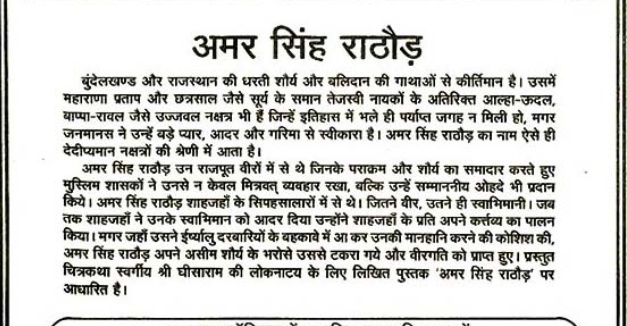
 राव अमरसिंह राठौड़ (11 दिसम्बर 1613 - 25 जुलाई 1644) मारवाड़ राज्य के प्रसिद्ध राजपूत थे। वो १७वीं सदी में भारत के मुग़ल सम्राट शाह जहाँ के राजदरबारी थे। अपने परिवार द्वारा निर्वासित करने के बाद वो मुग़लों की सेवा में आये। उनकी प्रसिद्ध बहादुरी और युद्ध क्षमता के परिणामस्वरूप उन्हें सम्राट द्वारा शाही सम्मान और व्यक्तिगत पहचान मिली। जिसके बाद उन्हें नागौर का सुबेदार बनाया गया और बाद में उन्होंने ही यहाँ शासन किया। सन् १६४४ में उनकी अनधिकृत अनुपस्थिति में सम्राट द्वारा कराधान से नाराज हुये और कर लेने के लिए जिम्मेदार सलाबत खान का तलवार से गला काट दिया। उनका वर्णन राजस्थान, पश्चिमी उत्तर प्रदेश और पंजाब के कुछ लोकगीतो में प्रसिद्धि प्राप्त है।


राजा गज सिंह मुगल शासक शाहजहां के अधीन मारवाड़ क्षेत्र के शासक थे। उनके पुत्र अमर सिंह राठौड़ एक महान योद्धा और एक देशभक्त थे, लेकिन उनके पिता ने उन्हें मुगलों से एक डाकू को बचाने के कारण राज्य से निर्वासित कर दिया था। बाद में वह शाहजहां की दिल्ली सल्तनत में शामिल हो गए जहा उन्होंने शाहजहां को अपनी वीरता से प्रभावित किया। जिससे उन्हें नागौर का जागीरदार बनाया गया। हालांकि सम्राट के भाई सलाबत खान, राज्य में अमर सिंह राठौड़ के उत्थान से जलते थे और राव अमर सिंह को बदनाम करने का अवसर की प्रतीक्षा कर रहे थे। उन्हें जल्द ही यह मौका मिल गया जब अमर सिंह की अनधिकृत अनुपस्थिति के बारे में कुछ छोटी सी चीजों के बारे में पता चला। सलाबत खान ने एक मुद्दा के रूप में इसे इतना बढ़ा दिया कि शाहजहां ने सलाबत से अमर सिंह को दंड देने का आदेश दिया। इसका फायदा उठाते हुए, सलाबत ने अमर सिंह को धमका कर उसी वक्त दंड का भुगतान करने को कहा। सलाबत ने यह भी चेतावनी दी कि वह अमर सिंह को बिना दंड का भुगतान किये उन्हें जाने नहीं देंगे।


अमर सिंह ने अपनी कटार बाहर निकाली और सलाबत को मौके पर मौत के घाट उतार दिया। सम्राट शाहजहां भी इस घटना से अचंभित हो गए और अमर सिंह को मारने के लिए अपने सैनिकों का आदेश दिया। हालांकि, बहादुर अमर ने अपने युद्ध कौशल को दिखाया और उन सभी को मार डाला जिन्होंने उनपर आक्रमण किया था। वह जल्दी से किले से भाग गए और सुरक्षित स्थान पर लौट गए।


अगले दिन अदालत में सम्राट ने घोषणा की कि अमर सिंह को मारने वाले को जगीरदार बना दिया जाएगा हालांकि कोई भी अमर सिंह राठौर के साथ दुश्मनी मोल लेने के लिए तैयार नहीं था, क्योंकि उन्हें सिर्फ एक दिन पहले ही अमर सिंह क्रोध का सामना करना पड़ा था। अर्जुनसिंह जो अमर सिंह के साले थे , ने लालच में आकर इस चुनौती को स्वीकार कर लिया। अर्जुनसिंह ने अमरसिंह से कहा कि शाहजहां को अपनी गलती का एहसास हो गया है और वे अमरसिंह जैसा योद्धा नहीं खोना चाहता। हालांकि अमर सिंह को शुरुआत में विश्वास नहीं था, परन्तु जल्द ही वे अर्जुनसिंह के विश्वासघात की कला के झांसे में आ गए।

इस बीच, शाहजहां की अदालत के सामने एक छोटा दरवाजा खड़ा किया गया था, जिससे राव अमर सिंह को अदालत में प्रवेश करने के लिए उसके सामने झुकना पड़ेगा। पहले अमर के कृत्यों को और अदालत में कार्यवाही देखकर , एक उत्सुक फकीर ने सम्राट से पूछा, "हम इतने सारे योद्धाओं वाले हिंदुस्तान को कैसे जीत सकते हैं" शाहजहां ने कहा, "रुको और देखें कि हम कैसे करेंगे "। अमर सम्राट के सामने झुकने के लिए तैयार नहीं था और अर्जुनसिंह ने ये जान लिया। उसने अमर सिंह को पहले प्रवेश करने कहा। अमर ने उनकी सलाह मान ली , अर्जुनसिंह दूसरी तरफ से आया और अमर सिंह की छाती में खंजर घोंप दिया ,अमर सिंह वही पर वीरगति को प्राप्त हुए। तो अर्जुनसिंह ने उनका सर काटा और सम्राट के पास ले गया। राजा ने फकीर की ओर इशारा किया और कहा "अब तुम्हें पता है कि हमने योद्धाओं से कैसे छुटकारा दिलाया"। बाद में शाहजहां ने अर्जुनसिंह को भी मार दिया।


अमर सिंह की मृत्यु की सूचना पर, उनकी पत्नी ,भल्लू सिंह और राम सिंह के नेतृत्व में राजपूत सैनिकों के साथ किले पर हमला किया जहां अमर सिंह का शरीर पड़ा था। हालांकि, हजारों मुगल सैनिकों ने राजपूत बलों को घेर लिया। बहादुर राजपूत बलों ने उन्हें विरोध किया जब तक अमर सिंह के शरीर को किले से दूर नहीं लिया गया। यद्यपि उन सभी राजपूत लड़ाकों ने अपना जीवन मृत्यु को समर्पित कर दिया , लेकिन वे कभी भी मुगल सल्तनत के सामने झुके नहीं। बाद में, किले में संकीर्ण दरवाजा लोकप्रिय रूप से अमर सिंह दरवाजा के रूप में जाना जाने लगा क्योंकि यह मुस्लिम सेना के ऊपर राजपूत बहादुरी का प्रतीक था। कुछ इतिहासकारों का दावा है कि शाहजहां ने स्थायी रूप से दरवाजा बंद करने का आदेश दिया क्योंकि यह उन्हें राजपूत बलों के हाथों से उनकी हार की याद दिलाता था। लोक कथा में उन राजपूत लड़ाकों की प्रशंसा में एक हृदयस्पर्शी गायन शैली विकसित हुई , जो स्वाभिमान के लिए लड़े और गर्व से मरे।आज आगरा के किले में आने वाले पर्यटकों के लिए मुख्य द्वार अमर सिंह द्वार ही है।


  लोकप्रिय संस्कृति में अमर सिंह राठौड़ को असाधारण शक्ति, इच्छा और स्वतंत्रता का प्रतीक माना जाता है। न ही डर, न ही लालच अपने फैसले को प्रभावित करने में सक्षम थे। वह एक स्वतंत्र व्यक्ति के रूप में अमर सिंह राठौर वीरगति को प्राप्त हुए और बल्ला चंपावत की बहादुरी अभी भी राजस्थान में लोकगीतों और आगरा के आसपास याद है। अमर सिंह पर आधारित एक हिंदी फिल्म 1 9 70 में 'वीर अमर सिंह राठौड़' नामक फिल्म बनाई गई थी और राधाकांत द्वारा निर्देशित थी। देव कुमार, कुमकुम और ज़ब्बा रहमान, ब्लैक एंड व्हाईट में फिल्म के प्रमुख अभिनेता थे। एक गुजराती फिल्म को एक ही विषय पर बनाया गया था और मुख्य भूमिका गुजराती सुपर स्टार उपेंद्र त्रिवेदी ने की थी। आगरा के किले का एक द्वार उन्हें 'अमर सिंह गेट' के रूप में नामित किया गया जो आगरा में एक प्रमुख पर्यटक आकर्षण है।


Wednesday, November 22, 2017

Concept of gravity originated from hindu gurukul


A little known school of scholars in south India discovered one of the founding principles of modern mathematics hundreds of years before Isaac Newton according to this new finding by Manchester University. Many would not believe how christian missionaries also helped in transporting this Information to Britian in 15th Century.

Dr George verghese Joseph from The University of Manchester says the ‘Kerala School’ identified the ‘infinite series’- one of the basic components of calculus – in about 1350. The discovery is currently and wrongly attributed in books to Sir Isaac Newton and Gottfried Leibnitz at the end of the seventeenth centuries.


The team from the Universities of Manchester and Exeter reveal the Kerala School also discovered what amounted to the Pi series and used it to calculate Pi correct to 9, 10 and later 17 decimal places.

And there is strong circumstantial evidence that the Indians passed on their discoveries to mathematically knowledgeable Jesuit missionaries who visited India during the fifteenth century. That knowledge, they argue, may have eventually been passed on to Newton himself.

Dr Joseph made the revelations while trawling through obscure Indian papers for a yet to be published third edition of his best selling book ‘The Crest of the Peacock: the Non-European Roots of Mathematics’ by Princeton University Press.


He said: “The beginnings of modern maths is usually seen as a European achievement but the discoveries in medieval India between the fourteenth and sixteenth centuries have been ignored or forgotten.

The brilliance of Newton’s work at the end of the seventeenth century stands undiminished – especially when it came to the algorithms of calculus. But other names from the Kerala School, notably Madhava and Nilakantha, should stand shoulder to shoulder with him as they discovered the other great component of calculus- infinite series.

There were many reasons why the contribution of the Kerala school has not been acknowledged – a prime reason is neglect of scientific ideas emanating from the Non-European world – a legacy of European colonialism and beyond. But there is also little knowledge of the medieval form of the local language of Kerala, Malayalam, in which some of most seminal texts, such as the Yuktibhasa, from much of the documentation of this remarkable mathematics is written.


He added: “For some unfathomable reasons, the standard of evidence required to claim transmission of knowledge from East to West is greater than the standard of evidence required to knowledge from West to East.

Certainly it’s hard to imagine that the West would abandon a 500-year-old tradition of importing knowledge and books from India and the Islamic world. But we’ve found evidence which goes far beyond that: for example, there was plenty of opportunity to collect the information as European Jesuits were present in the area at that time.

They were learned with a strong background in maths and were well versed in the local languages. And there was strong motivation: Pope Gregory XIII set up a committee to look into modernizing the Julian calendar.


On the committee was the German Jesuit astronomer/mathematician Clavius who repeatedly requested information on how people constructed calendars in other parts of the world. The Kerala School was undoubtedly a leading light in this area.

Similarly there was a rising need for better navigational methods including keeping accurate time on voyages of exploration and large prizes were offered to mathematicians who specialized in astronomy. Again, there were many such requests for information across the world from leading Jesuit researchers in Europe. Kerala mathematicians were hugely skilled in this area.


Monday, November 20, 2017

LEGENDARY QUEEN MOTHER PADMINI - IMMORTAL RAJPUTS

रगता सेता रंणा नमो माँ क्रसना नीला
कुळेस्सुरी आसुरी सुरी सुसिला गर्वीला,
दीरघ लघु वपु द्रढ़ा सबेही रूप विरूपा
वकला सकला व्रजा उपावंण आप अपूपा,
घण पवण हुतासण सूं प्रबळ, चामुंडा वंदूं चरण,
कवि पार तुझ ईसर कहै, कालिका जांणे कवण ।।१।।


हे माँ! आपके अनेक रूप हैं। आप अरुणवर्णा, श्वेतवर्णा तथा नीलवर्णा हो । आप भूलोक में कुलेश्वरी, पाताललोक में आसुरी शक्ति तथा देवलोक में देवशक्ति हो। आप सौम्य प्रकृति के प्राणियों में सुशीलता के रूप में तथा प्रखर पराक्रमी जनों में गर्व के रूप में शोभायमान हो। आपका स्वरूप बड़े से बड़ा (महतो महीयान्) तथा छोटे से छोटा (अणोरणीयान्) है। आप भक्तरक्षा के लिए दृढ़प्रतिज्ञ हो। आप सर्वरूपा हो। आप त्रिगुणातीत तथा त्रिगुणमयी हो। हे व्रज की उपास्या अम्बा! आपने अपने-आप से ही जगत् की सृष्टि की है। आप पवन और अग्नि से भी प्रबल तथा प्रचण्ड हो। हे चामुण्डा ! मैं आपके चरणों की वन्दना करता हूँ। आप कवियों की वर्णनशक्ति से परे हो, तथापि आपके दास ईसर ने आपकी महिमा का वर्णन करने की चेष्टा की है। हे कालिका! आपको कौन जान सकता है।

घम घमंत घूघरी, पाय नेउरी रणंझण,
डम डमंत डाकळी, ताळ ताळी बज्जे तंण,
पाय सिंघ गळ अडै़, चक्र झळहळे चऊदह,
मिले क्रोड़ तेतीस, उदो सुरियंद अणंदह,
अद्भूत रूप सकती अकळ, प्रेम दूत पाळंतिय
गहे गहे वार डमरू डहक, महमाया आवंतिय ।। २।।

हे महामाया माँ! आप इस अकिंचन ईसरदास को दर्शन देने सिंह पर सवार होकर आई हो। घूघरी की घमकार और नेवर की रणझण ध्वनि से वातावरण व्याप्त है। डमरू की मधुर डम-डम ध्वनि गूंज रही है। तेतीस करोड़ देवी-देवता आनन्द से तालबद्ध करतल ध्वनि कर रहे हैं। आपका एक चरण सिंह की गर्दन पर शोभायमान है। हे आदिशक्ति चक्रेश्वरी! आपके चक्र की प्रभा चौदह लोकों में व्याप्त है। आपका स्वरूप अद्भुत है। प्रेमतत्त्व आपकी कृपा का सन्देशवाहक है जो दुःख और दीनता से बचाता है। उसकी शक्ति अपार है।

चढ़े सिंघ चामुण्ड,कमळ हुंकारव कद्धौ,
डरो चरन्तो देख, असुर भागियो अवद्धौ,
आदि सक्ति आपड़े, रूक वाहिये रमंतां,
खाळ रगत खळहळे, ढळे ढींगोळ धरंतां,
हींगोळराय अठदस हथी, भखै मैख भुवनेसरी,
कवि जोड़ पांण ईसर कहे, उदो उदो आसापुरी ।। ३।।

ंिसंह पर सवार चामुण्डा माता ने मुखकमल से हुंकार की, तो भैंसे के रूप में विचरण कर रहा महिषासुर जो सबके लिए अवध्य था, डरकर भागने लगा। आप आदिशक्ति ने उसके सामने प्रकट होकर उसे रोका तथा खेल-खेल में त्रिशूल का प्रहार किया। रक्त का नाला बह निकला और महिषासुर वहीं ढेर हो गया। हे अठारह भुजाओं वाली भुवनेश्वरी हिंगलाजमाता! आपके सिंह ने महिषासुर को अपना आहार बना लिया। हे आशापूरा माता! आपका भक्त ईसरदास हाथ जोड़कर कर प्रार्थना कर रहा है कि आप भक्तों की रक्षा के लिए ऐसे ही बार-बार अवतरित होती ।


The recent debate ones about Rani Padmini of Chittorgarh have compelled me to write this post to you.

Dhimmi seem to be disgusted by the fact that the people of Mewar and a large population of india regards Rani Padmini as a brave woman worthy of immense respect because she chose self immolation over dishonour.


They cant even tolerate one word (which is baby not even babe)... But call 5 percent patriotic Royal Warrior community of 1.4 billion natives, goons and what not for raising voice against....

This kind of reverence to a queen who lived 700 years ago for an allegedly “regressive and patriarchal” decision and “celebration” of her sacrifice seems to have outraged many liberandus, progressive high on dope ideology, please allow me to demystify some myths (pun intended ) for you All.


Rani Padmini was the wife of Maharawal Ratan Singh who was the ruler of Mewar when Alauddin Khilji decided to conquer the Chittorgarh fort. Now, romanticism and popular culture has made us believe that Khilji attacked Chittorgarh because be wanted to “have” Rani Padmini. This is where all the confusion originates. Because your disillusionment about why Rani Padmini didn’t “choose life” also roots from this confusion. Because this idea that Khilji wanted to “have” Rani Padmini gives rise to the notions that why then she didn’t just let him “have” her and then continued to “Survive and thrive” (yours words, not mine)?

Unfortunately, medieval warfare was a little more complicated than that.


Chittorgarh is not a mere fort. It’s a massive 700 acres of fortified city. Formidably built on a 180 metres high mountain top. That’s huge even by medieval standards. The citadel was the seat of power in the region since 7th century and reasonably so. The citadel is massive, difficult to access and most importantly it’s designed to be self sustainable when faced with prolonged siege. The water reservoirs and lands within could sustain an army of 50,000 for almost a year. Considering the dry, sandy landmasses of north western India, you can imagine why the citadel was so coveted. Yes, Chittorgarh means power. Whoever held the fort, held absolute power in the region. It should now be evident why Alauddin Khilji was so interested .


Bollydawood seems to have tried his best to picture Khilji as a roughed, beareded romantic but as any true historian worth his salt would tell you he was no such thing. He was a barbarian who liked killing infants over the heads of their mothers and used to boast about making towers of 60,000 ‘kaafir‘ skulls. As far as sexual orientation goes he was a known homosexual and paedophile. Now if this all powerful sultan had coveted only Rani Padmini don’t you think he would have tried to have her kidnapped and smuggled out? But medieval warfare was more complicated than Bollywood’s twisted romanticism.


The war between Maharawal Ratan Singh and Alauddin Khilji resulted in a 8 month long siege of Chittorgarh. When finally they fought full frontal battle, the Maharawal died fighting. Now, what do you think would have happened then? Let me clarify further. When an invader intent on destroying another kingdom attacks, he does much more than just killing the ruler. Wars are fought more on psychological level than by swords and shields. Why do you think that even modern nations fiercely protect the family members of their heads of states?

Now how do you think Khilji would have proceeded after he had killed the Maharawal and most of his generals and lead warriors? Yes he would capture the fort. How do you think he would have awarded his battle worn, travel worn and hungry foot-soldiers? He would have ordered them to go berserk on the citadel’s residents. Rape any woman they find, loot anything they can lay their hands on, medieval armies where known to even rape and defile corpses.

Now how would he ensure that not a single living soul would dare to resist him further? The answer is obvious. He would hold the royal women and children captive. How he would ensure that the morales of the people of Mewar is broken to such extent that no one would dare an attack on him while he stays there? He would torture his captives and set examples.


Rani Padmini was the queen of a fierce warrior clan. Don’t let the Romanticism and cheap popularization of Bollywood’s film makers fool you into painting Rani Padmini as the naive, demure, fancy doll. Rani Padmini knew what is going to be the fate of herself and hundreds of other women inside the citadel. They would have been raped, brutalised in every way possible, first by the sultan and his chief generals then gradually in decreasing order of military ranking. They would have been flogged, stripped naked and paraded around. Any infants and children would have been killed before their mothers’s eyes and this would go on endlessly till the sultan had absolutely made sure not a single male rajput is left alive and motivated enough to start an uprising. The women who survived would then had been transported to his harems to be sold and resold as sex slaves as long as they live. Think, what would it have done to the morales of the vanquished people of Mewar who have lost family members in the long war to see their queen and her royal companions flogged through the streets and raped everyday?

Rani Padmini knew better. She made sure that the Rajput flame for vengeance had to be kept burning. She knew she and her companions would have nothing but misery, torture and diseases if they are captured alive. She knew the brutes storming their walls do not even spare corpses in their desparate lust and bid to humiliate. She knew she can’t have her people see her defiled dead body. So she made a choice.


Yes, a choice. The choice of a queen who deserves every bit of the goddess like reverence she commands amongst her people till date. She decided that the brutes who have killed her husband and his gallant warriors will have nothing but a pile of ashes when then breach the walls of her citadel. She decided that she will not allow herself to be defiled and insulted. She decided that she will not let her people down. She knew that her life was not merely her own but belonged to the people of Mewar who would one day rise again to avenge their beloved queen.


She could not have been more right, because Chittorgarh did not perish after Khilji captured it. Rani Padmini had kept the flame burning, merely a decade or so after that, Rajput Sisodiyas regained control of the citadel. Chittorgarh saw lionhearts like Rana Sangram Singh, Rana Udai Singh, Rana Kumbha and many other great Hindu rulers who kept on the glory of Mewar touching unfathomable heights.


RANI PADMINI DID NOT CHOOSE DEATH. SHE CHOSE IMMORTALITY.

Indian Army Officers and men of the 9 Grenadiers (Mewar) on August 26, 2010, the 707th Chittor Day, remembering the ferocious defence of that famous Rajput fort back in 1303. Seated fourth from left is Lakshyaraj Singh Mewar, lineal descendant of Maharana Hammir, the Rajput ruler who liberated Chittor in 1326. photo from Eternal Mewar

Mewar the greatest state in Rajputana contributed the 1st Mewar Infantry, which became the 9th battalion of the Grenadiers Regiment.

THE IMMORTAL RAJPUT'S - A RACE OF ROYAL WARRIORS


FOR THOUSANDS OF YEARS, A RACE OF WARRIORS RULED OVER A VAST PART OF THE INDIAN TERRITORY: THESE WHERE THE RAJPUT, WHOSE COURAGE CONTINUES TO INSPIRE US.


Some say that men are naturally made to fight in war: although the conditions of our world have changed so much that modern warfare is more an exchange between machines than it is of men, the past is full of stories of courage overcoming fear and societies that grew and flourished according to these values.


A fairly unknown example of the latter is that of the Rajput (or Rashput), a martial caste from north-eastern India, which retained a unique autonomy for over a thousand years, perhaps one that is only comparable to that of the Spartans from the Greek Hellas.


Rajputana (Modern Rajasthan) is named after these warriors, and according to Sanskrit etymologists Rajput comes from rasha-putra, which means son of the king. Despite the fact that their first historical mention dates back to the sixth centuries, they are described as ‘worthy of being feared’ in classical Indian literature, like the Mahabharata, the Puranas and the Vedas.

In addition to war, the main occupation of the Rajput was agriculture: like the cult to Mars among Romans, the gods of war are also those of peace, since this tradition believed that the gods would only favour a just war thus establishing peace must always be the ultimate goal.


More than a caste, the Rajput where a group of clans that governed an ample region of India. Their code of honour has been compared to that elaborated by Medieval European Knights, since they describe an honour that, like Japanese warriors, led them to commit suicide before an imminent defeat.


Nonetheless, while a samurai refuses surrender by slashing his stomach open, the Rajput took more radical measures in the face of defeat: in the jauhar, the men would dress in red and surrender to a certain death at the hand of their enemy’s army, which undoubtedly surpassed them in number (most of Mongolian origin), while their women and children entered a funeral pyre to surrender to the element, which according to their traditional literature, had burgeoned them.


It was until the twentieth century that their full decay took place, when Indira Gandhi abolished their titles, stipends and property rights. Some of the higher ranking hierarchs were able to keep a certain status by transforming their cities into hotels for tourists and by adopting the customs of the English colonizers; but the legend of the fire warriors will forever remain an example of courage facing all odds and, as an element that brings light to darkness, they teach us that honour knows no adjective when it is brandished by a family of warriors that defeats history and death itself.


INDIA'S HINDU SAMURAI: 
THE BRITISH EMPIRE'S LOVE AFFAIR WITH THE RAJPUTS


Providence could not have endowed a more difficult setting for India’s greatest romance. Along the periphery of the Thar Desert, beyond the undulating dunes and thorny brush, are the Rajput nations. From Gujarat in the west until Delhi and the foothills of Kashmir, there existed since time immemorial glittering kingdoms ruled by fighting men. Yet it was in the Indian subcontinent’s arid north, the realm of the harrier and desert fox, where Rajputana came to be. It was a land where rugged noblemen hunted game, built magnificent strongholds, and repelled the tides of conquest.

They are the ‘sons of kings’, divided among clans whose ancestry dates so far beyond recorded time that descendants claim divine origins. Among the Rajput clans, some trace their descent from the Sun, others the Moon, and still others believed their lineage came from fire.


Until modern times, the prevailing consensus as to the Rajputs’ point of origin was an Aryan descent from India’s mythical age. This unsubstantiated belief in a shared heritage with white Europeans later provided ample justification for the British Empire’s designs on the subcontinent. Furthermore, no single source gives a complete index of the Rajput families. The English soldier and adventurer Lt Col James Tod’s Annals and Antiquities of Rajasthan is the seminal volume about these soldier-aristocrats and remains the best introduction to the subject.

Divided among three dozen clans and even more sub-clans, many notable surnames stand distinguished in the historical record. Consider the Chauhan clan, who once ruled Delhi before the Afghan conqueror Muhammad Guri vanquished them in the 12th Century. It is the Guhilot clan, however, who would conceive of India’s greatest fortress: Chittorgarh. Seized from its former masters whose fortunes ebbed with the decline of an ancient empire – of which many are found across India – the Guhilots held Chittorgarh for several centuries and grew wealthy from its country, the kingdom of Mewar.


But why did Will Durant, in his The Story of Civilization: Our Oriental Heritage, compare the Rajputs to Samurai? Perhaps it was their preoccupation with honour, a trait manifested in another well-known clan, the Sisodyas, who in the early 14th Century replaced the Guhilots as overlords of Mewar. 


Like the Samurai, the Rajputs had their own code of conduct. Theirs was detailed in no less than the Mahabharata, Hindu civilisation’s epic poem. In it, the Hindu Kshatriya, or warrior caste, were beseeched to always fight fair and observe correctness in their doings. No conquest should be followed by plunder, no victory accompanied by the dishonour of one’s foes. Importantly, combat was a rite where cool heads prevailed. 


“A Man should fight righteously without yielding to wrath or intending to slay,” 

the Mahabharata read.


On the other hand, it was Tod the chronicler of Rajasthan who found parallels between the Rajputs and European knights, a comparison that no doubt resonated with his fellow Englishmen raised on Walter Scott and Cervantes, for whom the echoes of medieval pageantry rang with sweet nostalgia. Meanwhile, another historian, Mountstuart Elphinstone, agreed with Tod’s portrayal yet drew a different assessment of the Rajputs. 

“They had not the high-strained sentiments and artificial refinements of our knights,”

Elphinstone concluded, while lauding their fighting spirit.


THE WARRIOR CASTE DEFINED


One of the first serious writers on India, James Mill, philosopher John Stuart Mill’s father, produced The History of British India, a groundbreaking work that sought to explain the nuances of the Hindu world.

Mill claimed that once land ownership supplanted pastoral society, it was imperative for a religious class, or the priestly Brahmin, to coexist with fighting men who would protect them: the fabled Kshatriya. “To bear arms is the peculiar duty of the Cshatriya [sic] caste,” he wrote. “And their maintenance is derived from the provision made by the sovereign for his soldiers.”

Below these exalted social strata, according to Mill, were two lower castes of common labourers and even less reputable, and not mentioned, are the untouchables.


The provisions Mill referred to, in the case of the Rajput, were more than adequate. The quintessential Rajput warrior, middle-aged and seasoned by at least several campaigns, was a swarthy gentleman fond of the hunt and the pleasant diversions befitting a nobleman.

His face adorned by a flowing moustache, head wrapped in a turban dyed the colours of his clan, the Rajput was a dapper fellow. Come war time, a steel helmet crowned his head and astride his mount the warrior sallied forth with a lance and a round shield – the latter perfect for single combat.


When it came to the preferred mode of fighting, cavalry raids were a perennial favourite and very effective against their Turkic adversaries. Once mounted on either a Kathiawari or Marwari horse, Rajput formations wrought havoc on enemy formations.


Always prepared to meet his end, the Rajput fought in a shirt of mail and tied around his waist was a bright coloured sash that held two sheathed talwars (curved swords akin to the Arabian scimitar), and the fearsome katar dagger for dealing mortal blows at close quarters. Other warriors preferred the heavier khanda, a lengthy single-edged blade similar to a cutlass that was ideal for slicing through armour.


In later centuries the Rajputs would embrace the firearm. When the matchlock arrived in India via the Mughals, it was widely adopted and used until the late 19th Century. Despite this seeming prowess, Mill, for some inexplicable reason, was quick to dismiss the fighting prowess of Hindus. “Yet has India given way to every conqueror,” he observed.


This conclusion betrays a lapse in Mill’s scholarship. Apparently, he failed to acknowledge how numerous Rajput clans repelled invasions from the time of Alexander the Great to the Persian Nadir Shah in the 18th Century. But deriding the Hindu was a distasteful consequence of British imperialism. The irony is during the British Raj in the latter 19th Century, it was fashionable to commend so-called “warrior” or “martial” races within Indian society.

A dated but superb example is The Martial Races of India by Lieutenant General George MacMunn, written and published after the Great War. Another similar text is The Sepoy by Edmund Candler published around the very same period.

Both Candler and MacMunn were in agreement as to the valour and toughness of the Rajputs.


CONSTANT INVASION


These clans formed a prosperous civilisation, until the 18th Century when enterprising warlords across Central Asia saw India as a source of loot for their armies. The geography of the Rajput kingdoms, including Mewar, meant the Kshatriyas had no choice but to thwart these onslaughts or be dispossessed.

While Rajput cavalry could best the seasoned Turks, Afghans, and Mongols, many catastrophic defeats were also dealt by the would-be conquerors. Of ruinous portent was the arrival of Zahiruddin Babur (14 February 1483 – 26 December 1530), who sought to expand his tenuous control over Kabul by annexing Delhi and its surroundings. Babur might have perished at an early age, but he left a son, Humayun (6 March 1508 – January 1556), to finish what he started. The rise of the Mughals signalled the greatest tribulation forced on Rajputana’s kingdoms.

It was during the reign of Akbar (5 October 1542 – 12 October 1605), considered the most accomplished Muslim ruler in his era, when Mewar’s ruling Sisodya clan was humbled and their country almost ruined.

Having failed in compelling a union with his growing empire, the cosmopolitan Akbar sought to annex the kingdom of Mewar. It was sheer luck that the current Sisodya Maharana Udai Singh II was a weakling and once the siege commenced on October 1567, he quickly abandoned the fortress.

Rajput Hazar Mikhi Chain Armour

Akbar used the enormous wealth at his disposal to raise an army equipped with cannon and musket. The five-month struggle of Chittorgarh, where fighters from several clans held fast, was brutal. Despite having mined a portion of its impregnable walls and inflicted horrific casualties on the defenders, the Rajputs were unbowed. It was only their ideal of honour that doomed them to suicide at the last moment. The men died fighting while their families committed Jauhar, grisly ritual suicide by self-immolation.

Akbar’s victory was the third and last time Chittorgarh fell. Further disgrace followed in the Battle of Haldighati, where Mughal arms prevailed once again.
Their forces scattered, it was the renegade Sisodya Maharana Pratap Singh (9 May 1540 – 29 January 1597) who carried the red banner of Mewar. Maharana Pratap, as he is known today, was such an ardent rebel and tactician he became a folk hero.


Maharana Pratap’s struggle continued after his death until Akbar’s son Jahangir (30 August 1569 – 7 November 1627) grew weary of fighting the Rajputs. Sparing the sword, he signed a treaty with Maharana Pratap’s son and from then on lavished gifts upon the Sisodyas. The bewildering sums of these bribes are described with detail in Jahangir’s memoirs.

In a rare gesture of magnanimity, Jahangir even returned the regal Chittorgarh fortress to its former owners. But could the Rajputs survive the oppression of European colonialism?

They did, and it led to a new age of prosperity for these landed Kshatriyas. Once again, 

 A striking instance of unyielding sense of military honour amongst the Rajputs noted by Col. James Skinner. 


British troops were marching from Anupshahar, UP to further into UP and found a half ruined mud fort and wanted to occupy it because the half ruined fort offered no molestation, but was occupied by 13 Rajputs with their rusted matchlocks and old swords.


James Skinner approached them alone at first and they agreed to empty the fort provided they could take their arms with them, they moved out to the place where the British troops were halting. The people there scouted the notion that a dozen "miserable wretches" should not think of terms at all and were told to go without their arms. 


This was unacceptable to the Rajputs, the Rajput honor code made it impossible for them to leave their arms, They declared that they would rather die than abandon their arms, they could never return to their families with this dishonour. They pleaded and begged to the commander but to no avail.  

Eventually James Skinner stepped forward, -"No," he said; 

“ these people have ...have come in on the faith of my pledge, and you have no right to dishonour me. If you don't like the terms, put them where they were-send them back to their fort, and make better if you can."


"Well, then," 

said the thoughtless young men, 

“do so; let them go back, ..back, and see if they will gain by it—what can they do?” 

“You will soon see that," 

replied Skinner ; 

“there will be blood before long." 

The commander permitted them to return; and the Rajputs, their faces instantly brightening up, went back to the fort, ..exclaiming contemptuously, when they entered it, said- 

"Khoob toomhara lushker lao!” 

Translation:-
“It is well! now bring on your army!" 


The brave Rajput men then fought for the last time in their lives, and they fought like lions, they made not a movement until the party was close to the wall, when every one taking deliberate aim brought down just as many men killed or wounded as they themselves numbered—and amongst the rest lay the young officer. The party, thus disabled, retreated; and, being reinforced, advanced again. 

Again the Rajputs gave their fire with equal effect, and then, throwing down their matchlocks and drawing their swords, quietly awaited the assault. They neither barricaded the gateway, nor attempted to defend it; eventually all of the Rajputs were slain. The commander, alarmed or curious, now brought up more troops, who, on entering, found the inside of the little fort thickly strewed with their own people, among whom lay the thirteen Rajputs.

The Rajputs before dying had killed three to four times the number of Britsh troops as compared to their own numbers.


These 13 Rajputs instead to leaving the fort abandoning their weapons, chose to fight and killed 3-4 times their own numbers before eventually dying.

It is Tod’s Annals that explains why the Rajputs, having likewise suffered from the constant battles after the decline of the Mughals, sought help from the British Empire.

As early as 1775, in fact, a battalion of Rajput riflemen were levied by the East India Company, whose grip on the subcontinent was now uncontested after besting the French during the Seven Year’s War. By 1817 this core unit became the Rajputana Rifles, the foremost senior regiment in the Indian armed forces.


FROM ONE EMPIRE TO ANOTHER


It wasn’t until the 19th Century when Rajputana’s leading clans sought to federate with British India. A deal was brokered by the Maharanas and Charles Theophilus Metcalfe, a special aid to the acting British Governor-General in Delhi.

The reason was entirely practical, since by 1818 Rajputana had been economically ruined by the collapse of Mughal power, repeated invasions from Persia, as well as the resurgent Marathas who wished to carve out their own piece of empire.

Once the British controlled the whole of India, the Rajputs proved willing partners in governing the small kingdoms throughout this vast colonial possession. Their usefulness quadrupled as soldiers and allies, while the habits of the Rajput nobility also mixed well with their British counterparts.

The attraction, by any account, was mutual – this sentiment is found in the aforementioned The Martial Races of India by MacMunn. MacMunn believed the Rajputs were the Aryans of Central Asia and belonged to the same racial stock as modern Europeans. “They are the descendants of the warriors who carried forward the Aryan exodus and influx,” MacMunn concludes, before distinguishing the Rajputs from the Huns, the Tartars, and Mongols.

MacMunn also found the Rajputs to be a fair race, admiring their features that had the 

“Aryan beauty and physiognomy of the Greek.”

In MacMunn’s view, at least, these favoured Kshatriya were white men too.


INTO THE WORLD WARS AND BEYOND


Despite the understated contempt among the British for Hindus in general, the British Indian Army was a force to be reckoned with. 

8th Rajputs on the march near Shuster, Mesopotamia, Nov 1916


In World War I alone, 1.3 million Indians fought in every theatre and the Rajputana Rifles distinguished themselves in France, Palestine, and Mesopotamia (now Iraq).

Indian infantrymen of the 7th Rajput Regiment about to go on patrol on the Arakan front in Burma, 1944. WW2


Come World War II, it was in East Africa where the Rajputana Rifles rose to the occasion despite the brutality of modern warfare.

Come independence and bloody partition, the Rajputana Rifles fought every major war with Muslim Pakistan and were even deployed on counter-insurgency operations in Sri Lanka and Jammu-Kashmir.

The warrior kings of Akbar’s reign and James Tod’s book are long gone. Their weapons remain unused, their martial valour unneeded, as the noble Rajputs gently surrendered to the modern age. Nonetheless, In the first year of World War I, British General O’Moore Creagh summed up their character with exquisite praise: 

“They are, and ever have been, honourable, brave, and true.” 

His words fit the Rajputs to a tee.