Monday, June 4, 2018

Sushruta: The first Plastic Surgeon in 600 B.C.


|| सुस्वागतम् ||

शरीरे चैव शास्त्रे च दृष्टार्थः स्याद्विशारदः|
दृष्टश्रुताभ्यां सन्देहमवापोह्याचरेत् क्रियाः||
(सु. शा. ५/५१)

Sushruta, one of the earliest surgeons of the recorded history (600 B.C.) is believed to be the first individual to describe plastic surgery. Sushruta who lived nearly 150 years before Hippocrates vividly described the basic principles of plastic surgery in his famous ancient treatise 'Sushruta Samhita'

In 600 B.C. 'Sushruta Samhita'(Sushruta's compendium) which is one of the oldest treatise dealing with surgery in the world indicates that he was probably the first surgeon to perform plastic surgical operations. This paper presents a historical window into various contributions of Sushruta to plastic surgery and allied fields which were described in 'Sushruta Samhita' more than 2500 years ago.


Although many people consider Plastic Surgery as a relatively new specialty, the origin of the plastic surgery had his roots more than 4000 years old in India, back to the Indus River Civilization. The mythico-religious shlokas (hymns) associated with this civilization were compiled in Sanskrit language between 3000 and 1000 B.C. in the form of Vedas, the oldest sacred books of the Hindu religion. This era is referred to as the Vedic period (5000 years B.C) in Indian history during which the the four Vedas, namely the Rigveda, the Samaveda, the Yajurveda, and the Atharvaveda were compiled. All the four Vedas are in the form of shlokas (hymns), verses, incantations and rites in Sanskrit language.3 ‘Sushruta Samhita' is believed to be a part of Atharvaveda. 4
‘Sushruta Samhita'(Sushruta's compendium), which describes the ancient tradition of surgery in Indian medicine is considered as one of the most brilliant gems in Indian medical literature. This treatise contains detailed descriptions of teachings and practice of the great ancient surgeon Sushruta (Figure-1) which has considerable surgical knowledge of relevance even today.


Sushruta (600 B.C.)


The ‘Sushruta Samhita' contains the major surgical text of the Vedas and is considered to be the most advanced compilation of surgical practices of its time. ‘Sushruta Samhita' encomprises not only the teaching regarding the plastic surgery but contains composite teachings of the surgery and all the allied branches including midwifery and making it a comprehensive treatise on the entire medical discipline. Sushruta believed that knowledge of both surgery and medicine are essential to constitute a good doctor who otherwise “is like a bird with only one wing.” In fact, Sushruta emphasized in his text that unless one possesses enough knowledge of relevant sister branches of learning, one cannot attain proficiency in one's own subject of study. According to Sushruta, “Any one, who wishes to acquire a thorough knowledge of anatomy, must prepare a dead body and carefully observe and examine all its parts”. The method of study was to submerge the body in water and allow it to decompose followed by examination of the decomposing body at intervals to study structures, layer by layer, as they got exposed following decomposition. The most important point to note here is that the dissection was performed without using knife.
The exact period of Sushruta is unclear but most scholars put him him between 600 to 1000 BC.5,6,7,8Sushruta lived, taught and practiced his art in the area that corresponds presently to the city of Varanasi (Kashi, Benares) in northern part of India. Varanasi, on the banks of the Ganges is one of the holiest places in India and is also the home of Buddhism and Ayurveda, one of the oldest medical disciplines. The followers of Sushruta were called as Saushrutas. The new student was expected to study for at least 6 years. Before starting his training he had to take a solemn oath, which can be compared to that of Hippocrates.9,10 He taught the surgical skills to his students on various experimental modules, for instance, incision on vegetables (like watermelon, gourd, cucumber etc.), probing on worm eaten wood, preceding present day workshops by more than 2600 years.(Figure-2)


‘‘Saushrutas'‘ doing mock surgeries on gourds, watermelons, cucumbers


This master literature remained preserved for many centuries exclusively in the Sanskrit language which prevented the dissemination. of the knowledge to the west and other parts of the world. Later the original text was lost and the present extant one is believed to be a revision by the Buddhist scholar Vasubandhu (circa AD 360-350). In the eighth century A.D., ‘Sushruta Samhita' was translated into Arabic as Kitab-Shaw Shoon-a-Hindi and Kitab-i-Susrud. The translation of ‘Sushruta Samhita' was ordered by the Caliph Mansur (A.D.753 -774).11 One of the most important documents in connection with ancient Indian medicine is the Bower Manuscript, a birch-bark medical treatise discovered in Kuchar (in Eastern Turkistan), dated around AD 450 and is housed in the Oxford University library.12 The first European translation of ‘Sushruta Samhita' was published by Hessler in Latin and into German by Muller in the early 19th century. The first complete English translation was done by Kaviraj Kunja Lal Bhishagratna in three volumes in 1907 at Calcutta.1
The treatise's insight, accuracy and detail of the surgical descriptions are most impressive. In the book's 184 chapters, 1,120 conditions are listed, including injuries and illnesses relating to ageing and mental illness. The compendium of Sushruta includes many chapters on the training and practice of surgeons. The Sushruta Samhita describes over 120 surgical instruments (Figure-3), 5,13 300 surgical procedures and classifies human surgery in 8 categories.


Surgical instruments as described by Sushruta


The ancient surgical science was known as Salya-tantra.Salya-tantra (surgical science) embraces all processes aiming at the removal of factors responsible for producing pain or misery to the body or mind. Salya(salya-surgical instrument) denotes broken parts of an arrow /other sharp weapons while tantra denotes maneuver. The broken parts of the arrows or similar pointed weapons were regarded as the commonest and most dangerous objects causing wounds and requiring surgical treatment. Shushruta has described surgery under eight heads Chedya (excision), Lekhya (scarification), Vedhya (puncturing), Esya (exploration), Ahrya (extraction), Vsraya (evacuation) and Sivya (Suturing).9,10
All the basic principles of plastic surgery like planning, precision, haemostasis and perfection find an important place in Sushruta's writings on this subject.Sushruta described various reconstructive methods or different types of defects like release of the skin for covering small defects, rotation of the flaps to make up for the partial loss and pedicle flaps for covering complete loss of skin from an area.14 (Figure -4)


Sushruta doing earlobe reconstruction


One of the great highlight of Sushruta's surgery was the operation of Rhinoplasty. The making of a new nose captured the imagination of the medical world and brought him fame as the originator of plastic surgery.1The famous Indian Rhinoplasty (reproduced in the October 1794 issue of the Gentleman's Magazine of London) is a modification of the ancient Rhinoplasty described by Sushruta in 600 B.C.15 (Figure-5). Even today pedicled forehead flap is referred to as the Indian flap.


Reconstruction of the nose by forehead Rhinoplasty


Ackernecht has aptly observed -”There is little doubt that plastic surgery in Europe which flourished in medieval Italy is a direct descendant of classical Indian surgery”.5,16
In describing the method of Rhinoplasty (Nasikasandhana) Sushruta says 17:
“The portion of the nose to be covered should be first measured with a leaf. Then a piece of skin of the required size should be dissected from the living skin of the cheek, and turned back to cover the nose, keeping a small pedicle attached to the cheek. The part of the nose to which the skin is to be attached should be made raw by cutting the nasal stump with a knife. The physician then should place the skin on the nose and stitch the two parts swiftly, keeping the skin properly elevated by inserting two tubes of eranda (the castor-oil plant) in the position of the nostrils, so that the new nose gets proper shape. The skin thus properly adjusted, it should then be sprinkled with a powder of liquorice, red sandal-wood and barberry plant. Finally, it should be covered with cotton, and clean sesame oil should be constantly applied. When the skin has united and granulated, if the nose is too short or too long, the middle of the flap should be divided and an endeavor made to enlarge or shorten it.” (SS. 1.16).
Speculations have been raised as how, in the absence of anesthetics, the Indian surgeons carried out such major operations. Sushruta writes that “wine should be used before operation to produce insensibility to pain.” He again remarks: “The patient who has been fed, does not faint, and he who is rendered intoxicated, does not feel the pain of the operation.”
Sushruta considered surgery the first and foremost branch of medicine and stated1,3: “Surgery has the superior advantage of producing instantaneous effects by means of surgical instruments and appliances. Hence, it is the highest in value of all the medical tantras. It is eternal and a source of infinite piety, imports fame and opens the gates of Heaven to its votaries. It prolongs the duration of human existence on earth and helps men in successfully fulfilling their missions and earning a decent competence in life.”

Health, according to Sushruta is a state of physical and mental well-being brought about and preserved by the maintenance of humours, good nutrition, proper elimination of waste products and a pleasant harmony of the body and the mind. Sushruta says there can be nothing more magnificent than the act of treating human suffering, life giving, indeed is virtue and fame personified.
He warns that improper intervention with surgical maneuver due either to ignorance of the progress of the disease-process, greed for money or lack of judgment, lead only to complications. Sushruta's general advice to physicians would certainly apply to doctors in any age and anywhere in the world: ‘‘A physician who has set out on this path should have witnessed operations. He must be licensed by the king. He should be clean and keep his nails and hair short. He should be cheerful, well-spoken and honest'‘.
The genius of Sushruta prompted eminent surgeon Whipple to declare - “All in all, Susruta must be considered the greatest surgeon of the premedieval period.”18 Rhazes repeatedly quoted Sushruta as the foremost authority in surgery.13
The Sushruta's contribution in the field of Plastic Surgery can be enumerated as follows
Rhinoplasty (cheek)
Classification of mutilated ear lobe defects and techniques for repair of torn ear lobes (15 different types of otoplasties)
Cheek flap for reconstruction of absent ear lobe.
Repair of accidental lip injuries and congenital cleft lip.
Piercing children's ear lobe with a needle or awl.
Use of suture materials of bark, tendon, hair and silk.
Needles of bronze or bone (circular, two finger-breadths wide and straight, triangular bodied, three finger - breadths wide)
Classification of burns into four degrees and explaining the effect of heat stroke, frostbite, and lightening injuries14.
Fourteen types of bandaging capable of covering almost all the regions of the body and different methods of dressings with various medicaments.
Use of wine to dull the pain of surgical incisions.
Described 20 varieties of sharp instruments *(sastra) and 101 types of blunt instruments (yantra) and their handling techniques.
Systematic dissection of cadavers.
Advocated the practice of mock operations on inanimate objects such as watermelons, clay plots and reeds.
Use of leeches to keep wounds free of blood clots.
A code of ethics for teachers as well as students.
*”should have an edge so fine that it should divide the hairs on the skin.”
The Sushruta's contributions to allied fields are:
Surgical demonstration of techniques of making incisions, probing, extraction of foreign bodies, alkali and thermal cauterization, tooth extraction, excisions, trocars for draining abscess draining hydrocele and ascitic fluid.
Described removal of the prostate gland, urethral stricture dilatation, vesiculolithotomy, hernia surgery, caesarian section, management of haemorrhoids, fistulae, laparotomy and management of intestinal obstruction, perforated intestines, accidental perforation of the abdomen with protrusion of omentum.
Classified details of the six types of dislocations, twelve varieties of fractures and classification of the bones and their reaction to the injuries.
Principles of fracture management, viz., traction, manipulation, appositions and stabilization including some measures of rehabilitation and fitting of prosthetics.
Classification of eye diseases (76) with signs, symptoms, prognosis, medical/surgical interventions and cataract surgery.
Description of method of stitching the intestines by using ant-heads as stitching material.
First to deal with embryology and sequential development of the structures of the fetus.
Dissection and study of anatomy of human body.
Introduction of wine to dull the pain of surgical incisions.
Enumeration of 1120 illnesses and recommended diagnosis by inspection, palpation and auscultation.
Sushruta took surgery in medieval India to admirable heights and that era was later regarded as The Golden Age of Surgery in ancient India .Because of his numerous seminal contributions to the science and art of surgery in India, he is regarded as the 'Father of Indian Surgery' and the 'Father of Indian Plastic Surgery'.
In “The source book of plastic surgery'‘, Frank McDowell aptly described Sushruta as follows: “Through all of Sushruta's flowery language, incantations and irrelevancies, there shines the unmistakable picture of a great surgeon. Undaunted by his failures, unimpressed by his successes, he sought the truth unceasingly and passed it on to those who followed. He attacked disease and deformity definitively, with reasoned and logical methods. When the path did not exist, he made one.

Saturday, June 2, 2018

BEGINING OF CIVIL WAR - THE GREAT CALCUTTA KILLING OF AUGUST 1946


The Great Calcutta Killing of August 1946 took a toll of 30,000 men, women and children. The fighting that followed thereafter, consumed more than a million lives. And yet, the conflict has never been described as a war, but as communal riots.


Is not a riot a civil war, which is a non-international armed conflict? 

One could also call it an internal conflict. Take the riot in Northeast Delhi towards the end of February, wherein pistols and guns were freely used; albeit the weapons were mostly country-made. Victims suffered bullet wounds almost by the hundred. Many an establishment was the target of arson and several places appeared as if bombed from the air, although perhaps they were not.

In the days bygone, the use of guns was rare. Now it is common. Maybe in the future helicopters may be deployed in what we call riots. The question is: why are these conflicts in our country called riots? Is this an attempt to conceal this phenomenon?

The number of casualties is unlikely to be the reason; the Great Calcutta Killing of August 1946 took a toll of 30,000 men, women and children. The fighting that followed thereafter on the eve of Partition and after, consumed more than a million lives, which is a major war by any standards. And yet, the conflict and the killings have never been described as a war, but as “communal riots”. In contrast, India and Pakistan fought several wars—1947-48, 1965, 1971 and 1999. All these conflicts devoured fewer people than the Great Calcutta Killing.

A number of countries have experienced civil wars. England in 1642 had an internal war between the Cavaliers led by King Charles I and the Roundheads led by Oliver Cromwell. In 1861 began the historic American Civil War between the Unionists and Confederates, broadly the northern and southern states. Its major issue was whether to abolish slavery or not. Incidentally, Abraham Lincoln led the north and went down in history as the emancipator of black slaves.

The first civil war of the 20th century began in 1917 between the Royalists and Bolsheviks or Communists in Russia, also known as White and Red Russians, respectively. In 1936 commenced the Spanish Civil War, when General Francisco Franco seized power in the country but was resisted by the Leftist Republicans. A few years earlier in 1927, the long drawn out Chinese Civil War had commenced, fought between the Maoists led by Mao Zedong and the Kuomintang led by Chiang Kai-shek. It culminated in 1949 when the Communists triumphed.

Earlier in 1950, North and South Korea fought a civil war whose after-effects continue to be felt till this day. Communist North and capitalist South Vietnam clashed with each other in a civil war in 1955 that ended in 1975.

New York City has suffered several riots, particularly one that lasted from 1712 to 1741. An entire book, The Great Riots of New York City, has been written; yet, there is no reference to any expression as “civil war”. But for this, there might have been a special reason, which is to avoid reference to a conflict between the white people and the blacks.

There has been a recorded total of 8,175 riots across the country between 1950 and 1992. The first one, which was noted by R.N.P. Singh, a former Intelligence Bureau officer in his book Riots and Wrongs, was in Ahmedabad as far back as 1713 over Muslim objections to local Hindus lighting the traditional ceremonial fire during Holi. The riot continued for the next three to four days, taking a heavy toll of lives on both sides. Leaders of both communities had to work hard to restore peace in the city.

But what would India be trying to conceal? Is it to protect what M.K. Gandhi termed as “brotherhood” between the two communities and what Jawaharlal Nehru re-labelled as “secularism”? In between, India lost one-third of its land area to Pakistan. Whether we call it war, civil war or a riot, the fact is the country, its people and their economy—all bleed. The inevitable consequence would be retardation of national progress. If we accept this viewpoint, we would be able to begin a search for a solution.

There is an urgent need to recount the history that led up to the Partition of 1947. The younger people of all communities are mostly unaware of why and how the vivisection took place. A typical symptom of why information is badly needed is the frequent mention of Qaid-e-Azam Jinnah. True, he, as it were, scored the goal but there were at least three other forward line players who helped the centre-forward Jinnah. The first was Sir Sayyid Ahmad Khan of Aligarh, who in 1887 at Meerut publicly said that Hindus and Muslims were not the same but separate nations. The following year, at Lucknow’s Aminabad, he again stressed the same point.

Sir Sayyid advised his co-religionists not to join the Congress party or to mix with other communities. At the turn of the century, Calcutta High Court Justice Ameer Ali, on retirement, migrated to England and managed to persuade Lord Morley, the Secretary of State for India, to introduce separate electorates for Muslims in the Government of India Act of 1909. Poet Allama Iqbal, as President of the League in 1930 also asked a virtual separation in the north-west and north-east, coincidentally precursors of today’s Pakistan and Bangladesh.

In 1915, the Hindu Mahasabha was formed and ten years later the RSS was founded. Prime Minister Ramsay MacDonald called three Round Table Conferences in London between 1930 and 1932. Since the communities could not mutually come to any agreement, PM MacDonald gave his Communal Award, which gave the Muslims what they wanted by way of political leeway.

The name Pakistan was coined by a Cambridge scholar called Rehmat Ali. In March 1940, Jinnah addressed a plenary session of the League at Lahore where he explained in great detail that Hindus and Muslims were so different that they could not coexist in one country. They need to separate; the next day the Pakistan Resolution was passed by the Party. To quote Dr B.R. Ambedkar (Volume 8 of his Complete Works published by the Maharashtra government): “such was the Hindu-Muslim relationship from 1920 to 1940. Placed side by side with the efforts made by Mahatma Gandhi to bring about Hindu-Muslim unity, the record makes most painful and heart-rending reading. It would not be much exaggeration to say that it is a record of twenty years of civil war between the Hindus and Muslims in India, interrupted by brief intervals of armed peace.”

Jinnah did not disturb the government as World War II was raging until 1945. In August 1946, the League asked its Calcutta branch to launch an almighty communal riot in the city. Soon the casualty number mounted to approximately 30,000. The riots were used by the British as well as several top leaders of the Congress to argue that a partition was the only alternative. Coeval with the division, Jinnah and his seven senior party colleagues proposed an exchange of populations so that all or most Muslims could enjoy life in their homeland, Darul Islam, while Hindus and Sikhs could be safe and comfortable in Hindustan.

Is not a riot a civil war, which is a non-international armed conflict? One could also call it an internal conflict. Take the riot in Northeast Delhi towards the end of February, wherein pistols and guns were freely used; albeit the weapons were mostly country-made. Victims suffered bullet wounds almost by the hundred. Many an establishment was the target of arson and several places appeared as if bombed from the air, although perhaps they were not.

In the days bygone, the use of guns was rare. Now it is common. Maybe in the future helicopters may be deployed in what we call riots. The question is: why are these conflicts in our country called riots? Is this an attempt to conceal this phenomenon?

The number of casualties is unlikely to be the reason; the Great Calcutta Killing of August 1946 took a toll of 30,000 men, women and children. The fighting that followed thereafter on the eve of Partition and after, consumed more than a million lives, which is a major war by any standards. And yet, the conflict and the killings have never been described as a war, but as “communal riots”. In contrast, India and Pakistan fought several wars—1947-48, 1965, 1971 and 1999. All these conflicts devoured fewer people than the Great Calcutta Killing.

A number of countries have experienced civil wars. England in 1642 had an internal war between the Cavaliers led by King Charles I and the Roundheads led by Oliver Cromwell. In 1861 began the historic American Civil War between the Unionists and Confederates, broadly the northern and southern states. Its major issue was whether to abolish slavery or not. Incidentally, Abraham Lincoln led the north and went down in history as the emancipator of black slaves.

The first civil war of the 20th century began in 1917 between the Royalists and Bolsheviks or Communists in Russia, also known as White and Red Russians, respectively. In 1936 commenced the Spanish Civil War, when General Francisco Franco seized power in the country but was resisted by the Leftist Republicans. A few years earlier in 1927, the long drawn out Chinese Civil War had commenced, fought between the Maoists led by Mao Zedong and the Kuomintang led by Chiang Kai-shek. It culminated in 1949 when the Communists triumphed.

Earlier in 1950, North and South Korea fought a civil war whose after-effects continue to be felt till this day. Communist North and capitalist South Vietnam clashed with each other in a civil war in 1955 that ended in 1975.

New York City has suffered several riots, particularly one that lasted from 1712 to 1741. An entire book, The Great Riots of New York City, has been written; yet, there is no reference to any expression as “civil war”. But for this, there might have been a special reason, which is to avoid reference to a conflict between the white people and the blacks.

There has been a recorded total of 8,175 riots across the country between 1950 and 1992. The first one, which was noted by R.N.P. Singh, a former Intelligence Bureau officer in his book Riots and Wrongs, was in Ahmedabad as far back as 1713 over Muslim objections to local Hindus lighting the traditional ceremonial fire during Holi. The riot continued for the next three to four days, taking a heavy toll of lives on both sides. Leaders of both communities had to work hard to restore peace in the city.

But what would India be trying to conceal? Is it to protect what M.K. Gandhi termed as “brotherhood” between the two communities and what Jawaharlal Nehru re-labelled as “secularism”? In between, India lost one-third of its land area to Pakistan. Whether we call it war, civil war or a riot, the fact is the country, its people and their economy—all bleed. The inevitable consequence would be retardation of national progress. If we accept this viewpoint, we would be able to begin a search for a solution.

There is an urgent need to recount the history that led up to the Partition of 1947. The younger people of all communities are mostly unaware of why and how the vivisection took place. A typical symptom of why information is badly needed is the frequent mention of Qaid-e-Azam Jinnah. True, he, as it were, scored the goal but there were at least three other forward line players who helped the centre-forward Jinnah. The first was Sir Sayyid Ahmad Khan of Aligarh, who in 1887 at Meerut publicly said that Hindus and Muslims were not the same but separate nations. The following year, at Lucknow’s Aminabad, he again stressed the same point.

Sir Sayyid advised his co-religionists not to join the Congress party or to mix with other communities. At the turn of the century, Calcutta High Court Justice Ameer Ali, on retirement, migrated to England and managed to persuade Lord Morley, the Secretary of State for India, to introduce separate electorates for Muslims in the Government of India Act of 1909. Poet Allama Iqbal, as President of the League in 1930 also asked a virtual separation in the north-west and north-east, coincidentally precursors of today’s Pakistan and Bangladesh.

In 1915, the Hindu Mahasabha was formed and ten years later the RSS was founded. Prime Minister Ramsay MacDonald called three Round Table Conferences in London between 1930 and 1932. Since the communities could not mutually come to any agreement, PM MacDonald gave his Communal Award, which gave the Muslims what they wanted by way of political leeway.

The name Pakistan was coined by a Cambridge scholar called Rehmat Ali. In March 1940, Jinnah addressed a plenary session of the League at Lahore where he explained in great detail that Hindus and Muslims were so different that they could not coexist in one country. They need to separate; the next day the Pakistan Resolution was passed by the Party. To quote Dr B.R. Ambedkar (Volume 8 of his Complete Works published by the Maharashtra government): “such was the Hindu-Muslim relationship from 1920 to 1940. Placed side by side with the efforts made by Mahatma Gandhi to bring about Hindu-Muslim unity, the record makes most painful and heart-rending reading. It would not be much exaggeration to say that it is a record of twenty years of civil war between the Hindus and Muslims in India, interrupted by brief intervals of armed peace.”

Jinnah did not disturb the government as World War II was raging until 1945. In August 1946, the League asked its Calcutta branch to launch an almighty communal riot in the city. Soon the casualty number mounted to approximately 30,000. The riots were used by the British as well as several top leaders of the Congress to argue that a partition was the only alternative. Coeval with the division, Jinnah and his seven senior party colleagues proposed an exchange of populations so that all or most Muslims could enjoy life in their homeland, Darul Islam, while Hindus and Sikhs could be safe and comfortable in Hindustan.

Sunday, April 8, 2018

GREAT PALA EMPIRE- MAGNIFICENCE OF THE GOLDEN PAST

3rd Biggest - Pala Empire 4,600,000 sq.km. 700 AD–1100 AD 

WHATEVER HU SHIH'S VIEWS ON POST- BRIT INDIA MAY'VE BEEN, HE BEGRUDGINGLY SAID THAT INDIA CONQUERED & DOMINATED CHINA CULTURALLY FOR 20 CENTURIES WITHOUT EVER HAVING TO SEND A SINGLE SOLDIER ACROSS HER BORDER. 

WITH UNIVERSITIES LIKE THESE, IS IT ANY WONDER?

Brief introduction to the great universities/mahaviharas of medieval Eastern India....

Forgotten monuments of pasts....

We take great pride in our ancient universities like Nalanda Somapura, vikramashila, odantipura, jaggadala.

 But beyond that there just the dark pages of our history for most people (courtesy to our schoolbooks).

Image: Seal of Nalanda University

This post gives very brief look into that glorious past of ours.


Nalanda or "Sri Nalanda Mahavihariya Arya Bikshusamghasya" as the seal in previous image reads was unarguably one of the most celebrated of the universities of the Medieval India.


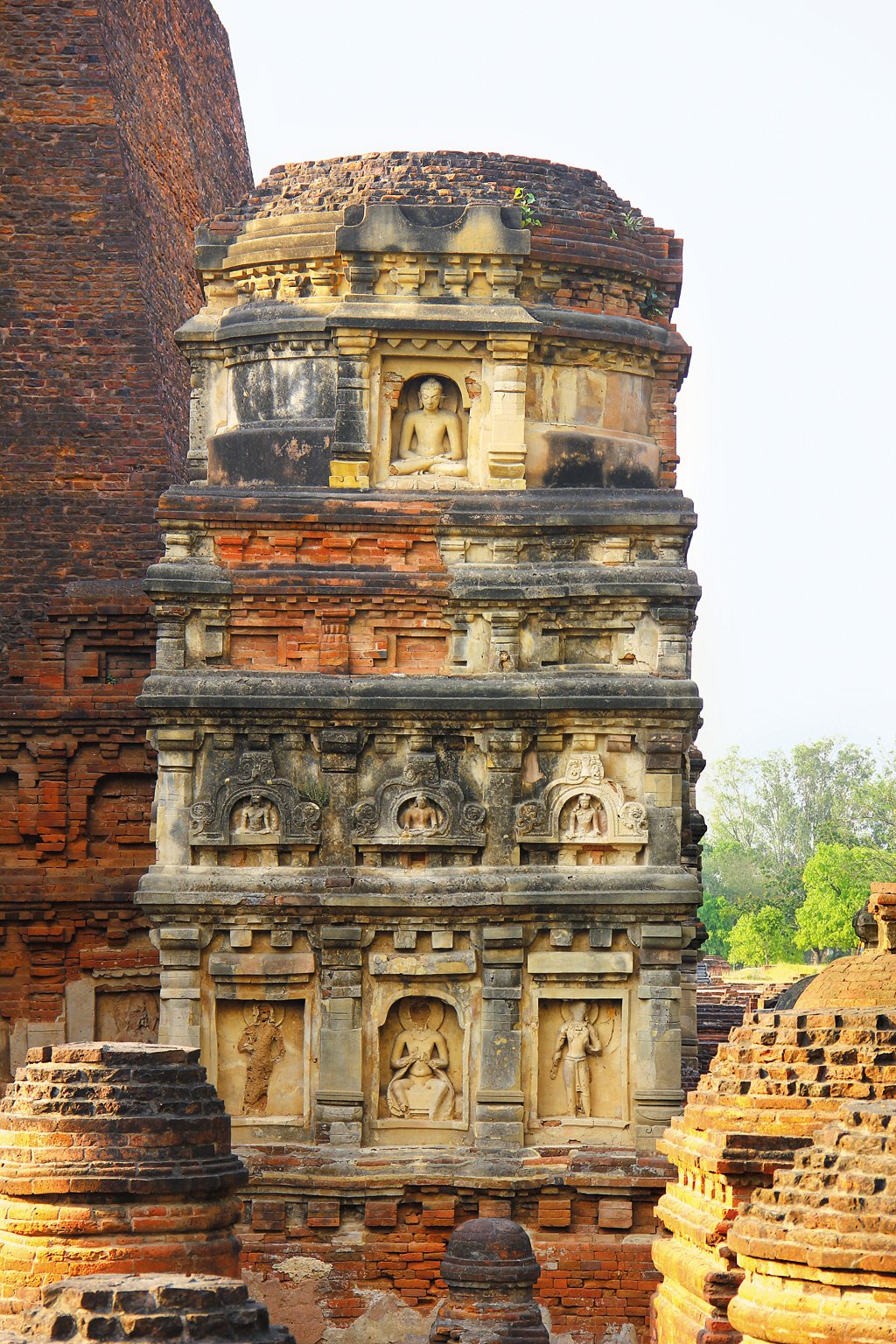
Ruins of monumental temples at Nalanda


Its 3 multi storey libraries housed the books written not only on Buddhist theological subjects but secular subjects like Logic, Philosophy, Mathematics, Medicine and Grammar.


Originally built in the Pancharatna style befit to the Mahavihara of the stature of Nalanda


they would have looked as grand as surviving grand temples of present like Brihadeshwara/Puri.


These dormitories of Nalanda at one time housed ~3000 monks, students & teachers.


Students came not only from India but from entire East & Central Asia, Tibet & beyond.


Talented teachers were recruited from as far as Kashmir and Afghanistan...Truly a global university! 

This copper plate charter from the Nalanda recording the donations from the king of Sumatra (Indonesia). IT gives further idea about the widespread popularity that Nalanda enjoyed once upon a time! Patronage came not only from Buddhist but also Hindu elites.


In Its glorious history came to an abrupt end in 13th century with the Jihadi inavsion of Khilji. 


The last recorded lesson in history of Nalanda was on Sanskrit Grammar by an aged monk named Rahul Sribhadra & sponsored by a local Brahmin named Jayadeva.... 


Somapura Mahavihara.


Known as "Shri Somapure Shri Dharmapaladeva Mahavihariya arya bhiksu sangghasya",


It was originally established by Emperor Dharampala Doda of Pala Empire in 8thcentury.


It was further patronized by subsequent Pala Rulers of Bengal & Bihar.


Monumental nature of its central temple/stupa and entire campus is impressive


When fully functional and not in ruins it must have been an impressive sites to behold with! The Pala empire existed from the 8th century A.D. to 12th century A.D. Reigning supreme during the late classical period on the sub-continent, the ruling dynasty, at its peak covered major portions of present day India, Nepal, Pakistan and Bangladesh. This empire was named "Pala" after the name of the royal family in power, who had "Pala" as suffixes to the name. This word from the ancient language of Prakrit translates to "protector". The kingdom started with the election of Gopala as the emperor of Gauda in 750 A.D.

They were known to be amazing diplomats and geniuses in military tactics. They were also known for their all-powerful elephant cavalry. Primarily, followers of Buddhism, they promoted classical Indian philosophy, literature, painting and sculpture. They also went on to build grand monasteries and temples like the Somapura Mahavihara and supported the great universities of Nalanda and Vikramashila.

(Terracotta panels running through the platform of the temples gives a glimpse into the mind of a medieval ordinary artisans and day to day lives of the people)

It was during the reign of Devapala and Dharmpala that the practice of making a fool of a close friend came into practice. They brothers ruled their empire (it was at its peak then) with an efficiency that rivalled the Roman Empire. They were known to be very just and loved by the public. Having divided the kingdom into the northern and southern frontiers, they used similar governing techniques and visited each other on alternate months to share their knowledge and exchange gifts.

The story goes as such that, during one such visit, Devapala the elder brother, had promised his younger sibling the best of sweetmeats that the North had to offer.  Dharmapala was known to have a sweet tooth, so he waited with baited breath as the day of his brother's arrival approached. When Devapala finally arrived at his palace, Dharmapala at once demanded that he be given his present that was promised to him. Devapala laughed and after a little formality, brandished a golden box that had the family crest on the top, made up of precious stones of various sizes and colours. Being the ruler of one-half of such a vast empire, mere gold and jewels did not impress Dharmapala. But when he opened the box, he was rather happy. But that happiness was short-lived.

Dharmapala took the biggest piece he could find and stuffed it into his face. And instantly regretted the decision. He immediately spat out the pseudo-sweet much to the delight of his elder brother who was laughing uncontrollably. Turns out the sweetmeats were made entirely out of coloured salt. This didn't spark a feud, as they were very close, however, it did start a chain of pranks that the brothers would partake in during their visits to each other.

(Spacious Living quarters surrounded the main temple/stupa and housed monks/students and teachers.)

This trend slowly caught on with their courtiers and with the upper-class administration and then eventually spread across their kingdoms. To celebrate their bond with each other with a little bit of fire mixed in, they called for one day in the year to be dedicated to a little bit of harmless fun. शरारत दिन. A day of playful naughtiness is what they called it. It was a day in the Pala Empire when friends played harmless pranks on each other with they only intention being to strengthen their bonds of love.

However, this trend more or less died with their empire, when the Sena Dynasty came into power during the 12th century. India is a country that is known to be playful, having some of the most amazing festivals in the world and not to mention the most number of public holidays in a calendar year. With days like Holi, when we say "Bura Namano, Holi Hain!" while we attack unsuspecting people with colours and water-balloon canons, it's easy to picture people running around with mischievous grins during the rule of the Pala Empire, saying "Bura Namano, Shararat Din hain!". Well, they'd say in Prakrit or Sanskrit or whatever was the local language, of course.


Few pics below to show their grandeur


Isn't it amazing 


Graphical reconstruction of Somapura Mahavihara


Also compare it with Scenic temples of Bagan in neighbouring Myanmyar. They show strong influence of Pala architectural style from Eastern India.


Basically This is how Somapura and other Mahaviharas would have also looked like once upon a time.. before It was deserted in late 12th c. CE after repeated Islamic invasions. 


Vikramshila Mahavira

Named after the Pala king Dharmapala who bore an epithet of Vikramshila and established this Mahavihara. 

Religion

All Pala kings were zealous Buddhists. They were liberal with their support to numerous monastic communities and for the upkeep of monasteries with patronage of the learned teachers heading them. Dharmapala reformed the religion although over the years his successors moved towards the Tantric form of Buddhist worship. By the middle years of the Pala rule the practice of Buddhism in Bengal was far removed from the one propagated by its originator, the ‘Enlightened One’. It had moved to a completely different space, with no connection to the original concept. The original version relied on a rationalisation of the human condition and was based on the observance of a code of ethics, which was considered inviolate. The trappings associated with conventional religion, its rituals and deities, were anathema and completely ignored. This idealistic situation could not endure for long and over a period of time Buddhism succumbed to the practices of the orthodox religion from which it was trying to separate.

A vAyu from the ruins of the somapura temple  in Praharpur in E.Bengal.

By the time the Pala dynasty reached the zenith of its power, the Buddhist icons were indistinguishable from the Hindu idols. Buddhist religious practice had by now acquired all that was shunned by the Buddha himself and was far removed from the ‘Middle Way’ that he had preached. In Bengal it also came under Tantric influence. The Tantras originate from a collection of esoteric texts of unknown origin that elaborate and describe difficult practices, which provided the practitioner a chance to commune with divinity and to assume supernatural powers. Its rituals and disciplines are complex and secret. The practice of Tantric rites consist mainly of mantras (repetitive formulae); yantras (mystical designs); and mudras (finger postures).

The shift towards a Tantric-influenced worship in the Buddhist religion compromised whatever was appealing in the practice of that religion for the lay person. This proved to be counter-productive for the popularity of Buddhism in the long-term. Over a period of time it became difficult for the common man to differentiate between orthodox Hindu practices and that of the evolving Buddhism, directly contributing to the decline and eclipse of the religion in its last bastion in India.


Its institutional structure included Adhyaksha, 6 Dwarpanditas, Mahapandita, 108 Pandita, 160 Upadhyayas and >1000 Bhikshus/students

Just Like Somapura, beautiful terracotta panels surrounded the entire platform of central stupa/temple of Vikramshila


Tibetan sources mention that during their last days, 


In anticipation of Jihadi invasion Vikramshila along with Odantpuri was heavily fortified by the military of Sena rulers. It none the less failed to stop the Jihadi onslaught & ultimate destruction of those Mahaviharas.
For
Vikramshila museum being visited by then President of India (along with future president of India)


Nothing is hidden. Defaced and mutilated sculptures recovered from Vikramshila are staring us in the eyes. But well when one wears the glasses of secularism...

Jaggadala Mahavira

Other two great universities Jagaddala & Odantapuri are still mostly buried beneath the earth and waiting archaeological excavations. 


Jagaddala Mahavihara (fl. late 11th century - mid-12th century) was a Buddhist monastery and seat of learning in Varendra, a geographical unit in present north Bengal. It was founded by the later kings of the Pāla dynasty, probably Ramapala (c. 1077-1120), most likely at a site near the present village of Jagdal in Dhamoirhat Upazila in the north-west Bangladesh on the border with India, near Paharapur. Some texts also spell the name Jaggadala.

Odantapuri Mahavira

Together with nalanda these five great Mahaviharas/universities formed a circuit of educational institutes with high degree of coordination and state control and the far spread acclaim.


In 1027 CE the Muslim invaders sacked & destroyed Jagaddala.


Maluti 108 Ancient Pala Temples

Maluti, a small village located on the border of Jharkhand and Bengal, is famous for it 108 ancient temples. The temples, made of terracotta, have great historical and religious significance, and contain Pala structures that have helped date the site archaeologically. The Kings of the Pala dynasty were devotees of the goddess Mowlakshi, and there are also temples devoted to the gods Shiva, Durga, Kali, and Vishnu.Today, only 72 temples remain intact, but they offer a unique economic opportunity to the village of Maluti.


CHAUSATH YOGINI TEMPLE

According to an inscription,It was built by Emperor DevaPala of the Pala Empire of North India in 9th century.

Chausath Yogini Temple, Mitavli, one of the rarest of Hindu temples in India. Its plan is circular and it is dedicated to the Tantric sect of Chausath Yogini. Most of the Hindu temples are based on square or rectangular plan. Circular temples are very rare. It is said that the design of Indian Parliament is inspired by this temple in Morena. It is also a very rare temple as there are only about a half a dozen Chausath Yogini temples in India. A Yogini in Tantra means a practitioner of Yoga, who has controlled her desires and reached a higher stage. They are related to the Matrikas and are basically various manifestations of the Divine Durga. This association with various forms of Durga gave rise to the cult of Chausath (64) Yoginis over time. The Chausath Yogini temple of Morena has an outer circle of 64 subsidiary shrines of Shiva with a central shrine of the Yogini. 


The 'Hedges Vishnu' in the Ashmolean Museum, University of Oxford - acquired in 1686, it is the oldest (by date of accession) Indian art object in a Western collection.
Pala Empire, 800-1100CE.
The two female figures are Lakshmi & Saraswati & Avataras in the Prabha


They were not only the great centers of education but also centers of art and culture.


A terrific 900 yr old murthi of Goddess Chamunda belonging to Pala empire who ruled over Bengal & Bihar. Notice the Mundamala & the Scorpion on the torso. At the very base r depicted asuras Chanda & Munda in a decapitated form. 

Smuggled away at @ LACMA (Los Angeles county museum of Art)


Intricately carved stone sculptures adorned their walls and Temple.

On side note: Look at the Pancharatna Stupa/Temple model of Mahavihara type on the last sculpture. 

Their libraries were filled with beautifully painted hand written manuscripts written on diverse variety of subjects.

This Very rare 1200 years old superbly painted Pala Empire period manuscript, probably frm Nalanda itself which has survived in complete condition for 1000 of years! 

Close up of a portion of the wooden cover of same manuscript to give further idea about its rich painting style of Medieval Eastern India


According to colophon it was donated by the mother of some great Pandita Ashoka during the reign of Surapala (last part of 11th century). This richly illustrated manuscript survived bcz prob. somehow it escaped destruction of Nalanda & managed to reach a Tibetan monastery. It is one of the rare illustrated manuscript from Pala period which have survived till present without much damage. Rare it may be, it still provides ample glimpse into the great libraries of Nalanda & other centres that were once adorned with 1000s of such manuscripts.

Beautiful bronze murtis were subject of devotion of studious yet pious monks...

Unfortunately all of these vanished in Jihadi invasions. But all was not lost. With the barbaric destruction of those Mahaviharas monks fled to the safe places like Nepal, Tibet and East India and along with it brought Buddhism, Indian art and culture to those regions.

For eg look at this 17th century bronze from China and Compare it with one from Bihar from above pic. Such striking resemblance even after >500 years!

Via Nepal & Tibet Pala art reached all the way to Chinese imperial courts even though it vanished in its homeland!

Greater Hindustan is neglected in the secondary literature. They have not looked at it. Pataliputra under the Pala Empire (until 1070) must be examined. After them: the 12th cent Muslim invasions. By 1300 Delhi was the biggest city in the Islamic east, acc to the credible Ibn Battuta.


Civilization had fallen but it soul remained alive!
Past can't be revived but lets at least remember that glorious past and strive to reach to the same heights of excellence in future. Lets these ruins be inspirations for us and may we achieve same excellence in education again!


Conclusion—The Importance of the Palas


At the height of their power, the Palas controlled a wide realm and enjoyed extensive influence across entire North India. As the predominant dynasty of the time, they were able to assert the right to reorder the affairs of North India to their own advantage. Bengal was no more at the periphery of Indian polity, but the core of politico-economic and military strength. Throughout their rule they held Magadha and Mungir (almost the entire Bihar), although Magadha was annexed by the Gurjara-Pratihara king, Mahendrapala, for a few years. The century between 780-890, which coincides with the combined rule of Dharmapala and Devapala, can be correctly assumed to be the most prosperous and greatest years of the Pala rule. The century is known for its marked intellectual and artistic activities and achievements.


This period saw the flourishing of two artists—Dhiman and his son Bitpalo (also called Vitapala)—who were painters, sculptors and bronze-founders of great repute. Some of their work is still extant and they are studied as two separate schools of Indian art in today’s contemporary art scenario. During the same period, Bhavadeva an exponent of the Brahmavidya system of philosophy, practiced and taught in the capital. Also, Madhava a well-known physician, produced commentaries on the tomes of Charaka (a great physician who lived around 175 B.C) and Susruta (considered the greatest surgeon of ancient time, who lived around 6th century B.C.). Unfortunately no buildings of the Palas survive for posterity, although a number of great tanks that the dynasty built in different towns in the central districts of the kingdom bear testimony to the involvement of the kings in projects of public benefit.

The Palas remain one of the most remarkable dynasties to have ruled a large Empire in India being the only royal line other than the Chalukyas to have reigned for nearly five centuries. Irrespective of the fact that there were two minor interludes when the Kambojas invaded in the 10th century and thereafter when the Kaivarta’s usurped power in the 11th century for a limited period, the Palas were at one time the foremost imperial power of medieval India. Although these two episodes of brief loss of power and kingdom were of minor importance in their immediate aftermath, they diluted the strength of the dynasty and also demonstrated to the feudatories that the great Palas could be defeated. The perception of Pala invincibility, which was one of the pillars of their dynastic strength, was removed.
Like every other dynasty in Indian history, and even in world history, the Palas vanished from the scene not in a blaze of glory, but in a rather timid manner, gradually becoming irrelevant to the broader political developments, holding on to an ever-decreasing geographical territory, becoming targets of rising and ambitious kings in the neighbourhood, and finally becoming a memory amongst the people. The golden days are remembered in folklore and song as are the faults and foibles of the lesser capable kings. This is the eternal law of the world as it moves on inexorably.