See the conquering hero comes.
An epitome of terror for Turk mlechhas..
He was the best in the Chahmans...
A multitalented personality..
"THERE is no spot in Rajputana",
says Colonel'Tod,
"that does not contain some record of the illustrious
Chauhan Rajputs; and though every race has had its career of glory, the sublimity of which, the annals of the Sisodias before the reader sufficiently attest, yet with all his partiality for those with whom he long resided, and with whose history he's best acquainted, his sense of justice compels him to assign the palm of martial intrepidity to the Chauhan over all the 36 royal races" of India.
 |
| The Ajmer inscription of the Shakambhari Chahamana ruler Vigraharaja IV (c. 1150–64 CE) claims that Chahamana belonged to the solar dynasty, descending from Ikshavaku and Bhagavān Shri Rama. |
Even the bards, to Solar family they belong, appear to articulate the very name as if imbued with some peculiar energy, and dwell on its terminating nasal with peculiar complacency. Although they had always ranked high in the list of chivalry, yet the seal of the order was stamped on all who have the name of Chauhan, since the days of Samrat Prithviraja, the model of every Rajput and who had a long line of fame to maintain. Of the many names familiar to the bard is Goga of Bhatinda who with forty-seven sons " drank the stream of the sword " on the banks of the Satluj, in opposing Mahmud of Ghazni."
The Chauhans rose and fell before the Gehlots
or the Sisodias attained to fame and before the
Rathors had their birth in Rajputana. They stemmed the tide of Afghan aggression for a very long time
until they were finally submerged in the fateful
year 1192 A.B. From the seventh to the thirteenth
century. they adorned the annals of Rajputana
with deeds of chivalry and valour, which found their
highest expression in the chivalrous career.
King Prithviraja, which put a seal on their
position at the head of Rajput hierarchy, and earned
for them the undisputed title to the crown of Rajput
chivalry.
King Visaldeva IV, also called Vigraharaja,
was the second son of Arnoraja or Anhaldeva, (also
called Anaji) king of Sapudlaksha, as the kingdom
of Ajaymeru(Ajmer) was then called, and came to the throne about A.D. 1152, after expelling his elder brother, the parricide Jugdeva. Both Jugdeva and Visaldeva were sons of Arnoraja by his queen Sudhava of Marwar. By his second queen Kanchandevi, the daughter of the celebrated Sidhraj Jai Singh, king of Gujrat, Arnoraja had a third son, named Someshwara, the father of the renowned King Prithviraja.
Chauhan King Arnoraja was Assassinated by His own son Jagaddeva. Traitor Jagaddeva was Slain by His Brother Vigraharaj IV, who Ascended the Throne of Ajmer. These were Tough Times For Chauhan Kingdom, as They had Lost a War against Chaulukyas of Gujrat, Resulting in Loss of Territories. Visaldeva' s reign is a landmark not only in the
history of the Chauhan Rajputs but also in the history of India. He was the first Chauhan Emperor of
India. He reduced to submission the various kings of
Hindustan. The principalities of Pali, Jalor and Nadole (the last, once an independent Chauhan kingdom) had during the time of Arnoraja acknowledged the suzerainty of the Gujrat king Kumarpal and transferred their allegiance to him.

However, all of that Changed with Vigraharaj IV, aka, "Bisaladeva". Visaldeva therefore attacked them. He " burnt Jalor, reduced Pali to a hamlet and Nadole to a marsh. All these were once Chauhan feudatories of Ajaymeru(Ajmer), and Visaldeva once more reduced them to their original status, and compelled them to look to Ajaymeru(Ajmer) rather than to Anhilwara Patan for protection and safety. *( Seethe Bijolian inscription dated the Samvat year 1226, (A. D. 1169),)* Visaldeva conquered Delhi from the Tanwars and made the king of Delhi a feudatory of Ajaymeru(Ajmer). He then advanced further north and then towards the East and drove the Musalmans out of Hindustan and became Emperor of India. Vigraharaja IV was an ancestor of Prithviraj Chauhan of the Tarrain fame.
 |
| In Delhi Shivalik inscription,he is described as "the god who made Aryavarta once again true to its name", i.e someone who made Aryavrata for Aryas once again by defeating the Mlechhas. |
There is difference of opinion as regards the date
of his conquest of Delhi. It has been placed by
various authorities between A. D. 1139 and 1166.
As a matter of fact, the event took place sometime
between A. D. 1153 and 1163; for, according to
an inscription ( For this inscription, see Dr. Kielliorn, Indian Antiquary, Vol. xx, p. 201. ) in the Rajputana Museum, Ajmer, Visaldeva was making preparations, in Ajrner to move towards Delhi and the north in A. D. 1153; arid the inscription on the famous Siwalik Pillar in Delhi ( See Indian Antiquary, Yol. xix p. 215 ; and Asiatic Be$earche8, Vol. viii, p. 130.) dated the 9th April 1164 says that the Emperor had conquered the whole of Hindustan.
The reign of Vigrahraj IV is a landmark and the golden period of Chauhan Empire.
He bravely fought the Turkish Malechas of Afghanistan for 2 decades and gave them several crushing defeats. His empire reigned from Himalaya Foothills in North to Vindhyanchal in South.
As per His own Inscriptions, His dominions Extended From Foothills of Himalayas in North, upto Vindhyas in South.
Delhi Siwalik Pillar of 9th April 1164 AD Tells Us That Vigraharaj Repeatedly Attacked Muslim Invaders, and Drove Them Out Of Aryavarta. Vigrahraj IV is said to restored Bharata as land of Aryans defeating Turks.
The Bijolian Inscription also disposes of another
popular error that Prithviraja of Ajmer got Delhi
by inheritance when he was adopted as son by
king Anangpal of Delhi. It is now clear that
it was not Prithviraja who got Delhi, as wrongly
stated in the famous Prithviraja Rasa, but his father's elder brother, Samrat Visaldeva, who had conquered it, and who, by extending his conquests to the whole of Upper India, was the first of the Chauhan Emperors of India the Chauhans being the last of the Kshatriya races who became Lords Paramount of India. This fact has now been proved beyond doubt by the Delhi Siwalik Pillar inscription shared below.
The history of this pillar called the Delhi
Siwalik Pillar is a chequered one. Built by Emperor Asoka nearly three hundred years before Christ, it
has seen many a dynasty come and go in India.
It is a single shaft of pale pinkish sandstone, 42 ft.
7 inches in length, of which the upper portion, 35 ft.
in length, has received a very high polish. Its
upper diameter is 25-3 inches and its lower diameter
38*8 inches, the diminution being 3-9 inches per foot. Its weight is rather more than 27 tons.
This celebrated pillar was originally erected at a
place called Topar Suk or Topur or Tobra and was
situated on the bank of the Jumna in the district
of Salora near Khizrabad, 180 miles from Delhi.
This position at the foot of the mountains points out
the present Khizrabad on the Jumna just below the
spot where the river issues from the lower range of
hills. Salora is perhaps Sidhoni, only a few miles
to the west of Khizrabad. Visaldeva, after conquering the territories from Vindhya to the Himalayas reached this place at the foot of the latter mountain, and seeing this pillar there had his inscriptions engraved on it. From this place it was removed to Delhi about A.D. 1356, by Firoz Shah Tuglak (A.D. 1357-88) The pillar was conveyed by land on a truck to Khizrabad from whence it was floated down the Jumna to Ferozabad or New Delhi and fitted on the top of the three-storied building called Firozshah's Kotilla. When it was fixed, " the top was ornamented with black and white stonework surmounted by a gilt pinnacle from which it received its name of Minar Zarin or Golden pillar. This gilt pinnacle was still in its place in A. D. 1611 when William Finch came to Delhi."
This pillar was one of several such put up in
the middle of the third century B. c. by Emperor
Asoka for the promulgation of his edicts in the Pali
language. The Asoka inscription on it ends with a
*(Cunningham's Archaeological Survey Reports, Vol. I., p. 164.)* Sentence in which the Emperor directs the setting of these monoliths in different parts of India as follows :
"Let this religious edict be engraved on stone pillars and stone tablets that it may endure Forever."
The other inscriptions on it are those of
Emperor Visaldeva. They are three in number and
are of great historical importance. The first is immediately above Asoka's edicts, and the other two
immediately below them. The upper one is engraved
and much larger characters than the lower ones. *( See Professor F. Kielhorn of Gottingen in the Indian Antiquary for uly, 1890, Page 215.)*
An impression o these inscriptions was presented
to the Asiatic Society of Bengal by Lt.-Col. Polier,
ind from it an account and partial translation of the
ascriptions as explained by lladhakant Sharma were
given in 1788 A.D. in the Asiatic Researches, Vol. I,
Dp. 379-382. Another impression of the inscriptions
prepared under the supervision of Captain James
Joare was presented to the same society in the
)eginning of the 19th century. These inscriptions with in English translation by H. T. Colebrooke was
Dublished in 1801 A. D in the Asiatic Researches,
Vol. VII, pp. 179-181. Captain Wilford referring to
Them in Vol. IX, pp. 188-189, pointed out that
Visaldeva was mentioned also in the Sarangadhra
Paddhati nearly in the same words with the inscriptions. On this, Colebrooke amended his reading of The text See his Miscellaneous Essays, Vol. II, pp. 232* 237; see also Prinsep's Essays, Vol. I,
D. 325. Later, Mr. Fleet supplied correct impressions
ind photo-Lithographs of these inscriptions to
Professor Kielhorn who has edited them in the
Indian Antiquary^
The first inscription covers a space of about 1' 11"
broad by from 8" to 10" high ; and the size of the
letters is between 2" and 2". The second covers a
space of about 3' 10" broad by about 8" high ; and
the size of letters is i". The third covers a space of
about 5' broad by about 1' V high ; and the size of the letters is about If in the first four, and about 1" in
the remaining two lines. Throughout, the writing is
well preserved, so that the actual reading of the text
of the inscription is nowhere in the least doubtful.
The characters are Nagri, with nothing renmrkable
about them except that the sign for which shows a rather peculiar form e.g. in Sakambhari-bhupati, in the first inscription, line 2, which we meet again, e.y., in the * Palam Baoli' inscription of the Vikrama year 1337.
All the three inscriptions were evidently written by
the same writer, the Kayastha Sripati, a son of
Mahava, of Gor descent (third inscription, line 5).
The language of the inscriptions is Sanskrit; the first
is in prose; the second in verse; and of the third,
lines 1-4 are in verse, and lines 5-6 in prose. As
regards Orthography the consonant b is denoted by
the sign for v in the word wrote in the third
inscription, line 3, the only word in which it occurs.
In the * Palam Baoli' inscription of the Vikrama
year 1337, which has been already mentioned above,
we are told that the country of Hariyanaka, to which
* Delhi' belonged, was first ruled by the Tomaras,
afterwards by the Chauhans, and later by the Saka-
rulers, i.e. the Muhammadans. And similarly, the
Delhi Museum inscription of the Vikrama year 1384
relates that 'Dhillika' was founded by the Tomaras,
and that it was afterwards the residence of Chahamanas, until it was conquered by the Mlechchha Sahabadin. Our inscriptions show that the Chahamana Visaldeva- Vigraharaja, king of Sakambhari (or Sambhar), had conquered a considerable tract of country even beyond
Delhi, and had apparently checked for a time the progress of the Muhammadan invaders by whom his
own descendants were defeated twenty seven years
after the date of these inscriptions. Samrat Vigraharaja is also said to have captured both Delhi and Hansi, a strong fort on the plain between the Sutlej and Yamuna rivers, in an inscription issued by Prithviraj's father in 1170 CE.
Another Chauhan inscription from 1168 is found at Hansi itself, corroborating that this fort was truly once in Chauhan hands. It is likely, therefore, that Vigraharaja's sovereignty was acknowledged over much of Haryana and the Delhi territory, and a large expanse of Rajasthan.
SIWALIK PILLAR INSCRIPTIONS
The first inscription simply says : " Samvat 1220,
Vaisakh Sudi 15th (9 April 1164 A.D.), this monument is of the Lord of bakambhari, Sri (illustrious), Visaldeva, the son of Sri (illustrious) Anhaldeva."
The second inscription is a eulogy of Visaldeva
and says that when he goes on an expedition he
resembles Vishnu. *( See Asiatic Researches % Vol. viii, p. 130.)*
It says:
" Om; tears are evident in the eyes of the enemy's
consort ; blades of grass are perceived between thy
adversary's teeth ; thy fame fills with glory all
space; the minds of thy foes are void of hope;
their route is the desert where men are hindered
from passing, Vigraharajdeva, when the Jubilee of
thy onward march has come. May thy abode,
Vigraha, Sovereign of the Earth, be fixed, as in reason it ought, in the bosoms (akin to the mansion of
dalliance) of the women with beautiful eyebrows, who were married to thy enemies. There is no doubt of thy being the highest of embodied souls. Didst thou not sleep in the lap of Sri (prosperity) whom thou didst seize from the ocean, having churned it."
The third is the most important of all and says:
"In the year 1220 (9th April, 1164), on the fifteenth day of the bright half of the month of Vaisakh (this
monument) of the fortunate Visaladeva, son of the
fortunate Anhaldeva, king of Sakambhari. As far as
the Vindhya, as far as the Himadri (Himalayas) having achieved conquest in the course of travelling to Holy places ; striking at the haughty kings and gracious to those whose necks are humbled, making Aryavarta once more what its name signifies (Land of Aryas), by causing the barbarians (Mlechhas) to be exterminated by Visaldeva, supreme ruler of Sakambhari and sovereign of the Earth, is victorious in the world. This conqueror, the fortunate Vigraharaja, king of Sakambhari, most eminent of the tribe which sprang from the arms (of Brahma) now addresses his own descendants ; ' by us the region of the earth between Himavat and Vindhya has been made tributary; let not your minds be void of exertion to subdue the remainder/ In the year, from Sri
Vikramaditya, 1220 on Thursday the 15th day of the
bright half of the month of Vaisakh. This was written
by order of the king in the presence of the astronomer Sri Tilak Raja, by Sripati, the son of Mahava, a Kayastha of the Gor family. At this time the fortunate Salakshana Pala, a Kaja-putra is prime minister. Siva the terrible, and the universal monarch."
*(See Professor F. Kielhorn's translation in the Indian Antiquary, July, 1890 A. D, p. 215. Also, Professor Colebrooke's translation in the Asiatic Researches, VoL viii, p. 130.)*
The remnants of its glorious Hindu past is still there, the carvings and the engravings on its pillars speaks of its past. This proud boast of Visaldeva that he had exterminated the barbarians and made Aryavarta once more what its name implies, marks the birth of the Empire which attained its zenith of glory under
Emperor Prithviraja, the beau ideal of Rajput chivalry.
His earnest appeal to his successors to drive them
beyond the borders of India, though unheeded by the
first three of his successors, found an echo in the thrilling heart of his nephew, the chivalrous Prithviraja, whose glorious exploits shed lasting lustre not only on Chauhan arms but on the whole Hindu race.
This expulsion of the Musalmans from Hindustan
occurred when the Yaminia dynasty of the Ghazni
Sultans founded by Sultan Subuktagin was still
reigning. Though the Musalman historians, as is
customary with them, omit defeats and skip over
reverses, and do not describe this event, it is clear that the Sultan who was driven out of Hindustan by
Visaldeva was either the last but one of this line,
the Khusrau Shah, who ascended the throne in A B.
1150 and who, according to the TazHrat-ul-Maluk,
returned from the Punjab to Ghazni subsequent to
the retirement of Alaud-din Hasan, son of Hasan
Ghori from Ghazni after plundering it; or, his son
Khusrau Malik, the last of the descendants of
Sultan Mahmud of Ghazni who had come to the
Punjab in A. D. 1160, and who was eventually impri-
soned and murdered by Sultan Muizzudin bin Sam,
popularly known as Shahbuddin Ghori, in A. D. 1186. *(Duff's Chronology, p. 165.)*
Visaldeva's immense army, as stated in the stone
inscriptions in the Rajputana Museum, Ajmer, (Lalita
Vigraharaja Natak of the poet Someshwara), consisted of one thousand elephants, a hundred thousand cavalry, and several lakhs of infantry. His Prime Minister appears to have been one Sulakhshanapdl. *(The Indian Antiquary, Vol. xx, p. 201.)
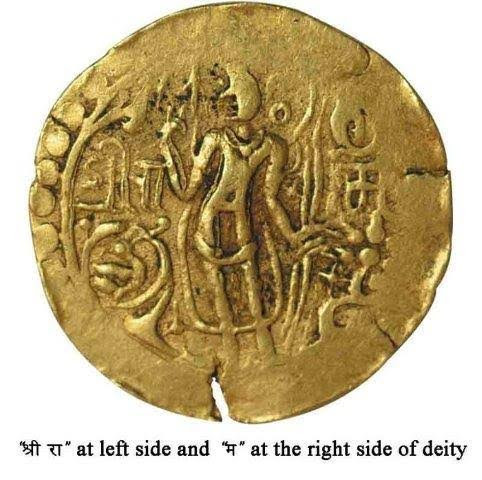
Coin of Chauhan King Vigraharāj IV (1150-64 AD)
Coin Depicts Lord Ram along with Legend श्री राम Written On it.
Lord Ram is seen holding a bow & arrow in this coin with “Sri Ra Ma” written in above bird and flower symbols across field / “Srimad Vigrahraj-deva” written in Devanagari.
Samrat Visaldeva founded a number of towns in different parts of his dominions and named them all Visalpur. One of them still stands about seven miles to the south- west of Thoda, at the south-west corner of the Girwar mountain range in Mewar. Its situation is striking. It lies at the mouth of the chasm-like gorge which runs through the range to Raj Mahal. The Dai and Khari rivers here join the Banas and form a triveni and the united streams then run through the pass to the east of the range. The pass is very narrow at each end with high precipitous cliffs closely approaching each other from the opposite sides, but it widens out into a great mountain-girded amphitheatre in the centre, where the Banas river in the rainy season forms a great lake called Anasagar, after Visaldeva's father Anaji.
" At the entrance to the pass is the temple of Visaldeva undefiled by the Muslim, which contains inscriptions of Emperor Prithviraja, dated Samvat 1231 and 1244 (A. D. 1174 and 1187)."
Emperor Visaldeva was a monarch as much distinguished for letters as for valour. Like the Roman emperor Marcus Aurelius or Sri Harshadeva who flourished in the sixth century A. D., his literary
achievements rivalled his military glory, and show that he was as pre-eminent in arts of peace as in deeds of arms.
Getting back to The Ajaymeru(Ajmer), Vigraharaj Built a Sanskrit Collage and a Saraswati Temple in 1153.This Collage and Temple were Exactly Same as 𝘗𝘢𝘵𝘩𝘴𝘩𝘢𝘭𝘢 (school) Built By Raja Bhoj in Dhar. It was Later converted In a Mosque. Visaldeva was a great poet. Fragments of his drama "Harakeli Natak" engraved on slabs of blackstone found buried in the courtyard of the Adhai Din ka Jhonpra at Ajmer in 1875 A. D., prove his scholarship. He was a great king he established sanskrit pathshala too but demolished by muslims and turned it into some dhai din ka jhopda.
Although, Invaders Tried to Turn it into a Mosque as Best As they could, There still Remains Enough Evidence of It being a Hindu Monument.
ADHAI DIN KA JHONPRA
Most People Have Heard About 𝘈𝘥𝘩𝘢𝘪 𝘋𝘪𝘯 𝘒𝘢 𝘑𝘩𝘰𝘱𝘥𝘢. However, Not Many Know About its Hindu Past.
Adhai Din ka Jhonpra is one of the oldest mosque in India that was built on the basis of Indo-Islamic architecture. Mohammad Ghori ordered the construction of the mosque
But where does the Name "𝘈𝘥𝘩𝘢𝘪 𝘋𝘪𝘯 𝘒𝘢 𝘑𝘩𝘰𝘱𝘥𝘢" Comes From?
Emperor Visaldeva- Vigraharaja has left two memorials of his memorable reign in Ajmer. The first is the College built by him which was converted into a mosque during the time of Qutbuddin Aibak and Sultan Shamsuddin Altamash and is now known as the Adhai Din Ka Jhonpra. From an antiquarian as well as an architectural point of view, the Jhonpra is one of the most important buildings in India. General Cunningham the first Director- General of
Archaeology, says: "There is no building in India
which either for historical interest or archaeological importance is more worthy of preservation. *(Annals and Antiquities of Rajasthan, Vol. i, p. 778.)*
Colonel Tod holds it to be " one of the most perfect as well as the most ancient monuments of Hindu architecture" still preserved. *(Cunningham's Archaeological Survey'Btportot el i, p. 456.)*
In its conception and execution, this building was
a fit monument of the reign of Emperor Visaldeva.
As a work of art, it was an exquisite ornament of the
Capital of his Empire. As a specimen of Hindu sculpture, this college building marks the high water-
mark of excellence attained in the art.
"For gorgeous prodigality of ornament, beautiful richness of tracery, delicate sharpness of finish, laborious accuracy of workmanship, endless variety of detail, all of which are due to the Hindu masons, this building'', says General Cunningham, " may justly vie with the noblest buildings which the world has yet produced.
*(Archaeological Survey of India, Vol. ii, p. 263.
a History of Eastern and Indian Architecture, p.)* Mr. Fergusson says: "As examples of surface decoration, the Jhonpra and the mosque of Altamash at Delhi are probably unrivalled. Nothing in Cairo or in Persia is so exquisite in detail, and nothing in Spain or Syria can approach them for beauty of surface decoration."
The building was originally constructed as a College house. It was built in the form of a square 259 feet each side, with cloisters on all the four sides enclosing a spacious court-yard, and four splendid star-shaped cloister towers on the four corners, surmounted by magnificent chhatrees.

The building stood on a high terrace, and was originally constructed against the scarped rock of the hill, having the Saraswati Mandir (Temple of Learning) on the western side, and entrances towards the south and east. The interior consisted of a quadrangle 200 feet by 175 feet. A comparison of this building with an almost similar one at Dhar also converted into a Mosque, and which is still known as Raja Bhoja's Pathshala (School), would remove all lingering doubts regarding its origin.
The towers, the exquisitely-designed fluting and ornamental bands of the columns, and the wonderful cloisters in the shape of a quadrangle, which originally extended to 770 feet, and of which only 164 feet are now left, were destroyed by the ignorant bigotry and fanaticism of the Afghans of Ghor, who attacked Ajmer under Shahabuddin Ghori in 1192 A. D.

Later in 1199 AD, They Started To Turn This Sanskrit Collage into A Mosque. It took them More than 15 Years to do so. the alteration consisted principally of the addition of the magnificent screen-wall, consisting of seven arches *(The number of columns of the pillared hall ill fit in with the size of the arches, and clearly shows what is old and what is new.)* fronting the western side, and the insertion in the back wall, of the inevitable mehrab or arch inseparable from a mosque, and the erection of a pulpit or mimbar near it. The imamgah or mehrab in white marble was built in 1199 A. D., and the screen wall was added during the time of Sultan Shamsuddin Altamash, about 1213 A.D. The conversion was carried on under the management of different persons, the names of two of whom are recorded Abubaker, the son of Ahmad (1200 A.D.), and Ahmad, son of Muhammad the Aariz. The inscriptions have the name of Iltumish and the supervisor named Ahmad ibn Muhammad al-Arid.
Thus, the work of reconstruction or conversion took more than fifteen years from 1199 to 1213 A.D. In Latter half of 18th Century, Moslem Fakirs Started Celebrating Urs of Their Leader Panjaba Shah, which lasted for 2 and a half Days.

The Western side of the quadrangle is a
vast pillared hall 248 feet long by 40 feet wide,
covered by a flat recessed roof, which is divided into
nine octagonal compartments corresponding with the seven arches of the screen wall and the two corners of the cloisters. In this hall there are five rows of columns, of which one row is placed against the back wall. Altogether there are 70 pillars now standing. These pillars have a greater height than those at the Kutub, and are more elegant in their sculpture and general appearance than the converted mosques in Malwa and Ahmedabad. *(Captain H. H. Cole's Preservation of National Monuments in Rajputana (1881).)*
"After confessing and admiring the taste" says
Colonel Tod, "of the vandal architect, we passed under the arch to examine the more noble production of the Hindu. Its plan is simple and consonant with all the more ancient temples of the Jains. It is an extensive saloon, the ceiling supported by a quadruple range of columns, those of the centre being surmounted by a range of vaulted coverings; while the lateral portion, which is flat, is divided into compartments. But the columns are most worthy of attention. They are unique in design, and with the exception of cave temples, probably among the oldest now existing in India. On examining them, ideas entirely novel, even in Hindu art, are developed. Like all these portions of Hindu architecture, their ornaments are very complex, and the observer will not fail to be struck with their similarity; it was evidently a rule in the art to make the ornaments of every part unlike the other, which I have seen carried to a great extent. There may be forty columns, but no two are alike.

The ornaments of the base are peculiar both as to form and execution; the lozenges, with the rich tracery surmounting them, might be transferred, not inappropriately, to the Gothic Cathedrals of Europe. The projections from various parts of the shaft (which, on a small scale, may be compared to the corresponding projections of the columns in the Duomo at Milan), with the small niches still containing the statues, though occasionally mutilated, give them a character which
strengthens the comparison, and which would be yet
more apparent, if we could afford to engrave the details. The elegant Camacumpa, the emblem of the Hindu Ceres, with its pendant palmyra branches, is here lost, as are many emblematical ornaments, curious in design and elegant in their execution. Here and there occurs a richly-carved corbeille, which still further sustains the analogy between the two systems of architecture; and the capitals are at once strong and delicate. The central vault, which is the largest, is constructed after the same fashion as that described at Nadole; but the cocentric annulets, which in that are plain, in this are one blaze of ornaments, which with the whole of the ceiling is too elaborate and complicated for description."
*( Annals and Antiquities of Rajasthan, Vol. i, p. 780,)*
The second memorial of Emperor Visaldeva is
the lake built by him named Visalsagar, and now called Vislya or Bislia. This beautiful lake was in old times, one of the two most notable and picturesque features of Ajmer. It is an artificial lake, oblong in shape.
The celebrated Prithviraja Rasa says that the
Emperor, returning from a hunt, one day finding
springs of water and hills amidst beautiful surroun-
dings called his ministers and ordered a lake like
Pushkar to be built. *(Prithviraja Rasa, Adiparva, Chhand 364.)* And Visalsagar was constructed accordingly.
It received the overflow from the Anasagar, which had been built by Visaldeva's father, Anaji or Arnoraja(1135-1150 A.D ) as well as water flowing down the western and northern slopes of Taragarh and the adjacent hills this side of Lakshmi Pol, through the Inderkot. It is about 2| miles in circumference. The surrounding embankment was faced in stone, with steps leading to the bottom of the lake. Temples and bouses stood all
round, and there were two islands in the lake in
which stood palaces for the king.
Though the embankment remains all round in a
more or less ruined state, as also the massive stairs on the eastern side a short distance from the water weir, nothing is left of the temples and buildings to mark the ancient grandeur of the place.
*("The vestiges of an island are yet seen in the lake, and upon its margin; but the materials have been carried away by the Goths," Tod's Rajasthan, Vol. I, p. 783.)* Images were extant on the embankment during the time of the Mahrattas (1790-1818 A.D.), which sent forth jets when the water rose to their lips.
The islands are hopelessly ruined, though marks
of a reservoir and foundations of buildings remind
the spectator that in ancient times the Visalsar
was a beautiful lake with island palaces fit to adorn
the capital of an Emperor distinguished as much for
letters as for valour. Up to the time of Jahangir the
place had some pretensions to beauty, as the Emperor in his memoirs (Tuzake Jahangiri) says that while at Ajmer in 1615 A.D., he ordered repairs to be executed to the lake.
The English church now stands on the south-west
embankment of the lake, where once stood the temples of the sun-god. In the north-east corner of the lake, on the embankment, is an enclosure containing Chhatrees and Chabutras built over the remains of the ancestors of the Osival Seths called the Dada bari
(ancestors' enclosure).
Bisaldeo Temple, Tonk
The temple is located in Bisalpur or Visalpur, which was also earlier known as Vigrahapura. The town was established by the Chahamana king Vigraharaja IV alias Visala or Bisal Deo (r. c. 1150–1164 CE). The king commissioned the temple that is now known as Bisal Deoji's temple.
Bisalpur is considered very important due to the temple of Gokarnesvara, also known as Bisal Deoji’s temple. It was constructed by Vigraharaja IV, who was an ardent devotee of Gokarna. The inner sanctum of the temple enshrines a Shiva Linga.
The courtyard of the temple is now partly submerged by the waters of the Bisalpur Dam reservoir whenever the water level is high; before the construction of the dam in the 1990s, the temple stood on the top of a hill overlooking the confluence of the Banas and the Dai rivers. The Archaeological Survey of India has classified the structure as a Monument of National Importance. The organization has also carried out a restoration of the temple.
INSCRIPTIONS
 |
| Visaladeva inscription on Delhi-Topra pillar, 12th century. |
Ten inscriptions of the time of Visaldeva have so far
been found, three on the Siwalik Pillar at Delhi of the
year A.D. 1164; one, on a pillar in the Bhuteshwar
temple in Lohari village in Mewar dated the Samvat
year 1211 (A.D. 1154) stating that Vishneshwara Pragya Acharya of the Shaiva religion bestowed a golden dome to the Siddeshwara temple, and six in the Adhai Din ka Jhonpra, Ajmer.
Of these six inscriptions, two are very small ones
and are engraved on the lintels of the two small staircases by the back wall of the cloistered hall, leading from the roof of the hall to the top of the Imamgah Mehrab of white marble. The one in the northern stair-case is fading fast, while the other one is in good condition, and "This building was constructed by the illustrious King Vigraharajadeva." The other one simply says, "Made by the illustrious King Vigraharaja."
During Its Renovation in the remaining four, recovered in 1875-76 A.D., consist of six tablets of polished basalt, inscribed in Devanagri of the twelfth century A.D., and are more or less in fragments. Four of these tablets contain fragment of two old plays in Sanskrit and Prakrita, hitherto unknown. On slabs one and two are engraved parts of the play called the Lalita Vigraharaja Nataka, "The Lovely Play of Vigraharaja," composed by the learned poet Sornadeva, in honour of the Emperor Vigraharaja of Ajmer. Slabs three and four contain portions of a play by Emperor Vigraharaja himself in honour of Siva, called Harakeli Nataka, or the play of Hara (Siva). The play is partly in imitation of Bharavi's Kiratarjunlya. It also contains the praise of the Emperor by Siva for the play. The date of the play as given in the inscription, corresponds to Sunday, the 22nd November, 1153 A.D.
These inscriptions were engraved by Bhaskar, son
of Mahipati and grandson of Govinda (a favourite of
King Bhoj), belonging to a family of Hun chiefs.
The fifth inscription is engraved on a slab and is
the beginning of a poem, the name of which is not
given. It contains the Stuti, invocation to and praises
of various devtas (gods), and finally comes to Surya,
from whom, says the poem, the Chauhans are descended. The remaining portions appear to have been engraved on other stones, which undoubtedly still lie buried in the debris of the Jhonpra. This inscription is in pure Sanskrit language.
The sixth inscription was evidently a Praasti 9
concerning the Chauhan Kings of Ajmer. Only a
few pieces of one of the slabs of the Prasasti have
been found. This inscription mentions that "Ajmer
was made for his residence by King Ajaideva," that
he conquered Narvarma (King of Malwa) on the
border of Avanti (Ujjain), and that after giving his
throne to his son, he became a Vanaprasti and took up his abode in the forest of the sacred Pushkar. It
is further stated that his son adorned the land of
Ajmer with the blood of Turushkas, as a woman whose husband returns alive and victorious from war adorns herself in clothes of red Kusunhk colour. It is also stated that the warriors of this king captured the elephants of the king of Malwa. The name Kumar
Pal is also found engraved on one of the pieces, but
for want of the next connected piece nothing further
can be made out of this name.
Pr. Kielhorn has edited the two inscriptions
engraved on the first four of the slabs mentioned
above, in the Indian Antiquary, Vol XX, p. 201-212.
The first inscription engraved on slabs one and two,
contains a portion of lalita Vigraharaja Nataka. He
say's:" The first slab contains thirty seven lines of writing which cover a space of about 3' 5" broad by I'll* high. The writing of lines 1-18 and 21-32 apparently is in a state of perfect preservation, though in the rubbing the first line is very indistinct. At the commencement of lines 33-36 some aksharas are mising, owing to the lower proper right corner of the stone having broken away. The lines 1 to 36 cover the whole breadth of the inscribed surface; the line 37 measures only 9|" in length, and is placed below the centre of the preceding line. The size of the letters is about jV'. The characters are Nagari of the twelfth century A.D. They were well and regularly written and carefully engraved by learned Bhaskara, the son of Mahipala. The languages employed in the inscription are Sanskrit and several Prakrita dialects.
The inscription contains the end of the third act
and a large portion of the fourth act of the Lalita-
Vigraharaja Nataka. It opens with a conversation
between Sasiprabha and the king (Vigraharaja), from
which we may conclude that the king was in love with a daughter of a prince Vasantapala. The two lovers^ one o whom apparently has seen the other in a dream, being separated, Sasiprabha, a confidant of the lady, is sent to ascertain the king's feelings ; and, having attained her purpose, she is about to depart to gladden her friend with her tidings, when the king confesses that he cannot bear to part with Sasiprabha, and proposes to send Kalyanavati to the princess instead. Accordingly Kalyanavati is despatched with a love-message, in which the king informs the lady that his march against the king of the Turushkas, a battle with whom appears to be impending, will soon give him an opportunity of joining her. Suitable preparations having been made for making Sasiprabha 5 s stay with the king comfortable, the latter goes to attend to his mid-day ceremonies. Thus ends the third act.
At the opening of the fourth act, two Turushka
prisoners appear on the scene, which represents the
camp of the King (Vigraharaja) of Sakambhari or a
place close to it, in search of the royal residence.
In their perplexity they luckily meet with a country-
man, a spy, sent to the camp by the Turushka king.
This man tells them how he has managed to enter the enemy's camp, in the guise of a beggar, together with a crowd of people who went to see the god
Somesvara. fle also informs them that the army of
the Chahamana (Vigraharaja) consists of thousand
elephants, a hundred thousand horses, and a million of men; in fact, that by the side of it the ocean would
appear dry. And having pointed out the king's
residence, he departs. The two prisoners take their
places near the royal quarters; they meet with the
king, who is thinking of his beloved, address him (in
rerses which unfortunately are greatly damaged in
the text), and are sent away richly rewarded.
Vigraharaja now expresses his surprise that his
own spy, whom he has sent to the camp of the Hammira, has not returned yet. But just then the spy
comes back and informs his master of what he has
been able to learn regarding the enemy's forces and
his movements. According to his account, the
Hammira's army consists of countless elephants,
chariots, horses and men and his camp is well guarded. On the previous day it was three Yojanas distant from Vavveraa, the place where Vigraharaja then is, but it is now located at a distance of only one Yojana. There is also a rumour that the Hammira, having prepared his forces for battle, is about to send a messenger to the king.
The spy having been dismissed, Vigraharaja sends
for his maternal uncle, the Raja Simhabala, and, having explained the state of affairs, consults with him and his chief minister Sridhara as to what should be done. The cautious minister advises not to risk a battle with the powerful adversary. But the king, intimating that it is his duty to protect his friends, is too proud to enter upon peaceful negotiations, and is encouraged by Simhabala to act according to his own views. While they are still consulting, the arrival of the Hammira's messenger is announced. The stranger is admitted into the royal presence, expresses his wonder at the splendour and the signs of power which surround the king, is struck with Vigraharaja's own appearance, and cannot conceal from himself that the task entrusted to him will be a difficult one to perform.
Here the inscription on the first slab ends. It may
be assumed that Vigraharaja and the Hammira on the present occasion did not fight, and that the king
eventually was united with his lady-love.
The second slab contains 38 lines of writing which
cover a space of about 3' broad by 1/10* high, and
contains a large portion of the first act and the beginning of the second act of the play. The writing appears to be well preserved, but the stone has several cracks by which some aksharas may have been damaged or lost and from the commencement of the second act it appears that the name of Vasantapala's daughter, with whom Vigraharajadeva is represented to be in love, was Desaladevi; and from line twenty, that this princess resided in the north, near or at the town of Indrapura(P)
 |
| Hindu-style pillar |
The second inscription also consists of two slabs,
slabs no. three and four. The third slab contains the concluding portion of the fifth act, called Kraunchavijaya, of the harakeli-nataka which in line 40, as well as in lines 32 and 35, is distinctly called the composition of the poet, the Maharajadhiraja and Paramesvara, the illustrious Vigraharajadeva of Sakambhari (line 37). It opens with a conversation, held by Siva, his wife Gauri, the Vidushaka, and a Pratihara, in which, so far as the fragmentary state of the inscription permits one to see, the worship rendered to Siva by Havana is spoken of with approval. Siva and his attendants then, for reasons which are not apparent turn into Sabaras or mountaineers. Noticing some fragrant smell, as of some oblation presented to him, the god despatches his attendant Muka to ascertain the cause of
it. Muka returns and reports that Arjuna is preparing
a sacrifice. He is told to assume the form of a
Kirata, to go near Arjuna, and there to await Siva.
As soon as he has left, Siva perceives that Muka and
Arjuna, who were enemies before, begin fighting with one another. He therefore goes himself, as a Kirata,
to assist his attendant; and behind the scene a terrible battle ensues between the god and Arjuna the progress of which is related to Gauri by the Pratihara and which ends with the god's acknowledging the valour of his opponent, and bringing him on to the stage. It is hardly necessary to say that the poet here has imitated the Kiratdrj aniya of Bharavi.
The two deities, Siva and Gauri, reveal to
Arjuna their real nature; and Arjuna asks their forgiveness for whatever he may have done to offend them, and praises Siva as the most supreme divine
being. Siva, pleased with Arjuna's valour and piety,
presents him with a mystical weapon and dismisses
him. After Arjuna's departure, Siva tells Gauri that
the poet Vigraharaja has so delighted him with his
Harakeli-nataka that they must see him too.
Vigraharaja then himself enters, and after a short
conversation, in which he pleads in favour of his
Harakeli ; and the god assures him of the pleasure
which that play has afforded to him, and tells him that his fame as a poet is to last for ever, he is sent home to rule his kingdom of Sakarnbhari, while the god with his attendants is proceeding to Kaila^a.
The fourth slab contains 41 lines of writing which
cover a space of about 3'1J" broad by 2' 2" high and
contain portions of the second and third acts of the
play. Of this inscription too the writing appears on
the whole to be well preserved.
Dr. Kielhorn says (Indian Antiquary, Vol. XX,
p. 203) ; "The metres of the twenty eight verses which my extracts contain are Sardulavikridita(in ten verses), Vasantatilaka (in seven verses), Sikharini (in four verses), Sragdhara (twice), and Anushtubh, Arya, Pushpitagara, Harini, and Mandakranta (once each).
None of these verses occurs in either Sarngadhara's
Paddhati or Vallabhadeva's Subhashitavali, and
Professor Pischel, informs me that none is quoted in
any of the work on Alamkara, accessible to him".
Dr. Kielhorn Says: l ' The Prakrita dialects employed
in the first inscription are besides the ordinary
Sauraseni, Maharashtri, in the two Arya verses recited by the lady &aiprabha, in lines 2 and 3, and
Magadhi, spoken by the two Turushka prisoners
arid the Turushka spy, in lines 13-18. According to
Professor Pischel, to whom I have submitted the
Prakrita passages with my Sanskrit translations and
to whom I am indebted for several suggestions, the
Prakrit furnished by this inscription is highly intrest-
ing, because it agrees more closely with the rules laid down by Hemachandra, than is the case with the
Prakrita of any of the known plays.
These inscriptions serve a threefold purpose.
Firstly, they show that Vigraharaja (Visaldeva) fought
against the invaders of India from the north-west,
and thus supports the Delhi Siwalik Pillar inscription
of the same monarch, and tends to show that the event took place about 1153 A.D. or soon after it- Secondly, they show that Visaldeva was not only a great king but was a great scholar and poet, and was a patron of learning. ''Actual and undoubted proof is h^re afforded," says Dr. Rielhorn, "to us of the fact that powerful Hindu rulers of the past were eager to compete with Kalidasa and Bhavabhuti for poetical fame." *(Indian Antiquary, Vol. XX., p. 201.)*
Thirdly, the inscriptions help us in fixing the date
of the building, which would be sometime before
1153 A.D. ; and if we remember the design of, and
similar inscriptions in the famous Pathshala of King
Bhoj, which was evidently the prototype of the Adhaidin-ka-Jhonpra, also in showing that the building was originally a college building.
J Dr. Kielhorn adds: "And it shows the strange vicissitudes of fortune that the stones on which a royal author, who could boast of having repeatedly exterminated the barbarians (Turushkas, Musalmans) and conquered all the land between the Vindhya and the Himalaya, made known to his people the products of his Muse, should have been used as common building material" by the descendants of those barbarians.