त्वं अदौ विक्रमदितयः सृष्टो अभूषवंशतो माया।
म्लेच्छ रूपवतलरणाणं असुरणं प्रशांताये ।।
- भट्ट सोमदेव इन वेताला पंचविमष्टि

https://t.co/uR8i3W8dxH
Last year when read this post by Rajat Mitra sir (shared in above link )!! Make me wonder ( As belong to bloodline of those Hindu Warriors who kept the dharmic flags always high) why North India(or in proper sense say hindu warrior reduced plains of North india) just doesn't have much of ancient temples and other historical places !
But rest of the claims are very untenable. North itself is a very broad term especially when we talk in historical sense. For instance is Gujarat and Rajputana part of North. If so one can find many ancient temples in coastal villages and towns of Western Gujarat. (Infact some of the most ancient temples in entire India).
There is argument, which is incorrect. Regarding North simply doesn’t have the kind of temple culture south has. Vastu Shastra is a house hold thing in the south but a post 90s phenomenon in the north. What one could argue is that if we had more Hindu kings in north they would have made more temples. Karnataka (and Tamil Nadu) indeed has some of the most ancient temples. Pallava and Chalukya temples are our earliest and yet some of the most wondrous temples of India


The Cave and the Temple in Lakhamandal are highly mysterious, this natural cave and the temple that has a truly fascinating mystery and history. The stone inscriptions near the temple dating back to the 6th century states that the temple was built by princess Ishwara from the royal race of Singhapura in memory of her deceased husband Chandragupta from the Jalandhar kingdom. The temple also has a green coloured “Shivling” and red coloured “Shivling” which is believed to be from different eras.

And then how about Bengal?

Where we see temples in Bishnupur being erected at the same time when tall gopurams being erected in the south.

While not on a monumental scale one can still see the glimpses of same terracotta art which we see during Gupta period or even earlier!

Infact north proper itself had flourishing temple culture in 16th century that had just started recovering from the tragedy of previous centuries.

For eg both Govind deo temple at Vrindavan

and Kashi vishwanath temple rebuilt can 16th crntury seem to be majestic

Kashi was the holiest city for the hindus across the Indian subcontinent
Today both its main temples - Kashi Vishwanath and Bindu Madhav are awaiting Hindus to reclaim them from mosques built atop them
Will there be a better opportunity than now?
Alighting at Panchganga ghat, climbing about 100 steps on a steep incline...and being told the Bindu Madhav temple there is a temporary temple and the actual temple was razed to ground and a Mosque now sits on its site...


The ruins of Laxmi Narayan temple lay at the Kangra Fort built in 15th century by a Rajput family of Katoch dynasty. It is the largest fort in the Himalayas and probably the oldest dated fort in India. The fort was seized by Mughal Emperor Jahangir in 1620. The massive walls, sturdy build and panoramic landscapes of Dhauladhar hills makes it look even the more mesmerising. The fort was built in different phases and spreads in an area of about 4 kilometers, but was severely damaged under the British rule in 1905 due to an earthquake.


And then how about Bengal?

Where we see temples in Bishnupur being erected at the same time when tall gopurams being erected in the south.

While not on a monumental scale one can still see the glimpses of same terracotta art which we see during Gupta period or even earlier!

Infact north proper itself had flourishing temple culture in 16th century that had just started recovering from the tragedy of previous centuries.

For eg both Govind deo temple at Vrindavan

and Kashi vishwanath temple rebuilt can 16th crntury seem to be majestic

Kashi was the holiest city for the hindus across the Indian subcontinent
Today both its main temples - Kashi Vishwanath and Bindu Madhav are awaiting Hindus to reclaim them from mosques built atop them
Will there be a better opportunity than now?
Alighting at Panchganga ghat, climbing about 100 steps on a steep incline...and being told the Bindu Madhav temple there is a temporary temple and the actual temple was razed to ground and a Mosque now sits on its site...

With the original site occupied by this evil mosque visited by thousands of shameless Muslims each day, this is the small room temple where a modern version of once glorious Bindu Madhav temple is housed
Can something be more shameful for a hindu?

At the peak of its glory, the great vishnu temple of Bindu Madhav extended all the way from 'Panch ganga' ghat to Ram ghat.
This mosque of Jihadi Aurnagzeb stands at the site of Bindu Madhav temple dominating the sacred 'panch ganga' ghat.
The temple of BinduMadhav was described as “The most important Vishnu temple in Varanasi since the fifth century A.D., finds mention, along with Adi Keshava, in the Matsya Purana, as one of the most important 'tirthas' in the ancient city of Varanasi.

French traveller Tavernier visited the Bindu Madhav just a couple of years before Jihadi Aurangzebe ordered its destruction
Bindu Madhav Temple, Varanasi:
Bindu Madhav was the biggest temple in whole of Kashi. All accounts Pauranic and travelers corraborate that.
French traveller Trevenier called it "Great Pagoda" and "the most impressive monument" in Kashi.
Tulsidas says that Bindu Madhav is Kashi's bliss.
He describes the temple as the most famous temple of the country, after the Jagannath Temple in Puri

South Indian pilgrims flock to makeshift temple
 Tavernier describes the beauty of BinduMadhav temple
On the right side of the ancient temple was a massive golden sculpture of 'Garud'

We hope up govt. ensure action to correct this

Aurangzeb destroyed it and constructed a Mosque.
The idol was 5 or 6 feet in height and covered with gold or silver brocade
Though original site of Bindu Madhav temple now occupied by Alamgir Mosque is an ASI protected monument, yet in violation of all the rules the occupied mosque complex is in illegal possession of muslim organisations.
But when Indian Muslims attend a mosque that stands atop ancient Bindu Madhav temple they not only support the injustice but also become partner to the Jihad of Aurangzeb against Hindus
( Though these action of their also lead to conclusion of their jehadi ideology where The crimes against kuffar and symbols of kuffar are not crimes but holy deeds as per Islam ! Chheen ke liya hai Pakistan, hans ke lenge Hindustan !)

We have no intention to blame Indian Muslims for the crimes of Jihadi Aurnagzeb.
Pencil and wash drawing of a sculpture of a sacred Hindu idol found near the ruins of Bindu Madhav temple in Varanasi 1789
Can something be more shameful for a hindu?

At the peak of its glory, the great vishnu temple of Bindu Madhav extended all the way from 'Panch ganga' ghat to Ram ghat.
This mosque of Jihadi Aurnagzeb stands at the site of Bindu Madhav temple dominating the sacred 'panch ganga' ghat.
The temple of BinduMadhav was described as “The most important Vishnu temple in Varanasi since the fifth century A.D., finds mention, along with Adi Keshava, in the Matsya Purana, as one of the most important 'tirthas' in the ancient city of Varanasi.

French traveller Tavernier visited the Bindu Madhav just a couple of years before Jihadi Aurangzebe ordered its destruction
Bindu Madhav Temple, Varanasi:
Bindu Madhav was the biggest temple in whole of Kashi. All accounts Pauranic and travelers corraborate that.
French traveller Trevenier called it "Great Pagoda" and "the most impressive monument" in Kashi.
Tulsidas says that Bindu Madhav is Kashi's bliss.
He describes the temple as the most famous temple of the country, after the Jagannath Temple in Puri

South Indian pilgrims flock to makeshift temple

On the right side of the ancient temple was a massive golden sculpture of 'Garud'

We hope up govt. ensure action to correct this

Aurangzeb destroyed it and constructed a Mosque.
The idol was 5 or 6 feet in height and covered with gold or silver brocade
Though original site of Bindu Madhav temple now occupied by Alamgir Mosque is an ASI protected monument, yet in violation of all the rules the occupied mosque complex is in illegal possession of muslim organisations.
But when Indian Muslims attend a mosque that stands atop ancient Bindu Madhav temple they not only support the injustice but also become partner to the Jihad of Aurangzeb against Hindus
( Though these action of their also lead to conclusion of their jehadi ideology where The crimes against kuffar and symbols of kuffar are not crimes but holy deeds as per Islam ! Chheen ke liya hai Pakistan, hans ke lenge Hindustan !)

We have no intention to blame Indian Muslims for the crimes of Jihadi Aurnagzeb.
Pencil and wash drawing of a sculpture of a sacred Hindu idol found near the ruins of Bindu Madhav temple in Varanasi 1789

Original ShivLing of AdiShankaracharya period is inside the nearby well. Nandi is waiting before the Ugly structure built by jehadi terrorist auranzeb on partly demolished KashiViswanath Temple

Illustration (James Prinsep, 1799-1840) of the Gyanvapi mosque, built atop the grand Kashi Vishwanath Temple demolished by the genocidal MONSTER Aurangzeb. No plaque one could see at the site that narrates this barbarity.

The eye sore of Kashi - Alamgir Mosque constructed by Jihadi Aurnagzeb built atop the ancient 100 ft high Bindu Madhav (Nand Madho) Temple after its destruction
Locals still call the site as "Beni madhav ka dharara"
Duty of every Hindu to reclaim & pul down this eye sore
If orphaned stones could speak and not just weep...

Imagine having a temple as part of your campus. The Shri Vishwanath Mandir at Banaras Hindu University.
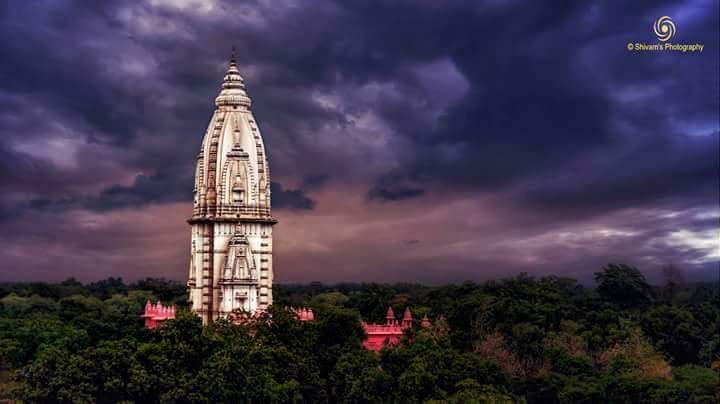
Beautiful.

Another view.
Gangetic plains didn't have any Hindu Kings. But it was the sacred heartland of Hinduism. So it kept receiving generous donations from Merchants and Rajput rulers of West, Kings and Nayakas of South and later on Maratha rulers. Temple culture never died there.

Maheshwar, Madhya Pradesh


Saraswati Temple in Bits Pillani Campus
We are surprised though about why these traditions died out in Hindu ruled regions of Rajputana though. From what we have seen Jainas have preserved their temple culture better than other Hindus have.
BUT AS K.M.MUNSHI STATED-
The history of India is not the story of how she underwent foreign invasions, but how she resisted them & eventually triumphed over them.
If Taj Mahal can be proved as a Hindu temple, it will be one of the grandest temples still active.

Yes, it might be true. Like Taj Mahal there is also a temple present in Pakistan which is called Katas Raj (Shiva Hindu Temple). The interior and exterior of Taj Mahal is very much similar to the Katas Raj (Shiva Hindu Temple).
So it is normal for Hindu Shiva temple to have a onion shape dome just the Taj Mahal has.
Well known Western authorities on architechture like E.B.Havell, Mrs.Kenoyer and Sir W.W.Hunterhave gone on record to say that the TajMahal is built in the Hindu temple style. Havell points out the ground plan of the of the ancient Hindu Chandi Seva Temple in Java is identical with that of the Taj.

The Tajmahal has identical entrance arches on all four sides. This is a typical Hindu building style known as Chaturmukhi, i.e. four faced.
A Sanskrit inscription too supports the conclusion that the Taj originated as a Shiva temple. Wrongly termed as the Bateshwar inscription (currently preserved on the top floor of the Lucknow museum), it refers to the raising of a "crystal white Shiva temple so alluring that Lord Shiva once enshrined in it decided never to return to Mount Kailash his usual abode". That inscription dated 1155 A.D. was removed from the Tajmahal garden at Shahjahan's orders. Historicians and Archeaologists have blundered in terming the insription the `Bateshwar inscription' when the record doesn't say that it was found by Bateshwar. It ought, in fact, to be called `The Tejomahalaya inscription' because it was originally installed in the Taj garden before it was uprooted and cast away at Shahjahan's command.

A clue to the tampering by Shahjahan is found on pages 216-217, vol. 4, of Archealogical Survey of India Reports (published 1874) stating that a "great square black balistic pillar which, with the base and capital of another pillar, now in the grounds of Agra, it is well known, once stood in the garden of Tajmahal". Rest opening the sealed chambers in the Taj will be more than sufficient.
I have never EVER thought of India with fragmented boundaries. These are temporary boundaries. Make no mistake about it. None what so ever.
Introduce your kids to the best story EVER. Story of courage. Story of valour, sacrifice, discipline, greed, betrayal, victory, defeat...story of LIFE !
Introduce your kids to the fascinating story of - Bharat The Immortal Nation.
People here often ask me for some good read suggestions. Go read about Bharat. Don’t be afraid. Don’t be biased. Read with an open mind...
Your ancestors will guide you towards the truth. They always do.
In a way, it is the story of every Indian who needs to understand how fear and resilience alternately shaped our memory and collective consciousness. It also won’t rest till we find an answer and correct that injustice. I believe that when that memory is shared and acknowledged, it can lead to closure and towards healing and reconciliation for all of us.
Ekanetra remarked that there was nothing really new to state in geopolitics: either we had prognosticated everything or the events were too subtle for our fragile brains to comprehend. While we were sort of fumbling with connecting the geopolitical dots, ST interrupted us and got me talking about some other issue. Since we felt a certain continuity in having provided a modern explanation for a problem that our great atharvan ancestors first discovered (AV-vulgate 7.116), we waxed on this for a while, losing sight of the geopolitical exposition. Finally, we got around to discussing it with some renewed focus with ST joining – in a sense we spent a while getting her up to speed so the repetition did not sound boring. The central question that concerned us was whether Anglospheric colonialism, i.e. control over the Hindu territory and the Hindu sphere of influence has really ended. On these pages we have repeatedly presented the answer as being a resounding NO.
Glorious was the time when from Attock to Cuttak entire landscape was dotted with monumental Nagara temples with Saffron on their Shikhara!

The ancient Nagara temples of Gandhara - last remnants of Hindu Shahi kingdom that once protected the frontiers of Aryavarta. Valiant fight given by the Hindu Shahi kingdom of Kabul & Punjab against the Jihadi onslaught of Mahmud Ghazni on India is one of the ...most tragic chapter of Indian history. Their demise opened the gates of Aryavarta to the barbaric hoards descending from the Hindu Kush.
So severe was the assault that today it is even hard to believe that Hindu civ. once flourished into this land now teeming with the Jihadis. This post is about temple ruins standing in the wilderness of the Salt Range,Pakistan which r now the only window into that glorious past.
The castle of Raja Gira, the last king of the Hindu Shahi period located in Udigram which was the capital of Swat during the Hindu Shahi period between the 8th and 10th century...


(In above pic) Massive substruction terrace for the Hindu Shahi temple on the hilltop of Barikot. Italian Archaeological Mission in Swat.

BILOT
Also known as Kafirkot - Its inhabitants must be proud of their magnificent intricately carved temples on the banks of the Sindhu.


KALLAR, ATTOCK
This scenic temple on the edge of a hillock overlooking Soan river was built by Kallar - Founder of the Hindu Shahi dynasty.

KAFFIR KOT
Fort of the infidels - No further clue is required to figure out what exactly happened to this fort and its monumental temples!😕


It is on this walls and bastions of the Kafirkot where Hindus must have taken their last valiant stand against the Jihadi hoards.


AMB


NANDANA
Last capital of Hindu Shahi kingdom. It was here that Hindu Shahi army took its final valiant stand against Mahmud Ghazni.

It was also somewhere in vicinity of this temples of Nandana that Al-Beruni gained knowledge of Sanskrit, Hinduism & India frm the scholars.


MALOT
This temple built in the Kashmiri Style was probably the outcome of marital alliance between rulers of Kashmir and Hindu Shahis.


KATAS RAJ
This ancient temple complex with its sacred pond managed to survive as popular Hindu pilgrimage place in Punjab till 1947.

Recently however archaeological dept. of Pakistan has restored many temples of Katas Raj after LK Advani visited the complex in 2005.
 T
T

Approximate location of these temples in North West Frontier area of Pakistan. All temples were built ~1000-1300 yrs ago.

The Hindu Kings who built it & the empires grown around them have perished, but they stand tall to tell the untold to the unheard.
Our temples, our pride!
My heart breaks when I see these ruins. Generations of Hindu Shahi kings fought and protected our N-W frontier.
A sadness engulfs me when i see these temples. Shahi Jayapal and Anandapal fought valiantly for Dharma and sacrificed their lives
Demise of Shahi Jayapal was start of destruction of Indian civilisation and coming of Kali Yuga in proper form.
It was sword of Shahis which acted as dam to the coming of demons. Once that dam broke after 200 year of struggle, flood came.
We all should salute the great Parambhatrakka Mahaarajadhiraja Jayapal Devasya Dod May you enjoy endless bliss in heaven for sacrificing your everything for Dharma.

This image which I sourced from https://t.co/agtcDrrWxX presents a very interesting view. This gives us the number of times Muslims attacked India till they gained a foothold in 1192. I am not interested in the actual numbers. It's the general trend which I am interested in.
The article itself is a very great read. Coming back to the topic. The depiction clearly shows there are three waves of Islamic advance into India - Arab Imperialism, Turkic advances under the Ghaznavids and Turkic advances under the Ghurids. And the first two, clearly failed.
The first wave was that of an imperialistic juggernaut where the Arabs tried to conquer whatever lands they can. Islam was formally founded in 622 AD and within a decade, it was a powerful militaristic force to reckon. Persia was attacked in 633 AD for the first time and theThe first wave was that of an imperialistic juggernaut where the Arabs tried to conquer whatever lands they can. Islam was formally founded in 622 AD and within a decade, it was a powerful militaristic force to reckon. Persia was attacked in 633 AD for the first time and the empire, considered to be one of the most powerful one in the world ceased to exist in less than twenty years. Coming to India. The first raid towards India was in 635 AD when a naval expedition was launched against Mumbai and Bharuch general area but it was defeated.
When Persia was being pulverized, a naval force was sent against Sind in 638 to raid Debal. Probably, we should see both of them in the same light - they were making the ground clear for the next kingdom beyond Persia. There was a lull till the gates to India were opened.
India, from West, is generally accessed through Khyber and Bolan Passes. While Bolan Pass led into Sind(Kikkan was in the area where Quetta stands now), to use Khyber, you need to cross the Shahis. The first serious force was launched in 660 but it withdrew on the news of death of the Caliph. Waves after waves were launched against Sind. Of the total of 14 invasions of Sind, Arabs lost 13. The trouble they faced both from the inhospitable desert and the armies of Sind were enough for a Caliph to declare India is not worth invading.
The story was to end one day or the other...A massive force was sent under Muhammad bin Qasim to take Sind, come what may. Debal fell first. The king took personal charge and held the Indus. He was defeated and killed, and Sind was annexed to the ever expanding Arab empire.
The invasion force marched forward till the Himalayas before turning back. Qasim met a gory end, that's a different story altogether. But, the real thing is that Arabs faced something which they never faced anywhere else - a roll back of their conquests.The invasion force marched forward till the Himalayas before turning back. Qasim met a gory end, that's a different story altogether. But, the real thing is that Arabs faced something which they never faced anywhere else - a roll back of their conquests.
After Qasim withdrew, Sindh rebelled under Dahir Sen's son, Jay Shah. It's a matter of time the Caliph recognized the ground realities. Jay Shah was accepted as a vassal but was allowed to do whatever he can. By the time next governor Junaid came, nothing was literally left to the Arabs in Sind. He had to go forth painstakingly to conquer each area. He conquered considerable tracts of Gujarat, Rajasthan and parts of Madhya Pradesh, sufficient enough to set up a new province for the Caliphate before he was recalled in 726.
Al-Hakim followed him and pressed forward. By then, the Hindus identified Arabs are a menace and should be crushed. A major Chalukya force intercepted Al-Hakim at Navasiri and turned the Arabs back. He died in 740 fighting against the Maitrakas.
Parallel to this, another massive force was crushed by Pratihara Nagabhatta in 738, famously known as Battle of Rajasthan. Two major defeats in 738 combined with massive losses/pyrrhic victories elsewhere(Kabul/Ardabil/Defile) made the Caliphate a spent force. This massive loss of manpower resulted in weakness of the centre and an eventual rebellion which forced the Caliphate to withdraw back into Arabia.
There were raids till almost 860, but they never made any real sense. This is with regard to advances through Bolan. What's happening in the Khyber area?
Legend says a Turk by name Bahra Tegin took control of the throne as if by divine sanction in 661. The story goes like, there is a prophesy which says the next king will be a fully grown boy who will come out of a cave and become a king. Bahra Tegin, a Turk who was hiding in that cave for whatever reasons, emerges from the cave and people accept him as a king. The reason for the dynastic change was preempted by an Arab raid of Kabul in the same year by a force which was searching for the Persian Crown Prince Peroz who withdrew into China.
His brother, who is known only as Rutbil slices off to create his own kingdom in 670. One can say, Kabul was almost shielded by Zabul till Zabul toppled in 785. Terrain was to their advantage. Kabul and Zabul literally crushed every army sent against them. Not just defeating, they had the temerity to raid deep into Arab Empire and give asylum to fugitive Arab armies. The first Zunbil was killed in a raid of Sistan in 685 and a massive invasion force was sent in 697. It was killed to the last man. In resposne, they sent another force under Abdurrahman ibn Muhammad ibn al-Ashath. The expedition was a huge success. But, when the soldiers understood it's not an invasion force but a settlement force, the 40,000 strong army rebelled. The Zunbil gave them asylum.
They invaded the Arab Empire and were defeated only in Iraq. This serious blood letting, highlighted before, led to the end of the Empire itself. By 738, Arabs were out of the theatre, replaced by local Muslim kingdoms. Now, the game changed. It's no more Arab vs Turk, it's your Turk vs my Turk. Kabul and Zabul somehow held fort with some reverses, and Zabul dragged on till 865 when the last Zunbil died in a battle against Yaqub al Laith, the founder of Saffrids. The Zunbil crown prince escapes into Kabul. Kabul has already shifted it's capital to Udabhandapura, on the other side of Khyber to proof itself. In 814, the Kabul Shahi ruler was forced to convert to Islam. As usual, they took their time to rebel.
When the crown prince of Zabul held fort in Kabul, Laith invaded Kabul, captured it and got him executed. In 890, there was a dynastic change when a Brahmin minister Lalliya captured the throne in a palace coup. It was a see saw from then. Kabul Shahis raided as far as Samarqand, Kabul was taken, Zabul changed hands atleast three times, with Bhimadeva being the most powerful in the new lot. By the time of Bhimadeva, Saffrids were toppled by a Turkic slave, Alptegin. Now, the fight for Zabul took a vicious turn, with the city changing hands every few years. Bhimadeva didn't have any sons. His only granddaughter, the famous Didda, was married into Kashmiri royal family and he felt the level of troubles he is facing, Kashmir and Kabul cannot be ruled by the same person. He nominated a southern vassal(it is said so. It can also be a palace coup) Jayapala. He took the Shahi title of Deva and called himself Jayapaladeva. By this time, Alptegin was replaced by Sabuktegin, his slave and slowly, Shahis started losing foothold on the other side of Khyber.
By the time Sabuktegin's son, Mahmud of Ghazni came to throne, Kabul Shahis didn't exist in Afghanistan. Jayapaladeva invaded Kabul with a massive force but was defeated. That battle literally broke the back of the Shahis. That defeat opened Khyber to Muslim armies for the first time and India saw raid after raid by Ghazni. Though it is portrayed as a grand raid of India, all of Ghazni's attacks were nothing more than raiding Kabulshahis and their allies. Of the purported 17 raids, atleast 13 are against Shahis and their allies.
Shahis spent whatever they got and moved into obscurity by the raids of Ghazni. Their tremendous effort to stop Muslims became a matter of legend. After all, they are the only kingdom in the whole world who challenged the mighty Arab caliphate again and again and outlived it!!
1001 AD Battle of Peshawar, decisive victory for the Turk Md. Gazni, Maharaja Jayapal immolates himself, the 500 year old Gandhar/Kabul Shahi Kingdom falls, things went downhill from there,

In Dec 1018, Ghazni crossed the Yamuna River and collected
1,000,000 dirhams from King Hardatt Dod of Baran (Bulandshahar), and then marched into
Mathura district, first into Mahaban

And Utbi describes that many men tried to flee the fort and cross the foaming river, but many were drowned, slain, or captured
>Almost 50,000 men were killed
And Ghazn directly attacked Mathura, the town sacred for Lord Krishna

And was impressed by the Keshava Rai temple, that marks the birth site of Lord Krishna, thinking that it must have taken 200 years to build
>Burnt the huge temple to the ground
And Pillage of the city went on for 20 days, in which Ghazni gave instruction to destroy all of the temples

AnA He took 5 golden deities and 200 silver deities, leaving the city in ruins.
And from there he went on to Kanauj, which had been the center of several
dynasties of Hindus, which is also described in the Kitabu’l-Yamini of Utbi

And Therein it explains the antiquity of the temples, in which it says: “In Kanauj
there were nearly 10,000 temples, which the idolaters falsely and absurdly
represented to have been founded by their ancestors two or three hundred
thousand years ago…”

And Of course, these invaders could not understand such a span of time and continued with the destruction of all things Vedic
And Seeing the destruction of so many temples and deities, many citizens
fled, and those who did not were butchered.

AAd Munj was the next city to be attacked, where the Brahmanas fought to the
last man, only after they had thrown their children and wives into the fire to
prevent them from being taken as slaves, which would have been worse than
death.

And Ruler of Asi fled, Ghazni demolished 5 forts
-Residents buried in the rubble
And In Shrawa after 3 days of slaughtering soldiers took time to search the dead of valuables
And Ghazni returned with 53,000 slaves
And Countries of Mawaraun-Nahr, Iraq, and Khurasan were filled with them

Erasure and fragmentation of the sacred geography in the Hindu consciousness
As long as mlechCha-s operate with impunity in TSP, a former portion the Hindu sacred geography, the colonialism cannot be said to have been completely overcome. It should be reiterated, because many among the Hindu elite do not understand it; the very creation of TSP and the subsequent abundant patronage offered to it by the mlechCha-s was to ensure that the colonial venture in the subcontinent does not end at all. The Hindus have also internalized some subtle historical propaganda in this regard: The mlechCha-s have been active in creating an alternative history for the sImAnta pradesha-s. Key to their patently false historical narrative is to push the delegitimization of Hindu presence in this lands back in history by claiming the that gandhAra and bAhlika were never a part of the Hindu sphere. Instead, they are handed over to the Iranians and it is presented as though the Greeks legitimately acquired these territories by conquering the Iranians. The Iranian Kushana-s are presented as being cultural derivatives of Hellenism rather than Hindu rulers. Since, the mlechCha-s have also created a false narrative (which is central to their own identity) that they are the true successors of the yavana-s they hold that these sImanta-pradesha-s are actually a natural sphere of their activity. They might even go as far as claiming that they actually belonged to them as as they are the successors of the yavana's.
Native Indian needs to remember and honour Kabul Shahi of Gandhar or later a Hindu Shahi Kingdom of Garh Muktsar, Punjab which lasted for 500 years till 1026AD covering all of South Afghanistan & Pakistani KPK. May be they all has to know the valour of Raja Jayapala deva shahi, Anandpal, Trilochanpal Shahi were last 3 Maharajas. Jayapal killed himself in 1001AD on the loss of Peshawar,
All afghanis are offsprings of Hindu Shahi who ruled in this region, most famous among them Jayapala.
Every Indian also should know Sikandar is Butshikan Sultan of Kashmir who documented in 15th century how he conducted a 25 year long genocide in which tens of thousands who refused to convert to Islam were killed and how hundreds of temples, countless books, statues were destroyed Those Kashmiris who long for Pakistan don't know the humiliating conditions in which their ancestors converted. Also Kashmir was never conquered by a Muslim Army, the first Sultan was the Prime Minister of the last Hindu Ruler a Queen whom he murdered in the 1350s.
9th CE Hindu Shahi king Jayapal and his followers fought and ultimately pushed to exile into kashmir. this pushing is still going on and now it's happening on eastern borders as well.
now look at the map, they are trying to shrink us in pockets since ages, modern 'democracy' and our so called secular laws doing it effortlessly.
so what changed since these invader begins their campaigns in india? from their side almost nothing, still using mediaeval methods and our forces don't know how to response. changed is that there are no chalukya, pratap or any resistance and reclaiming forces which we had in past.
Ever realised that We're being taught to speak Urdu in name of Hindi?
Aadmi not Purush
Aurat not stree
Hawa not Vayu
Paani not Jal
Kitab not pustak
Khana not bhojan
Insaan not manushya
Zindagi not Jeevan
Sharam not laaj
Mehnat not Shram
Baccha not balak
Shaadi not Vivaah
.
.
Why is the philosophy of the
Upanishads (Vedanta) not in the syllabus? Why no Mahabharata and Ramayana?
There is nothing "religious" about it.
If any other country had this treasure, of course it would be proudly taught.
India post-independence was dominated by political and intellectual leaders who did not belong to Indian (Bharatiya) civilisation, starting with Nehru. Tried to remake India in their own image borrowed from the West. But now Bharat is rising again with a new set of leaders.


Why is the philosophy of the
Upanishads (Vedanta) not in the syllabus? Why no Mahabharata and Ramayana?
There is nothing "religious" about it.
If any other country had this treasure, of course it would be proudly taught.
India post-independence was dominated by political and intellectual leaders who did not belong to Indian (Bharatiya) civilisation, starting with Nehru. Tried to remake India in their own image borrowed from the West. But now Bharat is rising again with a new set of leaders.

Etched in stone, these tablets sing many true stories - Stories of faith, parties, festivals and war.
These can be found in old temple premises or sometimes in the middle of nowhere; like in a dense forest.
When you see them, don't be ignorant, listen to the stories they tell!

Arab and Turks had to destroy Sanskrit and Sanatana Dharma to establish India as their religious colony though they succeeded partially bcz of our strength. From Dahir to Shahi Jayapala to Prithwiraj Chaohan to Rana Pratap.
Bhimadeva's holding of Khyber against Ghazni itself is a matter of legend. It's possible, by 1030, Mahmud himself became a spent force. One who had the temerity to invade Baghdad just to be declared an emperor - he is the first Muslim king who is not a governor of the Caliph,
we see that he raided Somnath in 1030 and ran back away, fearing the Paramaras who were waiting for them, through hostile territory, only to see his army plundered. He led a punitive mission after that, but that's the end of his story.
His nephew, Salar Masud led a grand invasion, may be, to settle in India in 1033. But he was defeated and killed at Bahraich. After that, it was reversal after reversal to the Muslims. Parallel to this, the Ghaznavid Emperor, Masud had to face an invasion from Seljuk Turks and faced a massive defeat at the Battle of Dandanaqan. The Ghaznis themselves became a spent force. Muslims had to wait for another century and half to rise as a potent force again in India.
History is not what we are taught. India was not conquered by Muslims because Muslims were bored. India was not conquered because Indians stopped the Muslims. And in both the times, there was an external independent act which broke the back of Islamic invasions.
Chalukyas, Pratiharas broke one wave with brute force, Kabul Shahis stood alone for centuries before being overwhelmed. Even when they are overwhelmed, someone else took the mantle and stopped the Islamic forces. This is what we should 4rememberinremember - the valour, the might and the contempt they showed. Another important thing is, Islam in India is spread not by the Arabs, the original beacons of Islam but by their Indian converts - Ghazni and all. And this is achieved only by sheer valour.
And to end with Kshatriya protection of Bharat was exemplary, we must salute those for the courage of facing the entire army of Islam/Asia,
If you look at it in reality then the last big Dharmic battle of the Hindus is against the colonized slaves either under Arab Colonization or Western colonization
well why rely on them when individual Hindus need to first get back into real Kshatriya mindset. From around the world there's martial artists,wrestlers ect traveling to india yearly to pick up ancient fighting techniques/practices while Hindus are turning into Gol Gappas/ladoos
And today When modern world makes him forget that s
he is kshatriya.
Do not outrage. Perform your Dharma.
No matter how difficult it gets,
No matter how frightful it gets,
As long as we live, we will never lose hope, we will fight on!
We will not rest until we have reclaimed our beloved Bhārata from the mlecchas.

Indra knew this.
Parashurama knew this.
Rama knew this.
Krishna knew this.
Pushyamitra knew this.
Chandragupta II knew this.
Jayapala knew this.
Maharana Kumbha knew this.
Maharana Sanga knew this.
Maharana Pratap knew this.
No other civilization in history has faced the brunt of so many barbaric invasions, fought back, survived and expanded as much as the Hindu/Indian civilization.
A new dawn of heroes rose to defend the honour of Bharat mata every time!
YOU! YES, YOU! ARE A HERO TOO!
And to end with Kshatriya protection of Bharat was exemplary, we must salute those for the courage of facing the entire army of Islam/Asia,
If you look at it in reality then the last big Dharmic battle of the Hindus is against the colonized slaves either under Arab Colonization or Western colonization
 | ||
| न उड़ने की इस दफा ठानी | परिंदों ने भी वफ़ा जानी |
And today When modern world makes him forget that s
he is kshatriya.
Do not outrage. Perform your Dharma.
No matter how difficult it gets,
No matter how frightful it gets,
As long as we live, we will never lose hope, we will fight on!
We will not rest until we have reclaimed our beloved Bhārata from the mlecchas.

Indra knew this.
Parashurama knew this.
Rama knew this.
Krishna knew this.
Pushyamitra knew this.
Chandragupta II knew this.
Jayapala knew this.
Maharana Kumbha knew this.
Maharana Sanga knew this.
Maharana Pratap knew this.
No other civilization in history has faced the brunt of so many barbaric invasions, fought back, survived and expanded as much as the Hindu/Indian civilization.
A new dawn of heroes rose to defend the honour of Bharat mata every time!
YOU! YES, YOU! ARE A HERO TOO!


